If your rankings shifted in the past week, you’re not imagining it. On August 18, 2026, Google released the August 2026 spam update, the third spam update of the year, following rollouts in March and June. The update finished rolling out on August 21, 2026, and it applies globally, across every language.
Google didn’t announce any new spam policies with this release. That’s actually the important part: there’s nothing new to learn, just existing rules being enforced more strictly. If your site is affected, the cause is almost certainly one of the seven issues below, and if it isn’t affected yet, this is the moment to check before the next one lands.
What Is the Google August 2026 Spam Update?
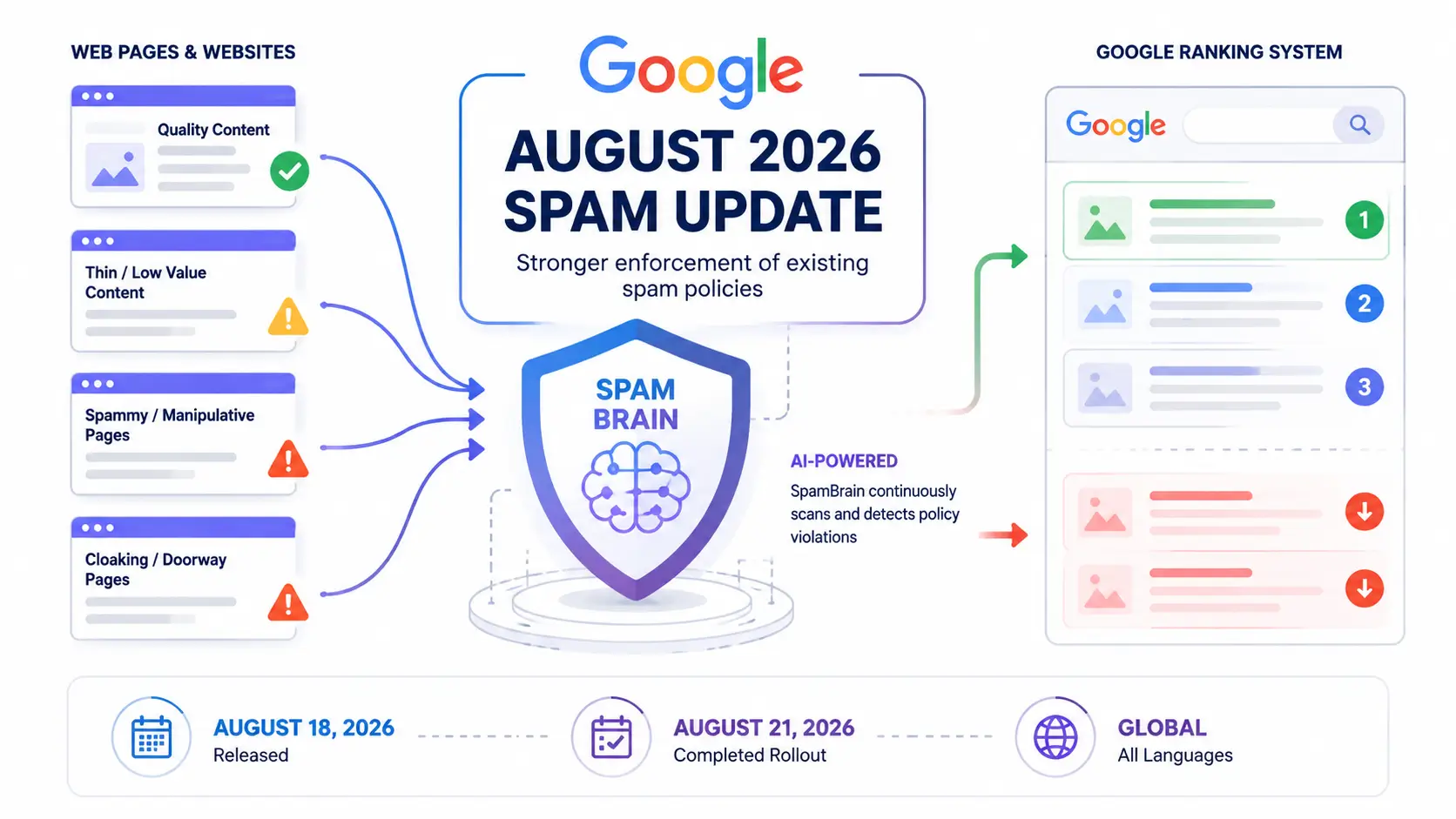
A spam update is different from a core update. Core updates reassess content quality broadly, across almost every ranking signal Google has. Spam updates are narrower and blunter: they specifically demote sites and pages that violate Google’s published spam policies things like cloaking, scaled content abuse, or expired domain abuse. Google runs spam detection continuously through its AI system, SpamBrain, but periodically pushes larger enforcement waves like this one.
How This Compares to March and June 2026
This is where the pattern gets interesting. The March 2026 spam update was the fastest confirmed rollout in the Search Status Dashboard’s history, completing in about 19 hours and 30 minutes. The June 2026 spam update took roughly two days and one hour. August’s update, at around three days, sits in the middle. Three spam updates in eight months is an unusually tight cadence Google hasn’t run back-to-back spam updates this frequently since March and June of 2024.
What Google Did Not Say
No companion blog post. No newly named policy category. Google’s spam policies page hasn’t changed since December 2025. That silence matters: it tells you this is a straightforward enforcement pass against rules you can already read in full, not a shift in what counts as spam.
How to Tell If the Spam Update Hit Your Site
Reading Search Console Data the Right Way
Because the rollout was still moving through August 21, any Search Console data pulled before that date is noisy and unreliable. Use the weeks before August 18 as your clean baseline, and compare that against performance from August 22 onward. A drop that appears gradually over months is a different problem; a drop that lines up tightly with the rollout window is the signal to investigate spam policy violations specifically.
Spam Update vs. Core Update How to Tell Them Apart
If your traffic fell in a way that tracks with a named core update, the cause is more likely broad content quality or relevance E-E-A-T signals, thin pages, unhelpful content patterns. If the timing lines up with a spam update instead, the cause is more likely a specific, identifiable policy violation. That distinction changes your entire recovery plan, so don’t skip it.
The 7 SEO Issues That Could Be Hurting Your Rankings Right Now
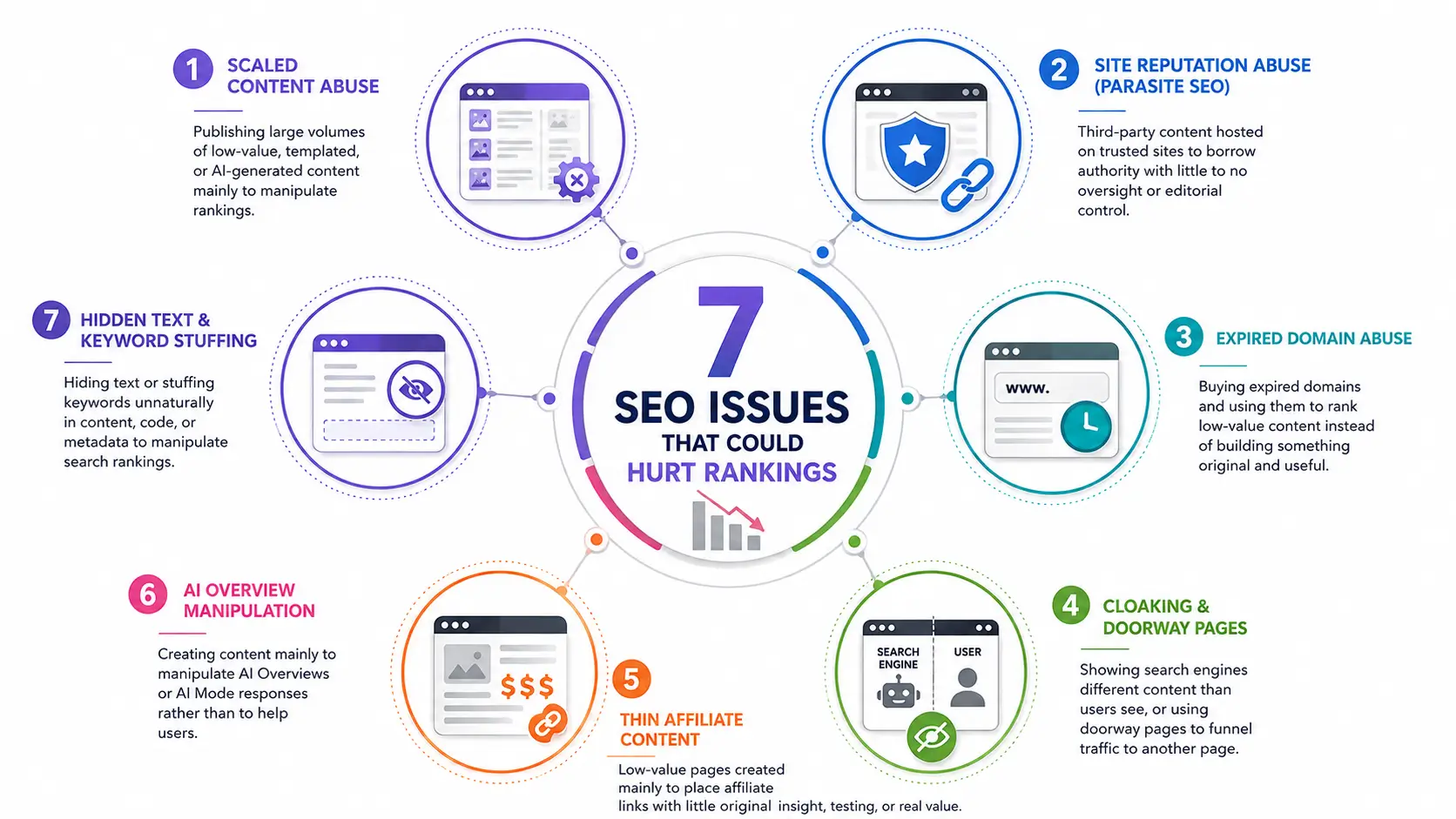
1. Scaled Content Abuse
This is Google’s term for publishing many pages primarily to manipulate rankings rather than to help users regardless of whether a human, an AI tool, or some mix of both produced them. Volume isn’t the violation on its own; the violation is when pages are thin, templated, and interchangeable, adding little beyond swapped-out keywords. If you’ve published in AI-assisted batches, audit for genuine originality per page, not just word count.
2. Site Reputation Abuse (“Parasite SEO”)
This happens when third-party content is hosted on a trusted domain mainly to borrow that domain’s ranking power, with little to no oversight from the host site. Common patterns include sponsored sections, “partner content,” or outsourced verticals that operate independently of the main site’s editorial standards. If you host contributor or sponsored content, make sure it’s genuinely integrated and reviewed not just parked there for its host’s authority.
3. Expired Domain Abuse
Buying a lapsed domain and repurposing it not to build something original, but specifically to inherit its old authority for low-value content is a named violation. It’s fine to reuse an old domain for a genuinely new, people-first site. It’s a problem when the domain’s history is the entire strategy.
4. Cloaking and Doorway Pages
Cloaking means showing search engines different content than what users see. Doorway pages are built to rank for narrow, near-identical queries, then funnel visitors to a separate, often less useful destination. Both are long-standing violations, and Google’s detection of them has only gotten more precise.
5. Thin Affiliate and Low-Value Content
Pages that exist mainly to place affiliate links, with little original analysis, testing, or perspective, remain a recurring casualty of spam enforcement. If a page could be swapped for any competitor’s near-identical version with a find-and-replace, it’s a target.
6. Manipulating AI Overviews and AI Mode Responses
This is the piece most coverage of the August update is missing. In a May 15, 2026 clarification, Google confirmed its spam policies also apply to attempts to manipulate generative AI responses in Search, including AI Overviews and AI Mode not just traditional blue-link rankings. As of this writing, Google hasn’t confirmed whether the August update specifically enforced that clarification, but given it came just weeks after the June update reportedly touched on the same territory, sites attempting to game AI-generated answers should treat this as an active enforcement area, not a theoretical one.
7. Hidden Text, Keyword Stuffing, and Legacy Manipulation Tactics
Older tactics text or links hidden via matching background colors, pages stuffed with keyword variations that read unnaturally are rarer today but still explicitly named in Google’s policies and still enforced when found. If your CMS or theme has legacy code doing anything like this, it’s worth a technical crawl to confirm.
What This Update Does NOT Target
Google indicated the August 2026 update does not specifically target link spam or the site reputation abuse policy though it stopped short of a full, itemized scope statement. That’s useful context if you’re ruling out causes: if your site relies heavily on a manipulative backlink profile and you saw a drop, this particular update likely isn’t the reason, and you should look at your link history or a different update window instead. Keep in mind that even when a link spam update does run, recovering lost link-based ranking benefit isn’t guaranteed once Google’s systems discount the effect of manipulative links, that benefit doesn’t automatically return.
How to Recover If You Were Impacted
Immediate Audit Checklist
- Pull Search Console data from after August 21, 2026, and compare it to your pre-August 18 baseline
- Cross-reference the drop against your content, backlink, and domain history not just one page type
- Check for each of the 7 issues above across your highest-traffic templates, not just individual pages
- Review any AI-assisted content workflows for genuine per-page originality
What NOT to Do
Don’t make sweeping changes based on volatility you saw before Google confirmed the rollout was complete on August 21. Early-day fluctuations aren’t a reliable read on the update’s actual effects, and reactive changes made on incomplete data can create new problems.
When to File a Reconsideration Request
Reconsideration requests apply to manual actions, not algorithmic spam update demotions you’ll know the difference because manual actions show up as a specific notice in Search Console’s Manual Actions report. If you have one, fix the underlying issue thoroughly and document the fix before requesting reconsideration. If you don’t have a manual action notice, there’s no request to file; recovery depends on the next update cycle recognizing your changes.
How to Spam-Proof Your Site Before the Next Update
Three spam updates in eight months is a pattern, not a coincidence. Treat compliance with Google’s spam policies as a standing quarterly habit rather than something you check only after a rollout. A simple cadence review new content for originality, audit any AI-assisted publishing workflows, check for legacy technical issues like cloaking, and monitor Google Search Console after every announced update will keep you ahead of enforcement waves like this one instead of reacting to them after the fact.
FAQ
What is the Google August 2026 spam update?
It’s Google’s third spam update of 2026, released August 18 and completed August 21. It’s a global, all-language ranking update that demotes sites violating existing spam policies Google didn’t introduce new rules, just intensified enforcement of current ones.
How do I know if my site was affected by the spam update?
Compare Search Console performance data from after August 21, 2026 (once rollout finished) against your baseline from the weeks before August 18. A sustained, update-timed drop not gradual decline is the clearest signal.
What’s the difference between a spam update and a core update?
Core updates reassess overall content quality and relevance broadly. Spam updates specifically target sites violating explicit spam policies, like scaled content abuse or cloaking. A spam update hit is usually a policy violation, not a quality judgment.
Does the August 2026 spam update target link spam?
No. Google indicated this update does not target link spam or the site reputation abuse policy specifically, focusing instead on other existing spam policy violations, though exact targeting details weren’t fully disclosed.
How long does recovery from a spam update take?
There’s no fixed timeline. Sites that clean up violations may see recovery within the next core update or spam update cycle, but Google doesn’t guarantee restored rankings, especially if the issue involved manipulative backlinks.
Is AI-generated content automatically considered spam?
No. Google penalizes content that’s mass-produced primarily to manipulate rankings, regardless of whether it’s written by AI or humans. Original, useful AI-assisted content that serves readers isn’t a violation.
Key Takeaways
- The August 2026 spam update rolled out August 18–21, 2026, globally and in all languages Google’s third spam update this year.
- No new policies were introduced; enforcement targeted existing rules, likely including scaled content abuse, expired domain abuse, cloaking, and thin content.
- This update reportedly did not target link spam or site reputation abuse specifically rule those out before chasing the wrong fix.
- Google’s May 2026 clarification that spam policies extend to AI Overviews and AI Mode manipulation is an underreported angle worth watching closely.
- Use post-rollout data only (after August 21) for a clean read on impact earlier volatility isn’t reliable.
- With three spam updates in eight months, treat compliance as an ongoing habit, not a one-time reaction.


