More buyers are getting their first impression of your brand from an AI answer, not a search results page. When someone asks ChatGPT, Perplexity, or Google’s AI Overviews to recommend a solution in your category, the response acts like a curated shortlist, and if your brand isn’t on it, you never even get considered. Tracking how often, and how accurately, AI tools generate AI brand mentions is quickly becoming as important as tracking your search rankings.
This guide walks through exactly how to check your AI visibility, what metrics actually matter, and how to build a repeatable monitoring process free or paid.
What “AI Brand Mentions” and “Citations” Actually Mean
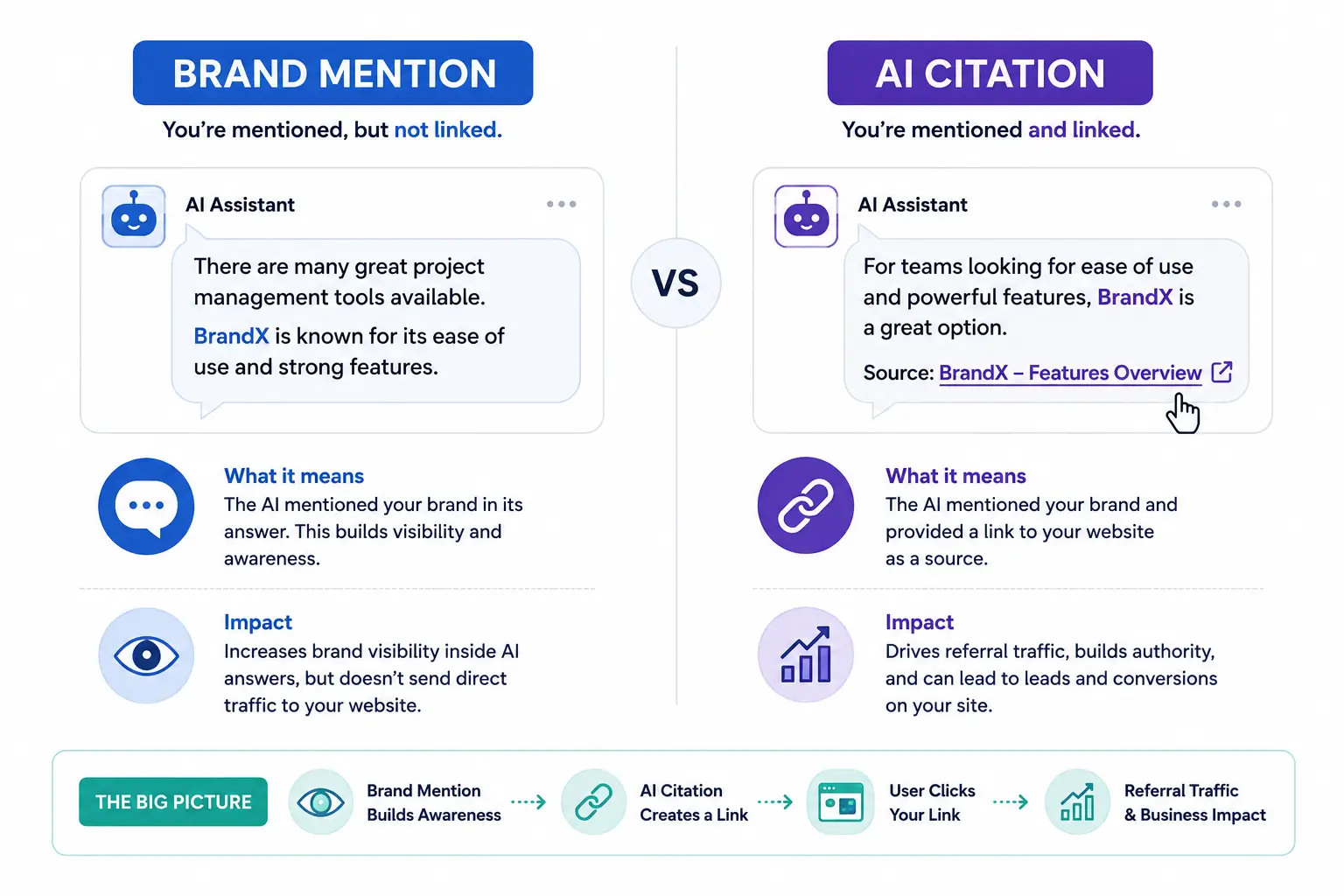
A mention is simply your brand being named somewhere inside an AI-generated answer. A citation is more specific: it’s a linked, sourced reference back to one of your actual pages. The distinction matters because Ai citations are trackable to a URL and can drive real traffic, while mentions sometimes exist purely inside the model’s response with no link at all.
This is also where AI tracking diverges from traditional SEO monitoring. A keyword rank checker tells you where a page sits on a results page. AI tracking has to account for sentiment too not just whether you’re named, but how you’re described, and whether that description is accurate.
Traditional SEO tools like Ahrefs and Semrush were built to measure rankings on a search engine results page, and they don’t capture any of this. AI answer engines are a distinct, fast-growing visibility channel that sits above traditional search, which is exactly why they need their own tracking approach rather than being bolted onto existing SEO dashboards.
Why Tracking AI Visibility Matters Now
AI-generated answers are increasingly the layer buyers see before they ever click a website. Being mentioned in that layer builds trust and consideration at the earliest stage of a purchase decision; being absent means losing pipeline you never knew existed. There’s also a real risk on the other side: AI tools can misdescribe your product, cite outdated pricing, or hallucinate details entirely and you won’t know unless you’re checking.
Before tracking your AI visibility, it’s important to understand what influences whether AI systems recognize and trust your brand in the first place. Our guide, How to Build Brand Signals and Their Impact on AI Search, explains the key brand signals that can strengthen your presence across AI search platforms.
How to Manually Check Your Brand’s AI Visibility (Free Method)
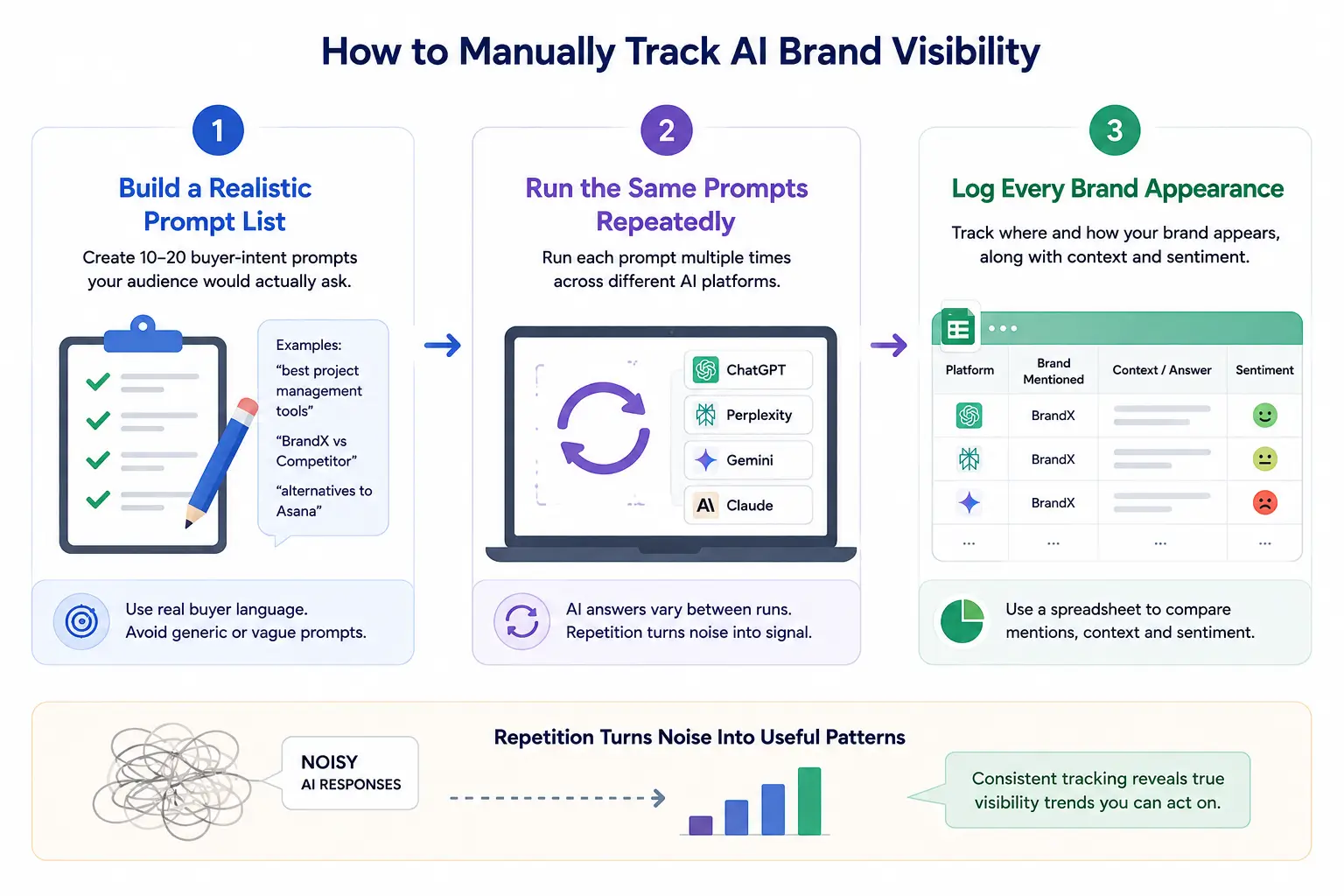
You don’t need a paid tool to get started. A manual audit takes about an hour and gives you a real baseline.
Build a realistic prompt list. Write 10–20 prompts the way an actual buyer would phrase them “best [category] tools,” “[your product] vs [competitor],” “alternatives to [competitor].” Generic prompts produce generic, unhelpful data.
Run the same prompts repeatedly. AI answers vary between runs, even for identical prompts, because these models sample responses rather than returning a fixed result. Running a prompt once and noting your position tells you almost nothing.
Log every appearance. For each run, record whether you were mentioned, in what context, and with what tone. Do this across ChatGPT, Perplexity, and Gemini at minimum, since each platform pulls from different sources.
The reason repetition matters: meaningful visibility data requires volume. A handful of runs isn’t a sample, it’s noise you need dozens of runs per prompt before a pattern is reliable enough to act on.
Platform-by-Platform: How Each AI Engine Surfaces Brands
Each AI engine sources brand mentions differently, and that difference explains why you can dominate one platform and be nearly invisible on another.
ChatGPT draws from a mix of its training data and, when it browses live, current web pages but it only shows clickable source links while actively browsing. For ChatGPT, focus on tracking the mention itself: does it name you, and how.
Perplexity runs a live web search on every query and lists its sources with each answer, often citing dozens of pages per response. That makes it the easiest platform to audit, since you get both the mention and the exact URL behind it.
Google AI Overviews appear in roughly half of all searches and link the sources they draw from, so you can directly check whether your pages are among them.
Claude and Gemini behave more like ChatGPT a blend of training knowledge and retrieval so treat them with the same repeated-prompt approach rather than expecting consistent source links.
Because these mechanisms differ so much, a brand with strong ChatGPT presence can show up in only a fraction of Perplexity responses simply because its recent content isn’t structured well for live retrieval. Single-platform monitoring will give you a false sense of security always check more than one engine.
Metrics That Actually Matter
It’s tempting to fixate on “ranking position” inside an AI answer, but that number is close to meaningless research on this has shown that position within a single response is essentially random. What you should track instead:
- Visibility rate the percentage of relevant prompt runs where your brand appears at all. A 40% visibility rate across 200 runs is a real, actionable signal; being “ranked #2” in one response is not.
- Share of voice how your mention frequency compares to competitors in the same category.
- Sentiment and accuracy whether the AI describes you correctly, favorably, and with current information.
Automated Tools for Ongoing AI Citation Tracking
Manual checks work for an initial baseline, but they don’t scale. Once you need historical trends or daily coverage, automation becomes worth it.
- Free/low-cost: Continue manual spot-checks, or build a simple DIY checker on an API like Perplexity’s Sonar, where a single query costs roughly a cent a full monthly audit of 20 prompts runs well under a dollar.
- Mid-tier tools (roughly $29–$500/month): Platforms like Otterly, Siftly, or Scrunch AI add multi-platform coverage, citation reporting, and competitive benchmarking.
- Enterprise tools (typically $1,000+/month): Options like Profound add API access, white-label reporting, and revenue attribution tied to your analytics stack.
Choose based on stage: early-stage brands running under 50 prompts a month can rely on manual testing; mid-market teams generally need automated multi-engine coverage; enterprise teams should prioritize API access and BI integration.
Whichever route you take, the real differentiator isn’t the platform count a tool advertises it’s whether it connects visibility data back to something actionable, like which of your pages get cited most, which competitor content outranks yours in AI answers, or how citation frequency correlates with actual site traffic.
Connecting AI Brand Mentions to Real Business Impact
Google Analytics can capture some of this picture GA4 will log a referral session when someone clicks a citation link from an AI answer. But that’s only part of the story: a large share of AI brand mentions, particularly from ChatGPT, never include a clickable link at all, so GA4 alone will undercount your actual AI visibility. Pair click-based analytics with your visibility-rate tracking to get the fuller picture, and watch for correlations between citation trends and pipeline or lead quality over time.
Building a Repeatable AI Monitoring Workflow
Treat this like any other recurring marketing function:
- Monthly, at minimum, for most brands enough to catch meaningful shifts without wasting effort.
- Weekly or daily for high-priority, purchase-intent prompts, or immediately after a major model update, since citation patterns can shift within days of a new release.
- Assign clear ownership, typically marketing or brand, and keep a running log so trends, not single snapshots, drive decisions.
FAQ
What’s the difference between an AI brand mentions and an AI citations?
A mention is when an AI tool names your brand in its answer, with or without a source. A citation is a linked reference to a specific page of yours that the AI pulled information from. Citations are trackable to a URL; mentions sometimes aren’t.
How do I check if ChatGPT is mentioning my brand?
Run a list of realistic buyer-intent prompts through ChatGPT repeatedly, since answers vary between runs. Log whether your brand appears, in what context, and with what sentiment. ChatGPT only shows source links when it’s actively browsing the web.
Can Google Analytics track AI search traffic?
Only partially. GA4 can capture referral sessions when someone clicks a citation link from an AI answer, but a large share of AI brand mentions never include a clickable link, so GA4 alone underreports your true AI visibility.
Are there free ways to track AI brand mentions?
Yes. Manually running 10–20 buyer-intent prompts through ChatGPT, Perplexity, and Gemini once a month and logging the results is free and takes about an hour. It won’t scale like a paid tool, but it establishes a useful baseline.
How often should I monitor AI mentions of my brand?
Most brands benefit from monthly manual checks at minimum. If you’re actively running content or PR campaigns, or a major model update just shipped, weekly or daily automated monitoring is worth the investment.
Does showing up in AI answers help my traditional SEO?
Not directly, but the two are connected. Getting cited by AI tools generally requires the same signals that support strong SEO authoritative content, clear structure, and consistent entity information so improving one often reinforces the other.


