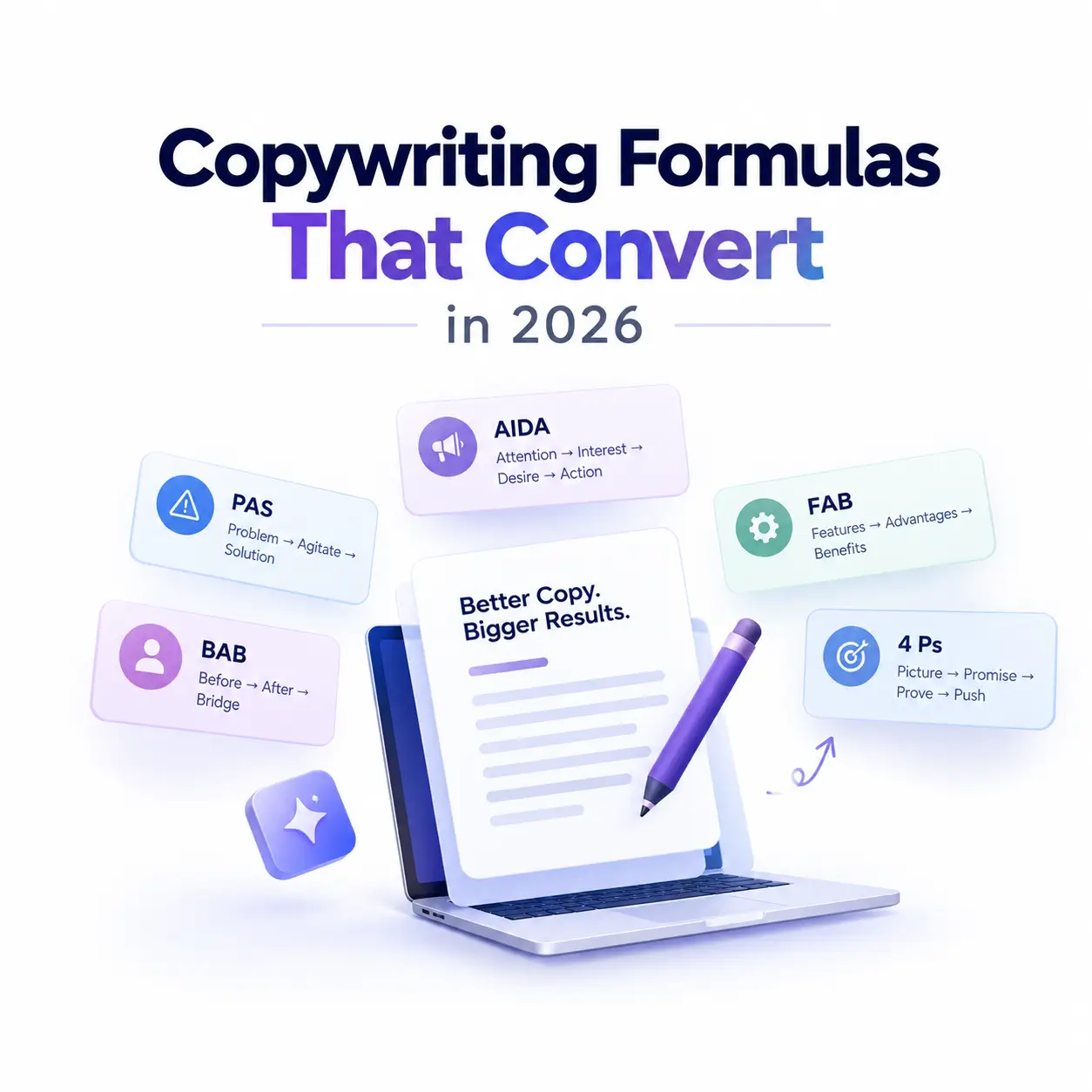
Open any “best copywriting formulas” list from the last decade, and you’ll find the same five frameworks recycled with barely a word changed. AIDA. PAS. The 4 Ps. Useful ideas, but presented with zero context for how radically the writing landscape has shifted. Readers now scroll past a dozen pieces of AI-generated marketing copy before breakfast. Inboxes are saturated with subject lines that all sound like they came from the same prompt. Attention spans haven’t just shortened; they’ve grown actively suspicious of anything that smells templated.
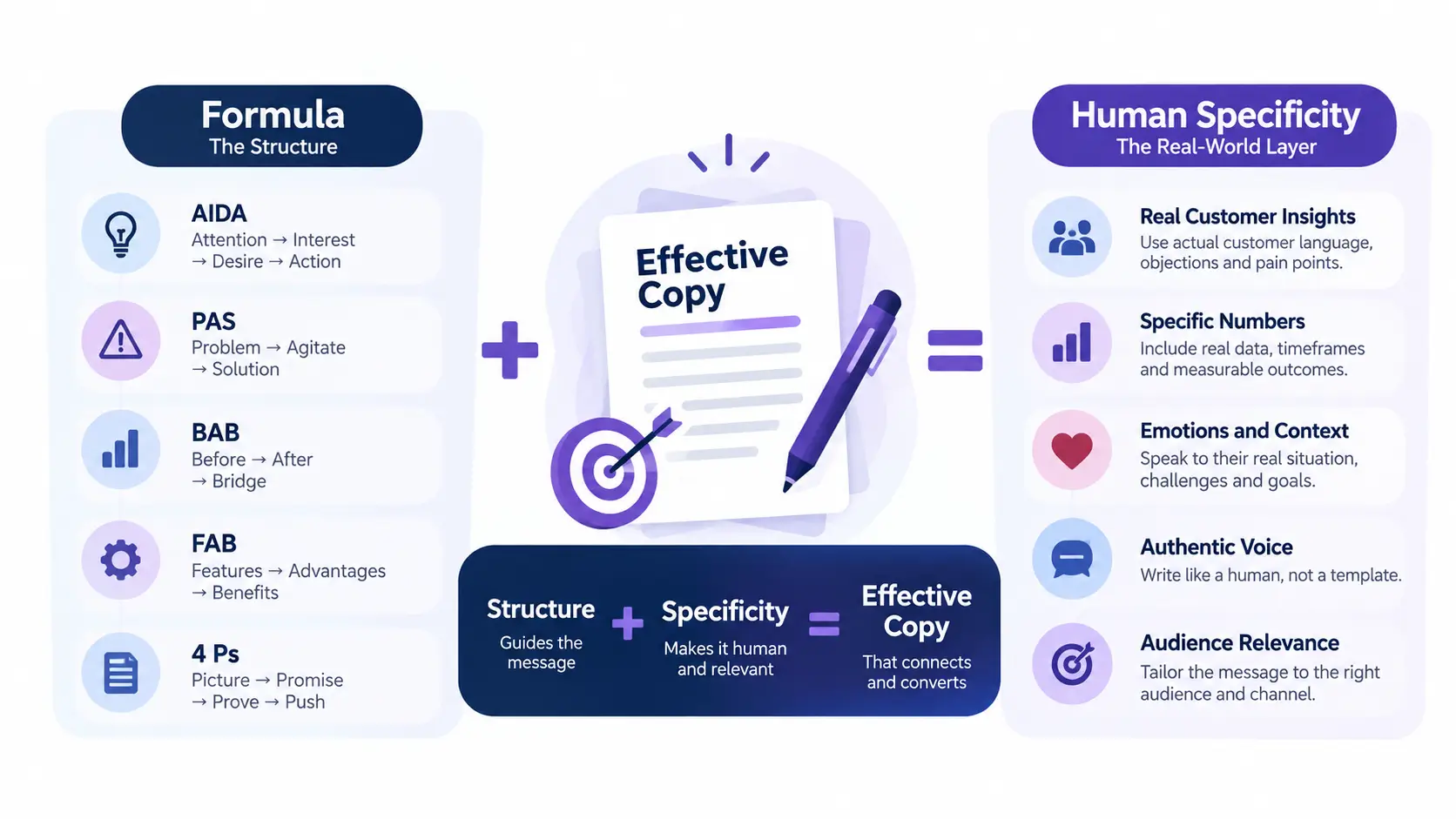
That doesn’t mean formulas are dead. It means the bar for using them well has gone up. In 2026, a copywriting formula isn’t a shortcut to good copy it’s a skeleton that only works when you put real specificity, real voice, and real understanding of your audience on top of it. This guide breaks down the formulas that still convert, how to match them to the right channel, and why “formula fatigue” is the biggest hidden risk in modern marketing copy.
What Makes a Copywriting Formula Work in 2026
Shorter Attention Spans and AI-Skeptical Readers
Today’s reader has two defense mechanisms running at once: an attention span trained by infinite scroll, and a skepticism trained by months of encountering copy that reads like it was generated in ten seconds. A formula that once felt persuasive because it was novel now needs to work harder to feel human. The words “imagine a world where…” or “picture this” trigger an almost instinctive eye-roll if what follows doesn’t immediately earn the reader’s trust with something specific and true.
This is the central tension of copywriting in 2026: formulas provide the structure readers subconsciously respond to, but structure alone is now a liability if it isn’t filled with genuine substance.
Why Structure Still Beats “Just Write Naturally”
The instinct to abandon formulas altogether and “just write naturally” is understandable but usually backfires. Persuasive writing has an underlying psychological logic: attention before interest, problem before solution, promise before proof, and skipping that logic doesn’t make copy feel more authentic. It usually makes it feel unfocused. The goal isn’t to discard formulas; it’s to use them as scaffolding while writing in a way that feels specific to your product, your customer, and this exact moment not generic enough to apply to anyone.
The Core Copywriting Formulas Every Marketer Should Know
AIDA (Attention-Interest-Desire-Action)
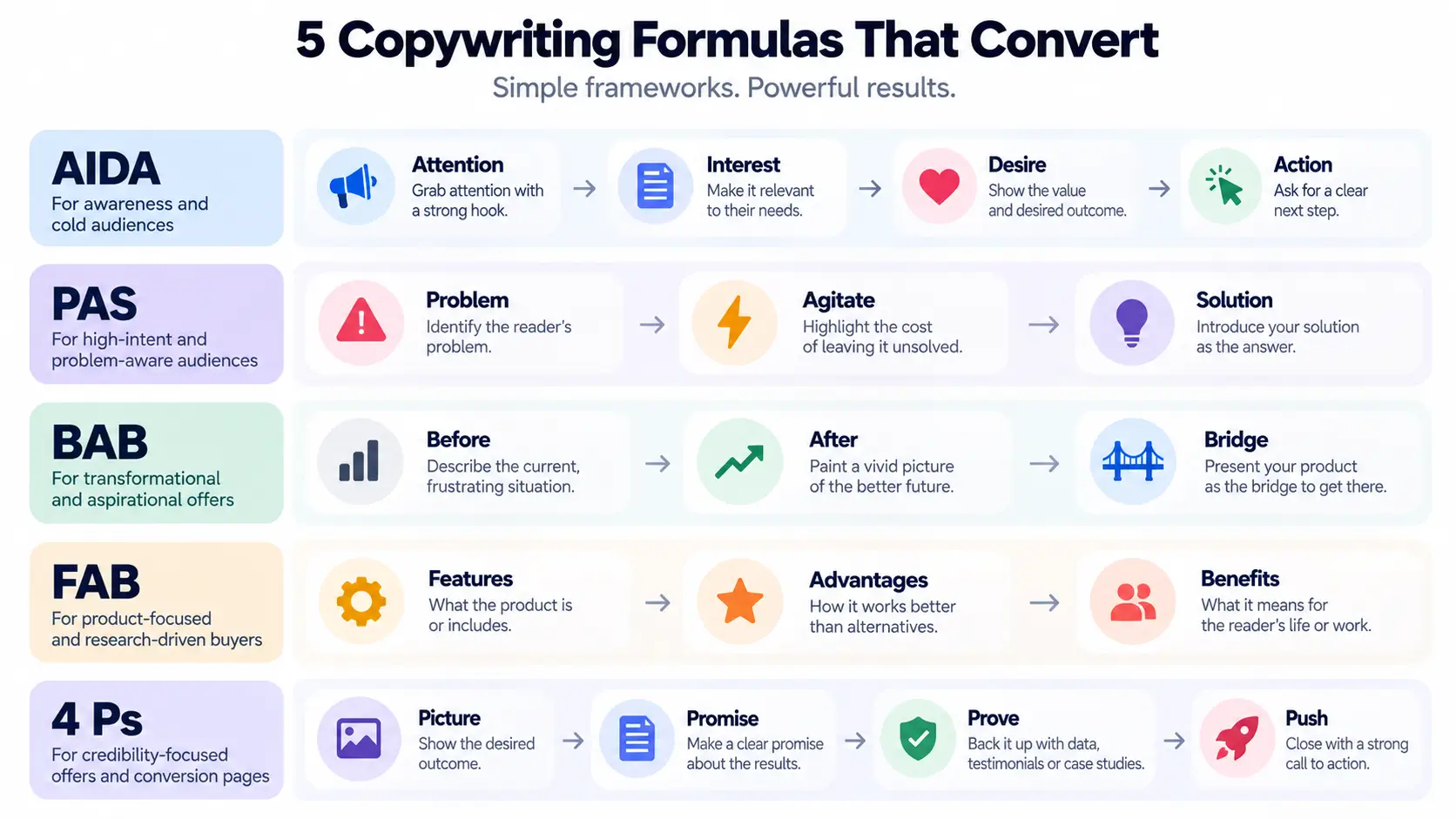
AIDA remains the most versatile framework because it mirrors how strangers actually move from noticing something to acting on it. You grab attention with a striking claim or question, build interest by making it relevant to the reader’s situation, create desire by painting the outcome they want, and close with a clear action. It works best for cold audiences who don’t yet know they have a problem you can solve top-of-funnel blog content, cold email, and awareness-stage ads.
PAS (Problem-Agitate-Solution)
PAS is the direct-response workhorse. Name the reader’s problem in language they’d use themselves, agitate it by showing the cost of leaving it unsolved, then introduce your solution as the natural relief. PAS converts especially well with warm, pain-aware audiences people who already know something is wrong and are actively looking for a fix. It’s blunt, which is exactly why it performs so well in high-intent contexts like landing pages and retargeting ads.
BAB (Before-After-Bridge)
BAB sells transformation. Describe the reader’s current, frustrating before state, paint a vivid picture of the after state once the problem is solved, then present your product as the bridge between the two. It’s a gentler cousin of PAS less confrontational, more aspirational which makes it a strong fit for wellness, lifestyle, and service-based offers where readers respond better to hope than to friction.
FAB (Features-Advantages-Benefits)
FAB is built for products with genuine technical differentiation. Start with the feature (what it is), explain the advantage (what it does better than alternatives), then land on the benefit (what that means for the reader’s life or work). This formula is undervalued in 2026 precisely because so much marketing copy has drifted toward pure emotional appeal FAB gives skeptical, research-driven buyers the concrete “why this, not that” they’re looking for.
The 4 Ps (Picture-Promise-Prove-Push)
The 4 Ps formula opens with a picture of the desired outcome, makes a promise about how your product delivers it, backs that promise up with proof (data, testimonials, case studies), and closes with a push a direct call to action, often with urgency. It’s essentially AIDA with a built-in credibility step, which makes it particularly effective in a market where readers have learned to distrust unsubstantiated claims.
Matching the Formula to the Channel
A formula that works beautifully in a 1,200-word landing page can fall apart in a 40-character push notification. Compression matters as much as sequence.
Best Formulas for Email Marketing
Shortened PAS and curiosity-driven AIDA hooks dominate high-performing subject lines because they surface a problem or spark curiosity in just a handful of words. In the body of the email, BAB tends to outperform for nurture sequences, since it can build a transformation narrative across several paragraphs without feeling pushy.
Best Formulas for Landing Pages
Landing pages have room to build a full argument, which makes the 4 Ps and PAS particularly effective you can agitate the problem, introduce the solution, stack proof points, and close with a strong push, all within a single scroll. FAB works well as a supporting section further down the page, once the reader is already invested and wants specifics.
Best Formulas for Paid Ads and Social Hooks
Short-form formats need aggressive compression. A three-second scroll-stopping hook usually condenses PAS into a single line (“Still doing X the hard way?”) or opens with the desire stage of AIDA rather than a slow build. The formula’s logic still matters it just has to happen in the reader’s head almost instantly rather than across several sentences.
How AI Has Changed Copywriting Formulas in 2026
Where AI Helps
AI tools have genuinely changed the economics of applying these formulas. Feeding a formula into a prompt as structural guidance “write this as PAS” or “structure this as BAB” produces far more persuasive output than an open-ended prompt, because the model has a proven narrative arc to follow instead of defaulting to generic, interchangeable phrasing. AI is also excellent at generating rapid variations for testing: five different AIDA hooks in the time it used to take to write one.
Where Formulas Still Need a Human Hand
What AI can’t reliably supply is specificity the real number, the real objection your customers actually raise, the phrase your best customer used in a support ticket last week. Formula-shaped copy without that texture is exactly what’s driving reader fatigue right now. The marketers winning in 2026 are the ones using AI to accelerate the structure while insisting on human-sourced detail to fill it in.
How Copywriting Formulas Support Content Marketing Strategies That Convert
Copywriting formulas are an important part of creating content that captures attention and encourages action. However, effective content marketing involves more than writing persuasive headlines or calls to action. It requires a clear understanding of your audience, valuable information, the right content format, and a strategy that guides readers toward a meaningful next step.
Whether you’re creating blog posts, social media content, email campaigns, or landing pages, combining persuasive copywriting with a well-planned content marketing strategy can help make your content more engaging and conversion-focused.
For a broader understanding of how to create valuable content that attracts your target audience, builds trust, and encourages action, explore our guide on Entity-Based Content Strategies That Convert. It covers practical approaches to creating content that supports your marketing goals and helps turn readers into potential customers.
Common Mistakes When Applying Copywriting Formulas
Formula-Stuffing Without a Clear Offer
Some writers layer PAS, then AIDA, then a 4 Ps close, all in the same piece of copy assuming more structure equals more persuasion. In practice, this usually produces bloated, repetitive copy that buries the actual offer. Pick one formula per piece of copy and commit to it.
Ignoring Audience Awareness Stage
Using PAS on a completely cold audience often feels aggressive, because you’re agitating a problem they don’t yet know they have. Using AIDA on a warm, pain-aware audience can feel slow and patronizing, because you’re re-explaining a problem they’ve already diagnosed. Matching the formula to where the reader actually is not where you assume they are is the single biggest lever for improving conversion rates.
Frequently Asked Questions
What is the most effective copywriting formula?
There’s no single “best” formula effectiveness depends on context. PAS tends to convert well for pain-point-driven products, while AIDA works broadly for awareness-stage content. The strongest approach in 2026 is matching the formula to the reader’s awareness level and the channel.
Are copywriting formulas still relevant with AI writing tools?
Yes. AI tools generate drafts faster, but they still need a structural framework to produce persuasive copy rather than generic text. Formulas give AI-assisted writing direction and emotional logic, helping marketers avoid the flat, interchangeable copy that now oversaturates search and ad platforms.
What’s the difference between AIDA and PAS?
AIDA builds interest gradually and suits broader awareness content. PAS leads with a pain point and agitates it before offering a fix, making it more direct and better suited to bottom-funnel, high-intent audiences.
How do you choose the right copywriting formula for your audience?
Start with audience awareness: cold audiences respond better to AIDA-style build-up, while warm or pain-aware audiences convert faster with PAS or BAB. Match the formula to channel too short-form ads need punchier structures than long-form landing pages.
What copywriting formula works best for email subject lines?
Shortened PAS or curiosity-driven AIDA hooks tend to perform best, since they surface a problem or spark curiosity in a few words. The key is compressing the formula’s logic into 6–10 words without losing the emotional trigger.
Can copywriting formulas be used with AI-generated content?
Yes, and it’s increasingly standard practice. Feeding a formula into an AI prompt as structural guidance produces more persuasive output than an open-ended prompt, since the model has a proven narrative arc to follow rather than defaulting to generic phrasing.
Conclusion
The formulas themselves haven’t changed much since the direct-mail era AIDA, PAS, BAB, FAB, and the 4 Ps are all decades old. What’s changed is the cost of using them badly. In a landscape flooded with AI-generated sameness, formula-shaped copy without real specificity gets tuned out faster than ever. Pick the formula that matches your audience’s awareness stage and your channel’s constraints, then do the one thing no AI can fully replicate on its own: fill it with the real, specific, unmistakably human detail that makes a reader believe you’re talking to them.


