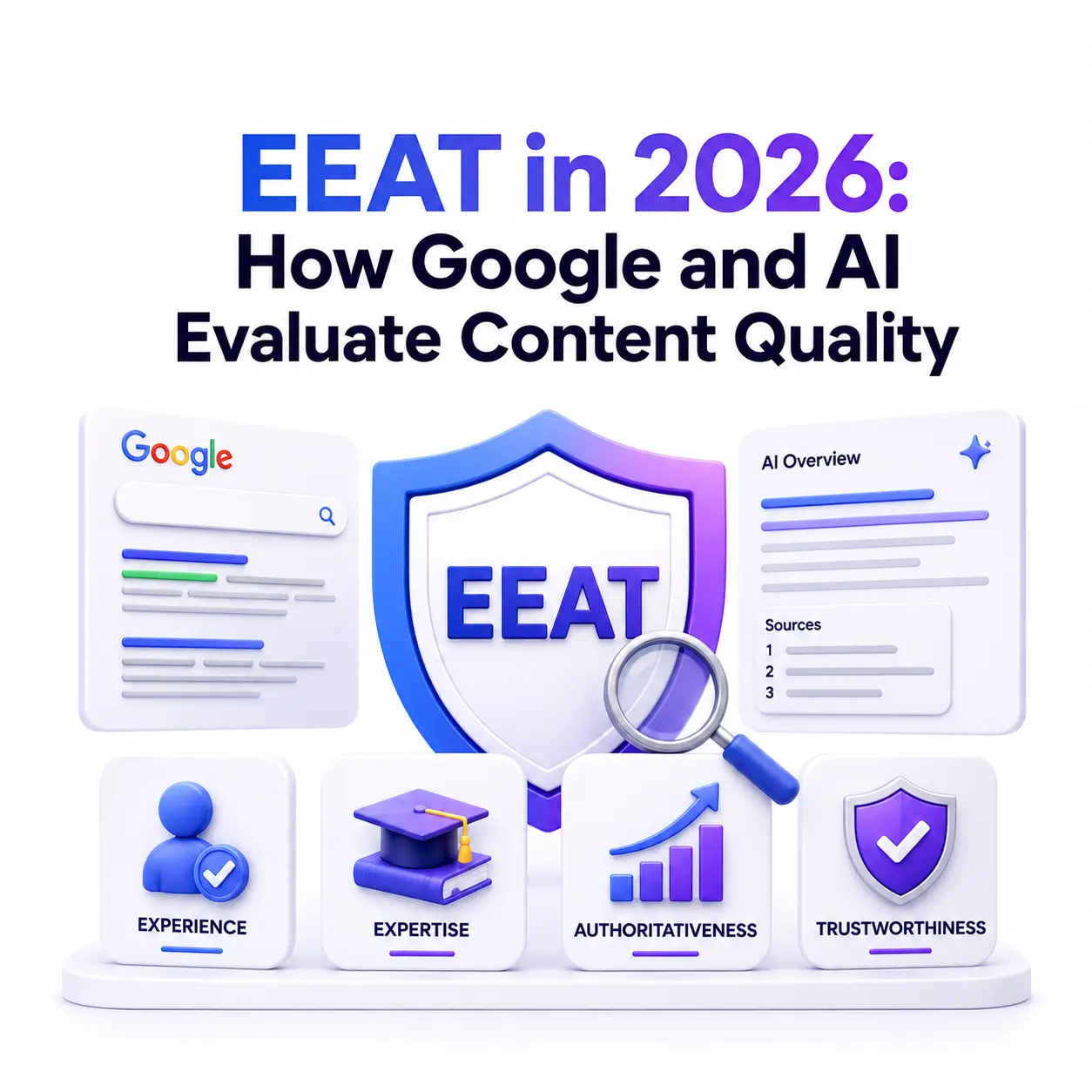
Search in 2026 no longer means a simple list of ten blue links. Between AI Overviews, AI Mode, and chatbot-driven research, a significant share of queries never generate a traditional click at all. A natural question has emerged among marketers: does EEAT still matter? The answer is yes it matters more than before, because EEAT has become the shared vocabulary for how human reviewers and AI systems decide which sources deserve trust.
This guide explains what EEAT 2026 is, how Google’s Quality Raters apply it, how AI-driven search evaluates and cites content, and what a practical EEAT strategy looks like for teams producing content at scale.
What Is EEAT? A Quick Refresher for 2026
EEAT stands for Experience, Expertise, Authoritativeness, and Trustworthiness. It originates from Google’s Search Quality Rater Guidelines (QRG), used to train the human evaluators who manually assess search result quality. EEAT is not itself a ranking algorithm; it is a framework describing what “high quality” looks like, which Google’s automated ranking systems are refined to approximate.
The Four Pillars
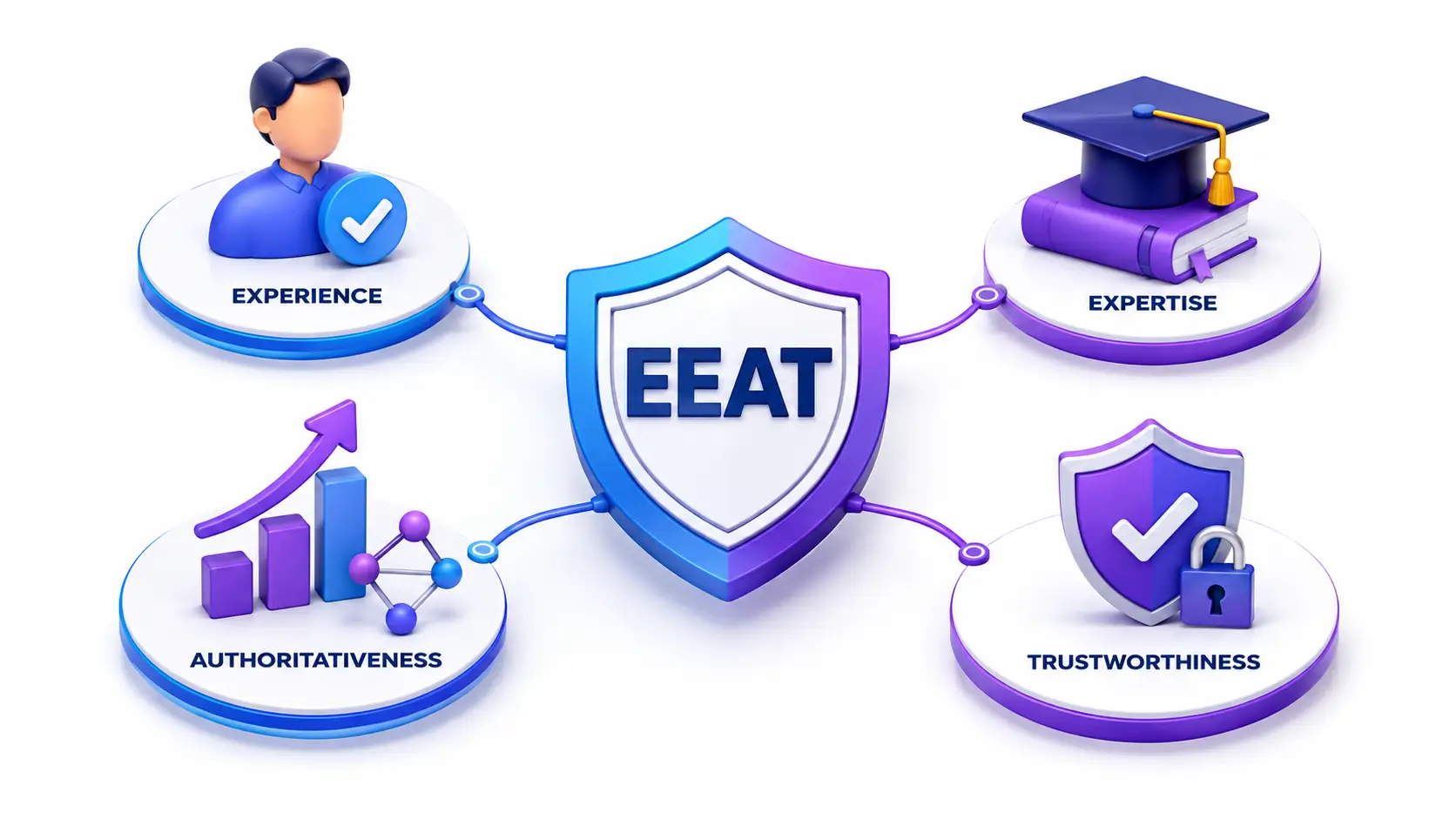
Experience asks whether the author has genuine, firsthand involvement with the topic not just researched knowledge of it. Expertise measures the depth, accuracy, and technical competence of the content. Authoritativeness reflects how the broader industry regards the author or site as a recognized reference point. Trustworthiness sits above the other three, concerning accuracy and transparency, and Google treats it as foundational, since the other pillars carry little value without it.
Why Google Added the Second “E” in 2022
The original framework, E-A-T, dates to 2014. Google expanded it to E-E-A-T in December 2022 by adding Experience, responding to a specific problem: as automated writing tools spread, it became easier to produce text that sounded authoritative without reflecting real, lived interaction with the topic. Separating Experience from Expertise gave raters a clearer way to distinguish genuine practice from secondary research.
Why EEAT Matters More in the Age of AI Search
The rise of generative search has not diminished the importance of credibility signals it has concentrated them. When a search page shows ten listings, users judge for themselves which source to trust. When an AI Overview synthesizes one answer from a handful of sources, that judgment happens on the user’s behalf, making EEAT in 2026 signals more consequential, not less.
From Ranking Pages to Ranking Sources
Traditional ranking operates at the page level: a URL competes for a query. Generative retrieval increasingly operates at the entity level, evaluating whether a website or named author is a credible reference across a topic part of why author identity and site-wide transparency now matter as much as on-page optimization.
How Generative Engines Reuse EEAT Signals
AI Overviews do not evaluate credibility from scratch; they draw heavily on signals that already inform organic rankings. This is why the industry treats Generative Engine Optimization (GEO) as an extension of EEAT in 2026 practice rather than a replacement for it.
How Google’s Quality Raters Evaluate Content
Google employs thousands of external Quality Raters who follow the published QRG to manually assess search results. These ratings do not directly change individual rankings; instead, they function as a feedback signal used to evaluate whether Google’s automated systems are correctly identifying trustworthy content and to guide adjustments when they are not.
The QRG and the Higher Bar for YMYL Content
Because the QRG is public, it doubles as the clearest blueprint for high-quality content. It applies an especially strict standard to Your Money or Your Life (YMYL) topics health, finance, legal, and safety content where inaccuracies could cause real harm typically expecting named, credentialed authors and rigorous fact-checking.
How AI Systems Evaluate and Cite Content
AI-driven search tools Google AI Overviews and AI Mode, along with assistants such as ChatGPT and Perplexity evaluate content through a related but not identical lens to the QRG. Rather than a human rater scoring a page, these systems retrieve, rank, and synthesize information in real time, then decide which sources to cite. Google says there are no special technical requirements for AI Overviews beyond the signals that drive strong organic performance.
Why AI Overviews Mostly Cite Pages Already Ranking on Page One
Pages cited in AI Overviews are almost always already ranking in Google’s organic top ten, and citation share is highly concentrated: the top five domains account for roughly 38% of all AI Overview citations, and the top ten account for over half. In practice, teams cannot treat AI visibility as a channel to optimize independently of organic SEO strong traditional rankings, built on EEAT in 2026 fundamentals, remain the prerequisite for AI citation, not an alternative to it.
Structured Data and Freshness as New Trust Signals
AI retrieval systems weigh how easily a page’s claims can be parsed and verified. Clear source attribution, visible publish and update dates, and schema markup such as FAQ or HowTo data make it easier for generative systems to extract and correctly attribute an answer. None of these replace EEAT in 2026 they are the machine-readable expression of the same signals human raters look for.
The Four Pillars in Practice: Building Real EEAT Signals
The following actions map to each pillar and apply whether content is written by hand or with AI assistance.
Experience and Expertise
Publish detailed, verifiable author bios describing direct, hands-on involvement with the subject, and include original photography or documented process where relevant. Attribute content to credentialed authors, and ensure the writing reflects genuine depth a surface-level treatment would miss.
Authoritativeness and Trustworthiness
Earn recognition beyond your own site through citations from reputable publications and a consistent publishing focus. At the site level, maintain a clear About page, accessible contact information, transparent sourcing, and a visible corrections policy table-stakes elements whose absence undermines every other EEAT signal a page might demonstrate.
Common EEAT Mistakes and Can AI-Written Content Qualify?
The most frequent EEAT failures are structural: unattributed bylines, YMYL content without credentialed review, sweeping claims without sourcing, and writing that reads as competent but shows no evidence of firsthand engagement. Weak signals carry a compounding cost suppressed rankings and exclusion from AI Overview citation, since generative systems draw disproportionately from sources that already perform well organically.
Can AI-Written Content Ever Satisfy EEAT in 2026?
AI-assisted writing is not inherently disqualifying, but content generated without human input struggles with the Experience pillar, since a model cannot have firsthand, lived involvement with a topic. Content combining AI-assisted drafting with genuine human expertise and editorial review can satisfy EEAT; substituting AI output for real subject-matter knowledge typically cannot.

A Practical EEAT Audit Checklist for 2026
Use this checklist to evaluate EEAT in 2026 for existing pages or brief new content:
- Named author byline with a credentialed, topic-relevant bio
- Visible evidence of firsthand experience (original photos, documented process)
- Citations or links to original data or primary sources
- Visible publish date and update history, kept current
- Clear About page and accessible contact information
- Editorial or expert review noted for YMYL topics
- Structured data (FAQ, HowTo, or Article schema) matching visible content
- A transparent process for corrections or factual updates
Pages that satisfy most of these criteria are well positioned for both human quality-rater evaluation and AI-driven citation, since the two systems draw on overlapping evidence.
Frequently Asked Questions
What does EEAT stand for?
Experience, Expertise, Authoritativeness, and Trustworthiness the framework Google’s Quality Rater Guidelines use to judge content credibility. Google added “Experience” in December 2022 to the earlier E-A-T model, emphasizing firsthand involvement with a topic over purely researched knowledge.
Is EEAT an official Google ranking factor?
Not directly. Google has confirmed there’s no single EEAT score applied to pages. Instead, EEAT describes qualities its ranking systems are trained to reward through signals like backlinks, author credentials, content accuracy, and site transparency.
How does EEAT in 2026 apply to AI Overviews and AI search?
AI Overviews and AI Mode largely draw from pages that already rank well organically, so traditional EEAT signals still matter. Freshness, structured data, and clear source attribution also influence whether AI systems select and cite a page.
What is YMYL content?
“Your Money or Your Life” content covering health, finance, legal, or safety topics where inaccurate information could cause real harm. Google applies its strictest EEAT scrutiny here, often requiring visible author credentials and rigorous fact-checking.
Can AI-generated content satisfy EEAT requirements?
It can inform EEAT-friendly pages, but struggles to independently demonstrate “Experience,” since that pillar rewards firsthand, lived involvement with a topic. Human review and documented expertise remain necessary to meet Google’s standards.
How can I audit my website for EEAT in 2026?
Review each page for named author bios with credentials, original examples, source citations, a clear About/contact page, and evidence of firsthand experience applying the QRG’s stricter YMYL criteria where relevant.
Conclusion
EEAT has not been diminished by the rise of AI search; it has been redistributed across two connected systems. Google’s human Quality Raters continue to apply the QRG to train traditional ranking, while AI Overviews lean on related signals, filtered through organic performance, to decide which sources earn a citation. Teams that treat these as one integrated discipline, building genuine experience, expertise, authority, and transparency into every page, put themselves in the strongest position to succeed in both systems at once.


