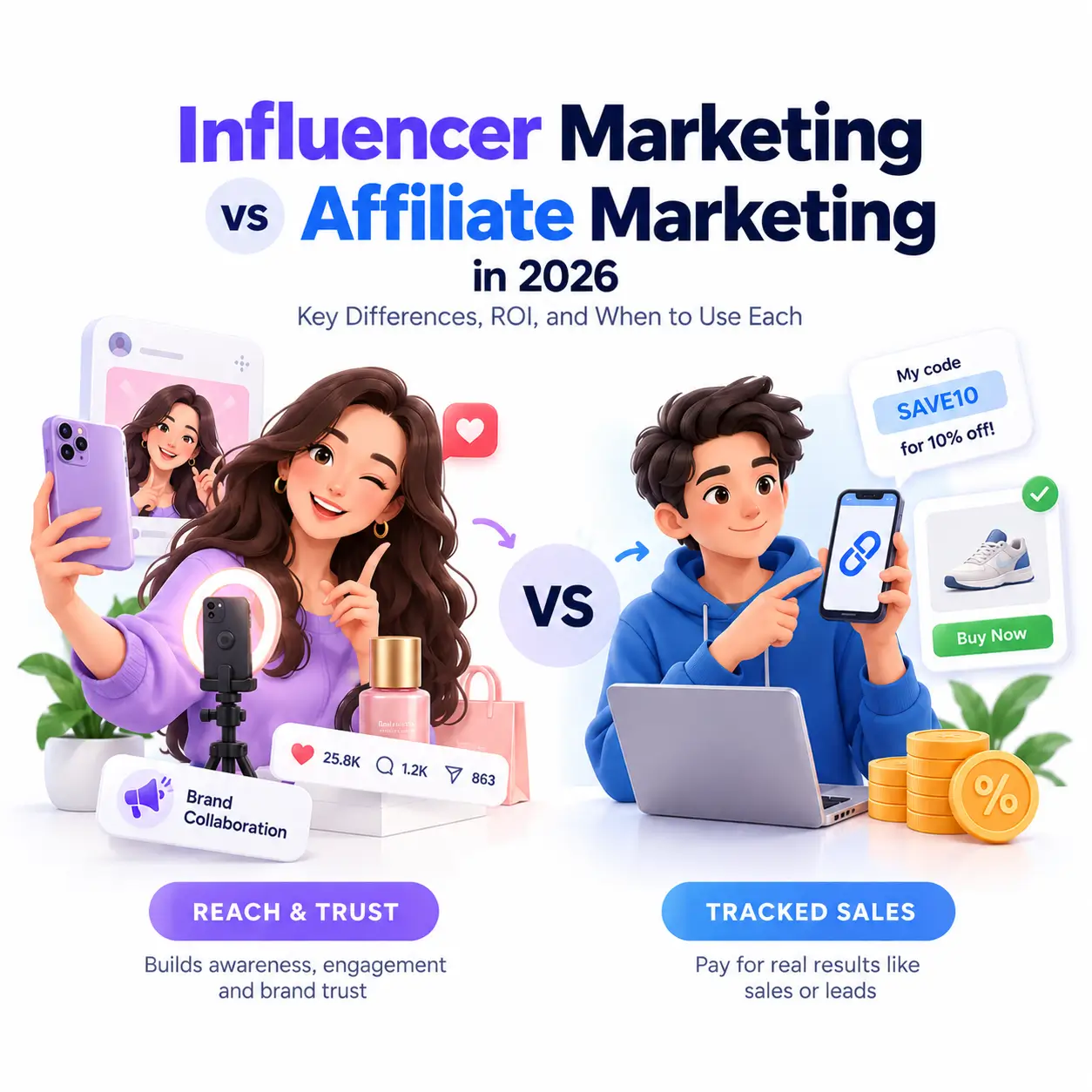
Influencer marketing vs affiliate marketing both rely on people with an audience recommending your product, so they’re easy to confuse. The difference is what you pay for. Influencer marketing pays for reach, trust, and content. Affiliate marketing pays only for tracked results, such as a sale or a lead.
For an intermediate marketer, the useful question in 2026 isn’t which channel is better. It’s which one fits your margins, your stage of brand awareness, and your tolerance for risk. This guide compares influencer marketing vs affiliate marketing on cost, ROI, and measurement, then gives you a scorecard to decide.
What Is Influencer Marketing?
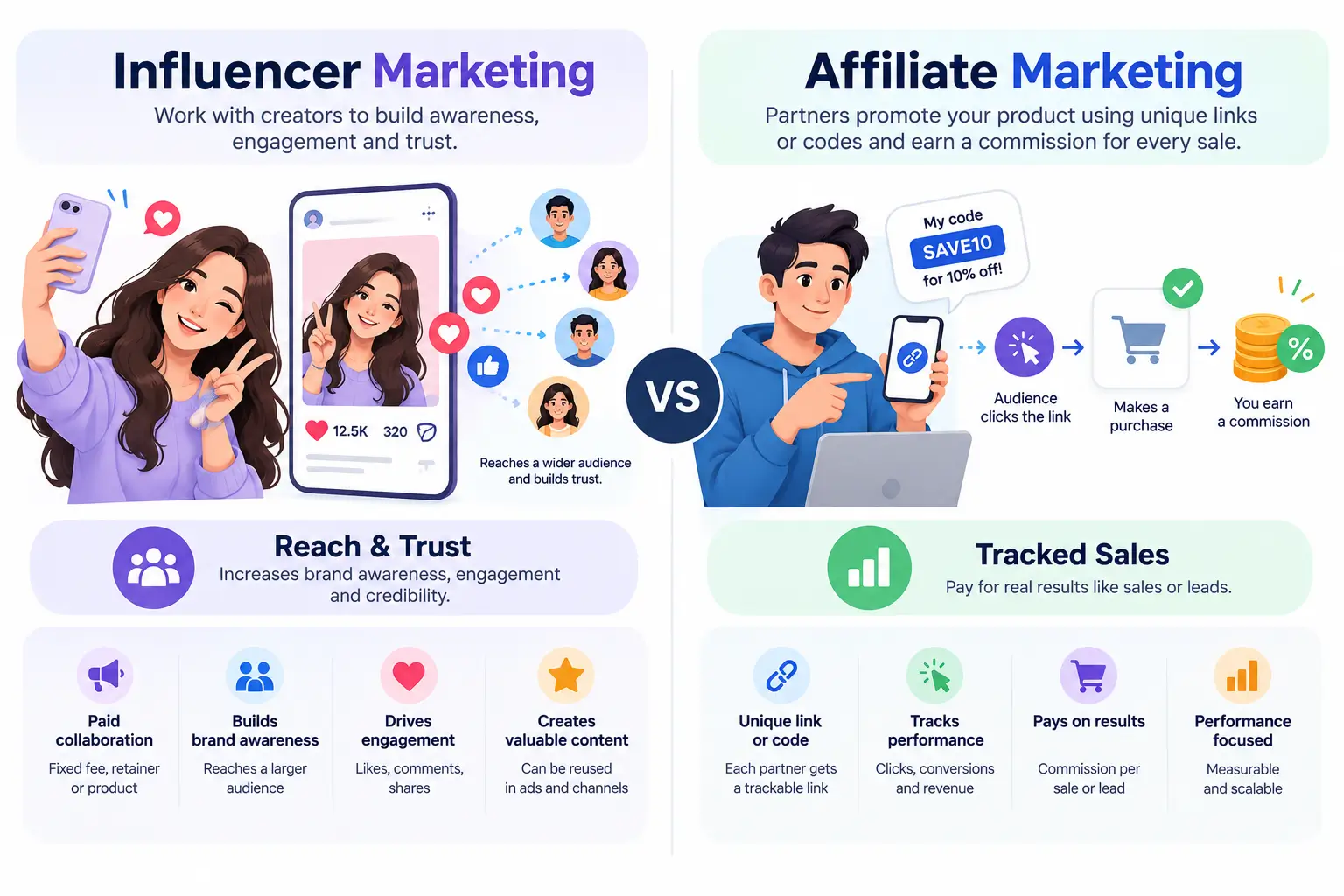
Influencer marketing means paying creators to feature your brand in their content. You’re buying access to an audience that already trusts them, plus the content itself, which you can often reuse in ads and on your own channels.
How partnerships are structured
Most deals fall into three models:
- Flat fee per post or campaign, the most common for paid work.
- Retainers, where a creator posts regularly over months, building familiarity.
- Gifting or product seeding, usually with smaller creators, where the product is the payment.
Influencer tiers
Nano (roughly under 10K followers) and micro creators tend to have tighter communities and higher engagement, while macro and mega creators deliver scale at a much higher price. Many brands now build portfolios of smaller creators instead of relying on one big name.
What Is Affiliate Marketing?
Affiliate marketing is a performance model. Partners promote your product through unique links or codes and earn a commission when someone buys or signs up. The partners aren’t only social creators. They include review sites, comparison blogs, newsletter writers, and coupon publishers.
How tracking works
Each partner gets a trackable link or promo code. When a visitor clicks, a cookie records the referral, and if a purchase happens within the attribution window (commonly 30 to 90 days, depending on the program), the partner is credited. This tracking is why affiliate marketing is so measurable.
Common commission models
- CPA (cost per action): a fixed payout per sale or signup.
- Revenue share: a percentage of the order value.
- CPL (cost per lead): a payout per qualified lead, common in B2B and finance.
Influencer Marketing vs Affiliate Marketing: Key Differences
Factor | Influencer Marketing | Affiliate Marketing |
| Payment trigger | Content delivered (flat fee, retainer, product) | Verified sale or lead |
| Upfront cost | Yes | Usually none |
| Funnel position | Top and middle (awareness, trust) | Middle and bottom (conversion) |
| Measurement | Reach, engagement, brand lift, assisted sales | Clicks, conversions, revenue |
| Partner scale | Handful to dozens of relationships | Dozens to thousands |
| Creative control | Often co-created | Mostly brand-provided assets |
| Time to results | Slower, compounding | Faster once partners are active |
Is affiliate marketing the same as influencer marketing?
No, though they overlap. An influencer who earns commission through a referral link is doing affiliate marketing. An affiliate who runs a coupon site isn’t an influencer at all. Influencer marketing describes the type of partner and the goal. Affiliate marketing describes the payment model.
Payment and risk
With influencers, you carry the risk: you pay whether or not the post sells. With affiliates, the partner carries most of it. That’s why affiliate programs feel safer for lean budgets, and why influencers often command higher fees.
Measurement and attribution
Affiliate attribution is direct. Influencer attribution is fuzzier because much of the value shows up as people searching your brand later, or buying through a different channel. Treat that as a measurement challenge, not proof that influencer marketing doesn’t work.
Cost and ROI: Which Performs Better in 2026?
Which is cheaper?
Affiliate marketing generally carries less financial risk, but “cheaper” depends on your numbers. Here is an illustrative example, not a benchmark:
If the creator’s audience converts well, the flat fee can beat the commission. If not, you’ve paid for reach that didn’t sell. Run this math against your own margin before signing anything.
Which has better ROI?
Affiliate marketing usually shows clearer direct ROI because every payout ties to a conversion. Influencer marketing does extra work that direct ROI doesn’t capture: awareness, branded search, and reusable content. Judge each channel by its job. Use cost per acquisition for affiliates. For influencers, use brand lift, assisted conversions, and the value of content you can repurpose.
How to track sales from influencer campaigns
- Give each creator a unique code and a UTM-tagged link.
- Add a “How did you hear about us?” field at checkout.
- Watch branded search and direct traffic in the weeks after each post.
- Compare against a baseline period to estimate lift.
When to Choose Influencer Marketing, Affiliate Marketing, or Both
Choose influencer marketing when…
- You’re entering a new niche or launching a product people don’t yet know they need.
- You have a strong brand story or visual product that benefits from creative storytelling.
- You can fund 60 to 90 days of spend before judging results.
Choose affiliate marketing when…
- You already have some brand recognition.
- Your margins can fund commissions and your sales cycle is short.
- You want costs that scale with revenue and clear reporting.
The 5-Question Channel Scorecard
Answer yes or no:
- Do you already have brand awareness in your niche?
- Is your margin high enough to fund ongoing commissions?
- Is your typical sales cycle under seven days?
- Do you have creative assets or a clear brand story to work with?
- Can you fund 60 to 90 days of spend before seeing returns?
Mostly yes to questions 1, 2, and 3: start with affiliate. Mostly yes to 4 and 5, with a no on question 1: start with influencer. Yes across the board: run both.
Which is better for small businesses and startups?
Cash-strapped businesses usually do best starting with affiliate marketing, or commission-only deals with micro-creators, because costs scale with sales. Add paid influencer campaigns once you have proof of conversion and a budget to support them.
The Hybrid Model: Influencer Affiliate Marketing
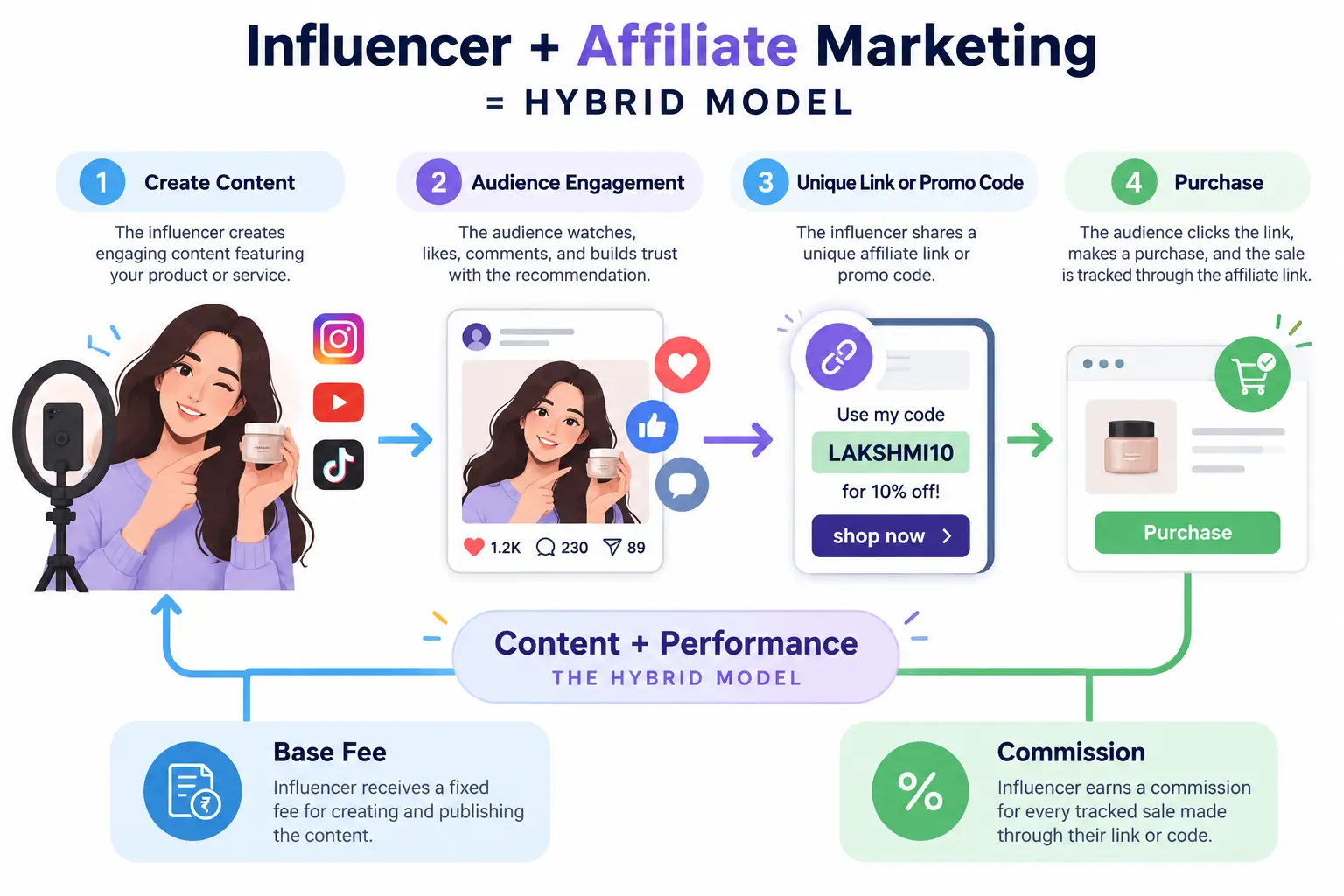
The two channels are converging. Brands increasingly pay creators a modest base fee plus a commission, so the creator is paid for effort and rewarded for results. Aspire’s 2026 report found that 74% of marketers plan to increase influencer budgets, with creator partnerships already averaging 23% of total marketing spend. Meanwhile, one industry estimate puts influencer marketing at about $32.5 billion globally in 2026, versus roughly $12 billion for affiliate marketing. Treat that market-size comparison as directional, since it comes from a secondary source: accelerationpartnersstackinfluence
Can you use both together?
Yes, and it’s often the strongest setup. Influencers create demand at the top of the funnel; affiliate links and codes capture and attribute the resulting sales. Content also moves between channels: a strong creator video can become an affiliate asset or a paid ad.
Sample hybrid structures
- Base + commission: for example, a small flat fee plus a percentage of tracked sales.
- Tiered commission: the rate rises as a creator hits sales thresholds.
- Gifting + commission: product seeding for micro-creators, with a code that earns a payout.
Avoid paying twice. Write cross-attribution rules into every contract. Decide upfront which touchpoint gets credit when a customer clicks a creator’s link, then later uses a coupon site.
2026 Trends Reshaping Both Channels
- Creator-led commerce: shoppable posts and in-platform checkout are shortening the path from content to purchase, blurring the line between awareness and conversion.
- AI-driven discovery: as people use AI search and assistants for recommendations, credible reviews and creator content increasingly influence what gets surfaced.
- Budgets shifting toward creators: more spend is moving to partnerships, so better attribution is becoming a competitive advantage.
Frequently Asked Questions
What is the main difference between influencer marketing vs affiliate marketing?
The main difference is how partners are paid and what they’re paid for. Influencer marketing typically compensates creators with flat fees, products, or retainers for reach and brand trust. Affiliate marketing pays commission only when a tracked link or code produces a sale or lead. One buys attention; the other buys outcomes.
Which is cheaper: influencer marketing or affiliate marketing?
Affiliate marketing usually carries less upfront risk because you pay commission only after a verified sale or lead. Influencer marketing generally requires paying fees before results arrive. However, “cheaper” depends on margins: high commissions plus platform and management costs can exceed a flat influencer fee when a campaign converts well.
Can you use influencer marketing and affiliate marketing together?
Yes, and most mature programs do. Influencers build awareness and trust at the top of the funnel, while unique links or codes attribute the resulting sales. A common structure pairs a modest flat fee with a performance commission, aligning creator incentives with results. Set clear attribution rules so you never pay twice for one conversion.
Which has better ROI, influencer or affiliate marketing?
Affiliate marketing typically shows clearer direct ROI because every payout ties to a tracked conversion. Influencer marketing’s value is harder to measure because it also drives awareness, search demand, and reusable content. Judge each by its job: cost per acquisition for affiliates; brand lift, assisted conversions, and content reuse for influencers.
Do influencers have to disclose affiliate links?
Yes. In the US, the FTC requires clear disclosure of any material connection, including free products, payments, or commissions, and the disclosure must be easy to notice. India’s ASCI and the UK’s ASA have similar rules. Brands share responsibility, so include disclosure requirements in contracts and monitor compliance.
Which is better for small businesses?
Small businesses with tight cash flow often start with affiliate marketing because costs scale with sales. Micro-influencers on product-seeding or commission-only deals are a low-cost way to test creator marketing. Once you have proof of conversion and a budget, add paid influencer campaigns to build awareness.
Conclusion
Influencer marketing vs affiliate marketing solve different parts of the same growth problem. Influencers build the awareness and trust that make people receptive; affiliates turn that interest into measurable sales at a cost tied to results. Use the scorecard to pick your starting point, run the break-even math on your own margins, and build attribution rules from day one. Start with the channel that matches your stage, then layer in the other as your program matures.


