For fifteen years, Google Search Console assumed one thing about you that you owned a website. If your brand lived on TikTok, or your best-performing asset was a YouTube video, Search Console had nothing to say about it.
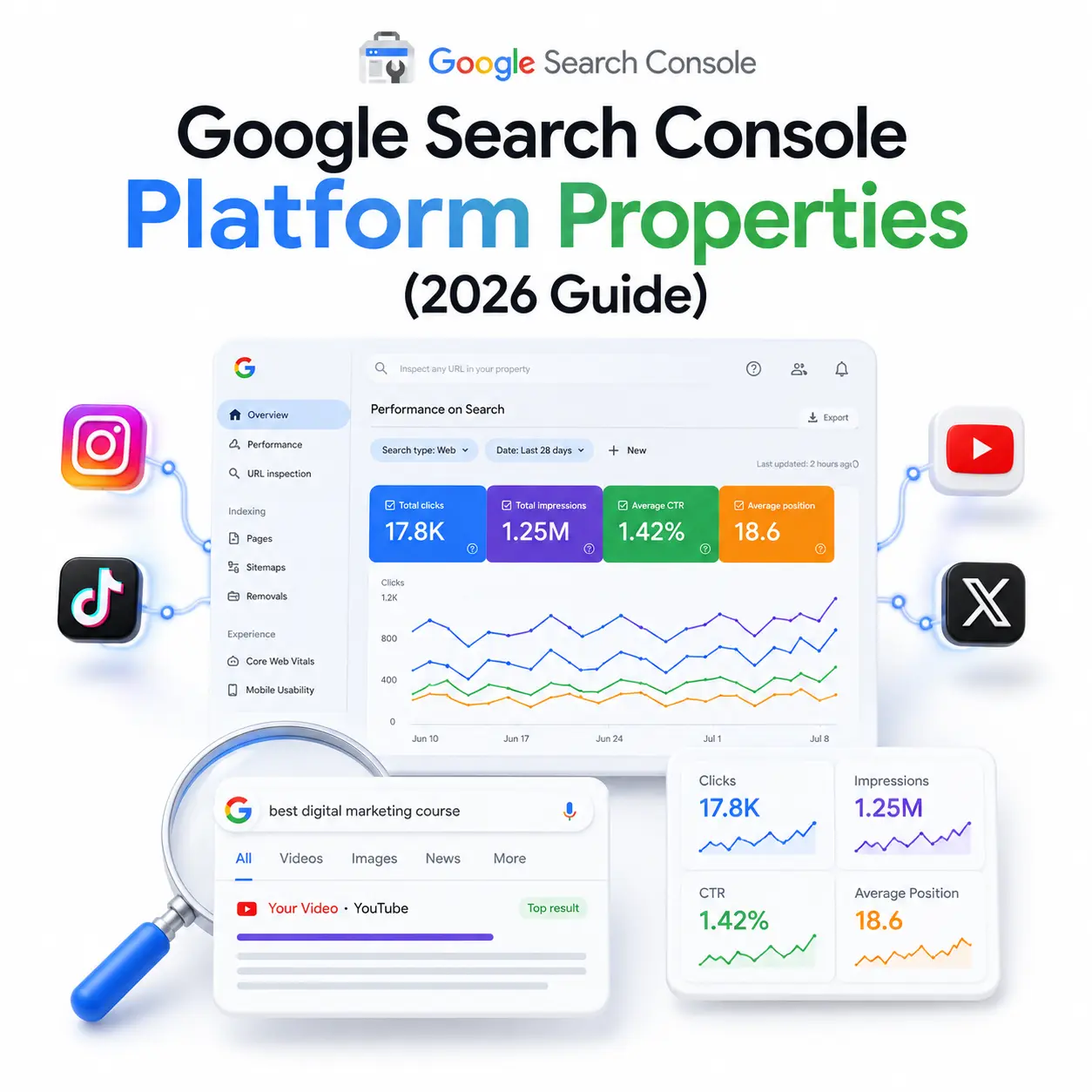
That changed on 7 July 2026. Google introduced platform properties, a new Search Console property type that reports how your social and video content performs in Google Search, Discover, and News.
The short version:
- Four platforms at launch: Instagram, TikTok, X, and YouTube.
- You do not need a website to use it.
- You do not need a website to use it.
What Google Actually Announced
Moshe Samet, Product Manager Lead for Search Console, announced platform properties on the Google Search Central Blog. The framing is straightforward site owners and creators can now track which search terms lead people to their Instagram, TikTok, X, and YouTube content, and see how audiences interact with those posts.
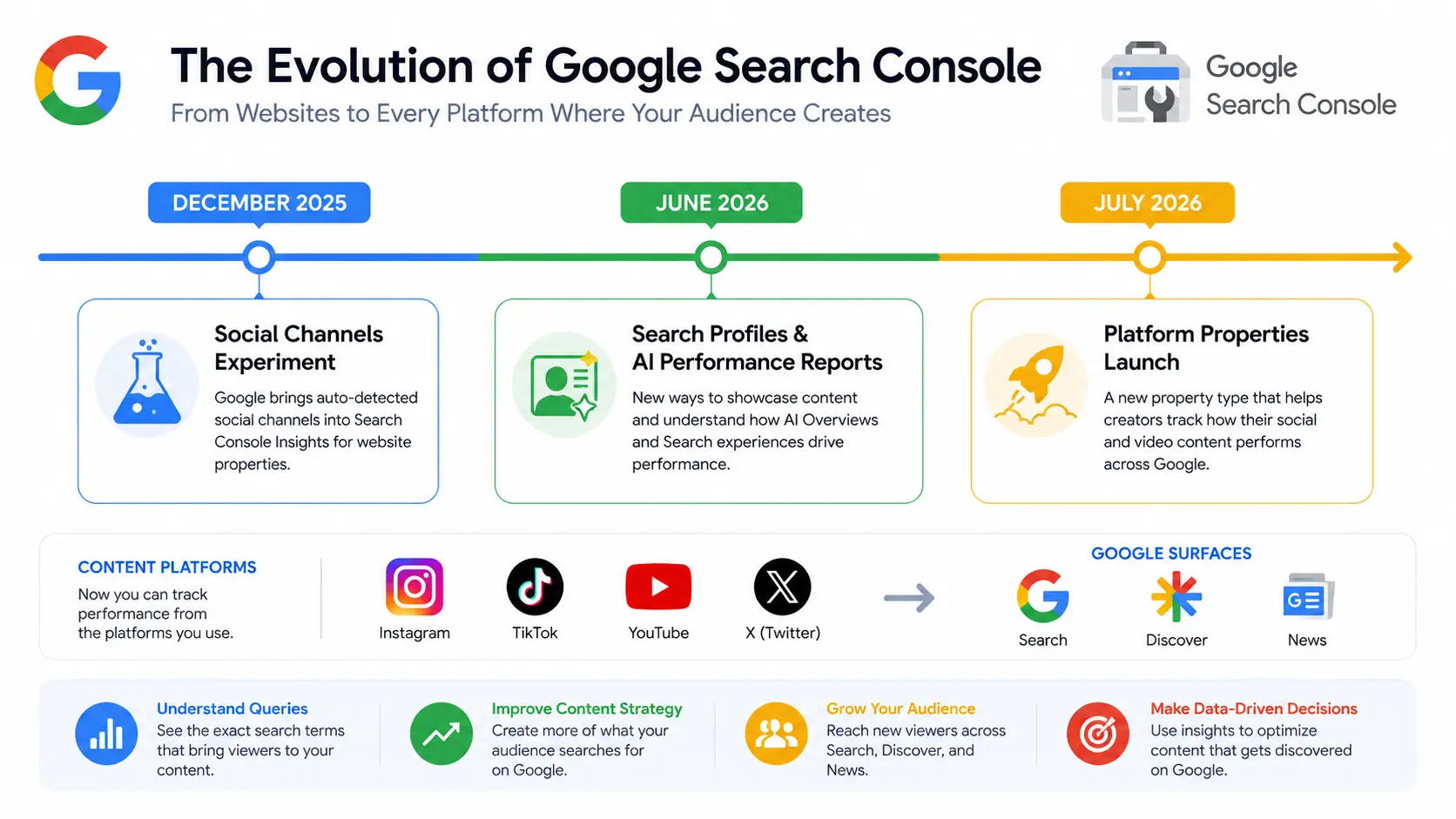
The feature builds on a limited experiment from December 2025, when Google pulled auto-detected “social channels” into the Search Console Insights report for website properties. Platform properties make that a first-class object rather than a side panel. For businesses and training institutes promoting a digital marketing course in Kochi, these insights can reveal how Instagram, YouTube, and other social platforms contribute to Google Search visibility, helping refine both content strategy and SEO performance.
What Is a Platform Property?
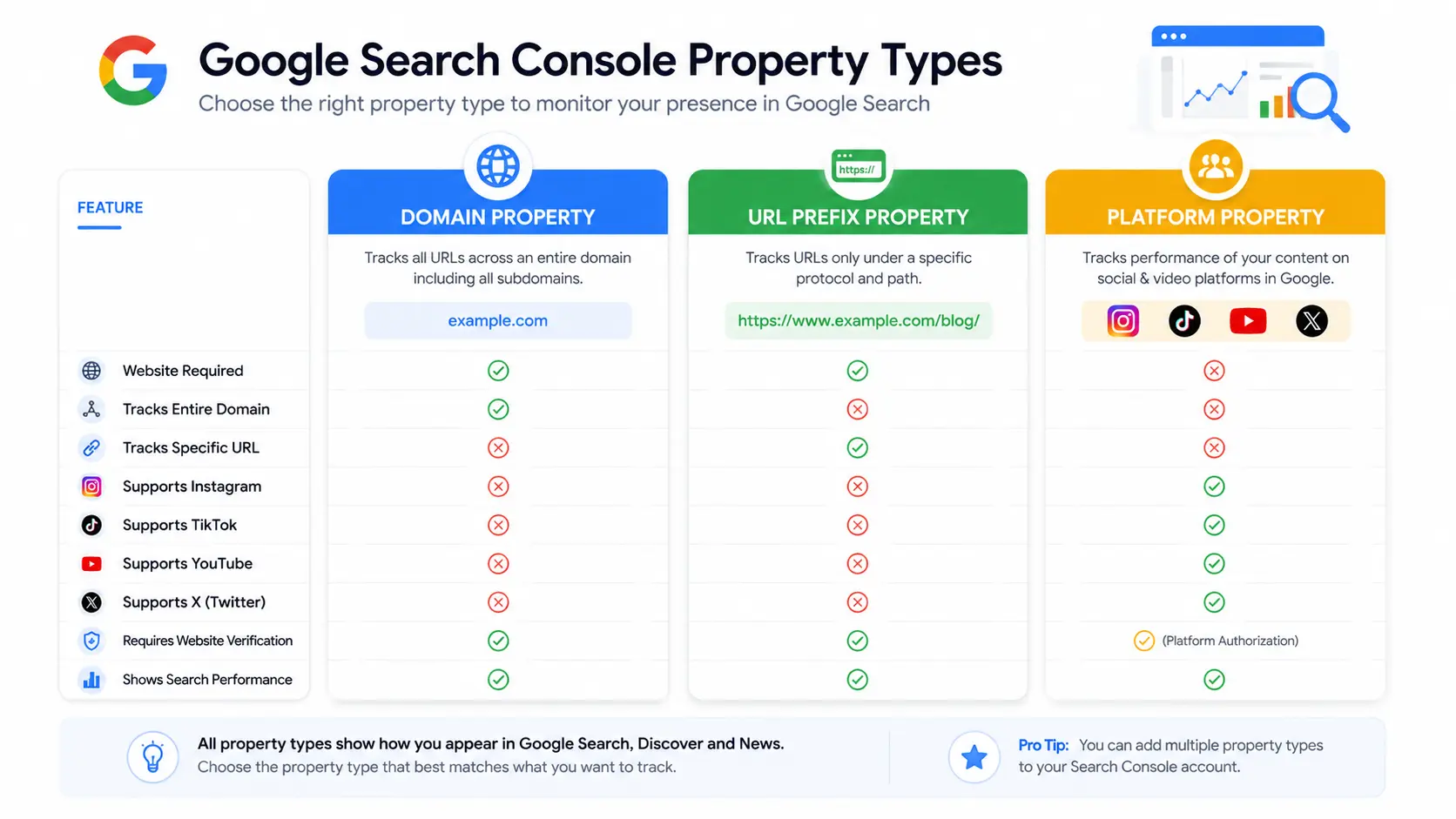
Until now, Search Console offered two property types. A domain property covers an entire domain and its subdomains. A URL-prefix property covers a specific path. Both assume you can verify ownership of a website.
A platform property is the third type. Instead of verifying a domain, you verify an account on a supported platform. Search Console then reports on that account the way it has always reported on a website.
Platform properties vs Search profiles
These are being confused constantly, and they are not the same thing.
A Search profile, which Google introduced in June 2026, is a public, shareable page that consolidates a qualified creator’s content for an audience. It is a surface other people see.
A platform property is private analytics. It is a report only you see. One is distribution; the other is measurement.
Creators without a website
This is the genuinely new part. Platform properties are explicitly aimed at creators who have never verified a site. If your presence is a YouTube channel and a TikTok account, Search Console is finally a tool you can use.
For agencies, it also means something quietly significant you can now see performance data for content sitting on domains you neither own nor have developer access to.
The Three Reports You Get
Performance report. The core analytical view. Total clicks, impressions, average CTR, and average position, sortable by individual post and by query. You can see the exact search someone typed before they landed on your Reel. Export it if you prefer to analyse elsewhere.
Insights report. The plain-language overview: recent traffic trends, top-performing posts, and how people are discovering your account on Google. Useful for a weekly pulse check or a client briefing.
Achievements. Milestone tracking, such as passing a new clicks threshold in the last 28 days. Be clear-eyed about this one it is a motivational layer built for creators, not an analyst’s instrument.
The default date range for both the Insights and Performance reports is 28 days.
What the Data Measures And What It Doesn’t
This is where practitioners will misread the numbers, so be precise.
Platform properties measure Google surfaces only: Search, Discover, and News. The Help documentation is blunt about it the reports show how your content performs on Google Search.
Nothing that happens inside the apps is included. Native TikTok views. Instagram likes. YouTube watch time from the home feed. None of it appears here. If a client sees 17,000 clicks and assumes it covers their in-app engagement, that is a reporting conversation you want to have before the invoice, not after.
The counting rules Google has published:
- If an Instagram Story appears in Google Search, that is an impression. If someone taps through, that is a separate click.
- If a video appears in search results or in Discover, that is an impression. A click counts even when the video opens inside Google’s own player rather than the native app.
Google’s own Insights screenshot shows a YouTube channel with 17.8K Search clicks over 28 days, broken out across Web search, Video search, Discover, and Image search. Note that fourth dimension. Most people have not registered that Image search is a reporting surface for video content.
How to Set It Up
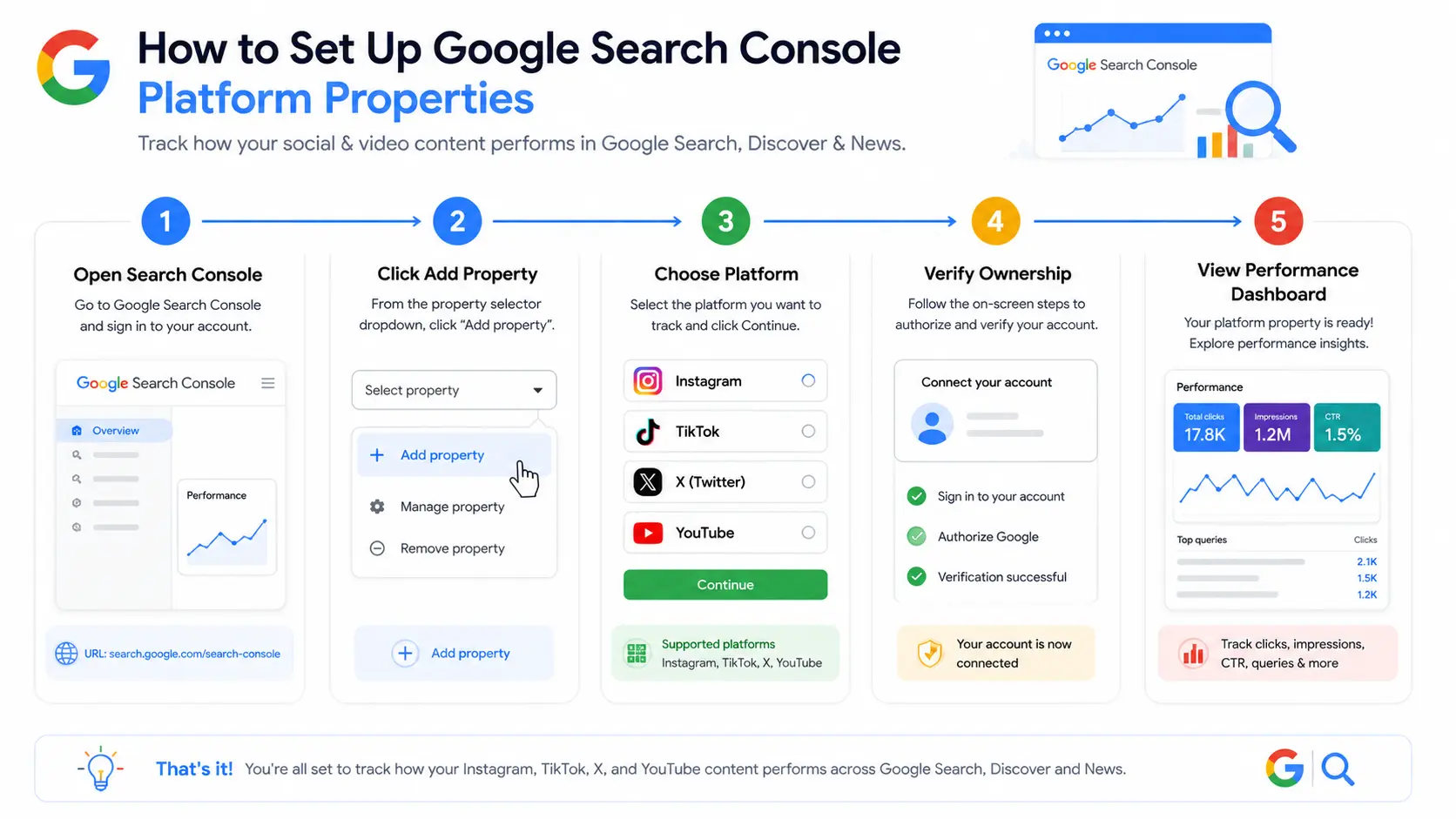
- Open the property selector dropdown anywhere in Search Console, or go to the verification page.
- Click Add property.
- Select Instagram, TikTok, X, or YouTube.
- Follow the on-screen steps to authorise the connection.
Setup takes minutes. Three mistakes to avoid:
- Scattering properties across team Google accounts. Use one. Consolidating later is painful.
- Authorising the wrong profile. Brands with several accounts on one platform routinely connect the wrong one.
- Expecting historical data. There is none.
If you do not see the option, that is expected. The rollout is gradual over several weeks. It is not an error and you are not excluded.
The over-optimisation trap
One warning. The temptation will be to rewrite every caption as an SEO exercise, until the content loses the thing that made people engage with it in the first place.
Resist it. Use the reporting diagnostically. Find the platform-native content that already earns search visibility, then work out why. That is a different question from “how do I stuff a keyword into a Reel.”
What This Signals
Look at the sequence. Social channels experiment, December 2025. Search profiles and Search Generative AI performance reports, June 2026. Platform properties, July 2026.
Three shipments in eight months, all pointing the same way: the unit of measurement is drifting away from the website.
Audiences never moved neatly from search to site to social. Google is finally reporting on the way people actually behave and handing you the query data to act on it.


