If you want to know how to become a performance marketer in 2026, start with one shift: the job is no longer about pulling levers inside ad platforms. Google and Meta now automate much of the bidding and targeting. What they can’t automate is the quality of the signals you feed them, the creative you test, and the judgment you apply to the numbers.
This guide gives you a practical path, written for marketers who already know the basics and want to specialize. It covers what the role involves, the skills and tools that matter, a six-step roadmap, and how the career develops.
What a Performance Marketer Actually Does in 2026
A performance marketer runs paid, measurable acquisition. Every pound, dollar or rupee spent is tied to an outcome such as a lead, a sale or an app install, and you optimize continuously against it.
Performance marketer vs digital marketer
A digital marketer manages many channels (SEO, email, social, content) in support of broad brand goals. A performance marketer goes deeper on paid channels and is accountable for outcomes. If a campaign burns budget without returns, the performance marketer answers for it.
Day-to-day work and the metrics you own
Expect to work with a core set of metrics:
- CPA (cost per acquisition): what you pay for each conversion
- ROAS (return on ad spend): revenue generated per unit of spend
- CAC (customer acquisition cost): the full cost of winning a customer
- LTV (lifetime value): what a customer is worth over time
Your week typically mixes campaign setup, creative testing, budget pacing, tracking checks and reporting to stakeholders.
How AI automation is changing the role
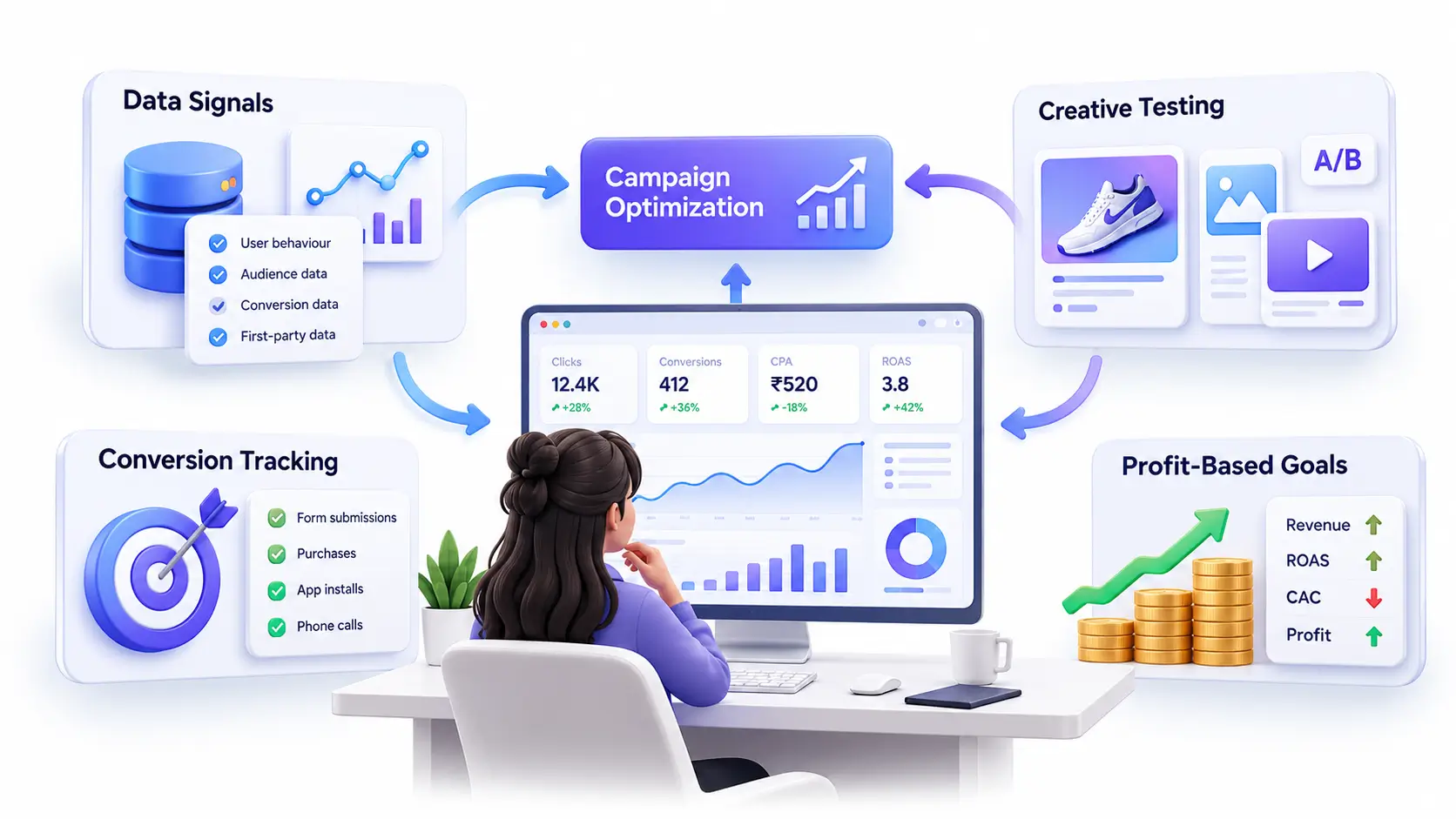
Automated campaign types such as Google’s Performance Max and Meta’s Advantage+ handle much of the execution. That moves your value upstream. Think of the modern performance marketer as a signal engineer: the person who owns conversion tracking, data quality, creative inputs and profit-based goals, then governs the algorithms accordingly. Marketers who only know how to click through campaign setup screens are the easiest to replace.
Skills You Need to Become a Performance Marketer
Technical skills: paid media, analytics and tracking
Learn Google Ads and Meta Ads thoroughly, then add one more platform such as LinkedIn or TikTok. Pair that with analytics and tracking: GA4, Google Tag Manager, and correctly set up conversion tracking. Attribution is notoriously tricky. One practitioner at Funnel calls it the most complicated aspect of performance marketing, so time spent understanding it pays off quickly.
Commercial skills: unit economics, margin and LTV
Platform metrics can mislead. A campaign with a strong ROAS can still lose money once margins, returns and fulfillment costs are counted. Learn to calculate break-even ROAS, and to judge whether a CAC is sustainable given customer lifetime value.
Creative testing and experimentation
With targeting automated, creative has become one of your biggest levers. Build the habit of forming a hypothesis, testing one variable at a time, and documenting what you learned.
Do you need coding or a degree?
Neither is required. Basic spreadsheet skills matter far more than code, and a little SQL or JavaScript helps with advanced tracking. Employers mostly want proof you can drive results, which a portfolio shows better than a degree does.
The Performance Marketing Tool Stack
You don’t need every tool at once. Learn them roughly in this order:
| Tool | Purpose | When to learn it |
| Google Ads | Search, Shopping, YouTube, Performance Max | First |
| Meta Ads Manager | Facebook and Instagram campaigns | First |
| GA4 | Behavior and conversion analytics | Early |
| Google Tag Manager | Deploying tracking without developers | Early |
| Looker Studio / Sheets | Reporting and dashboards | Mid |
| Server-side tagging, CRM integration | More reliable, privacy-resilient data | Advanced |
Add AI tools for drafting ad variants, analyzing exports and speeding up reporting, but verify their output. They accelerate your thinking and don’t replace it.
Step-by-Step Roadmap
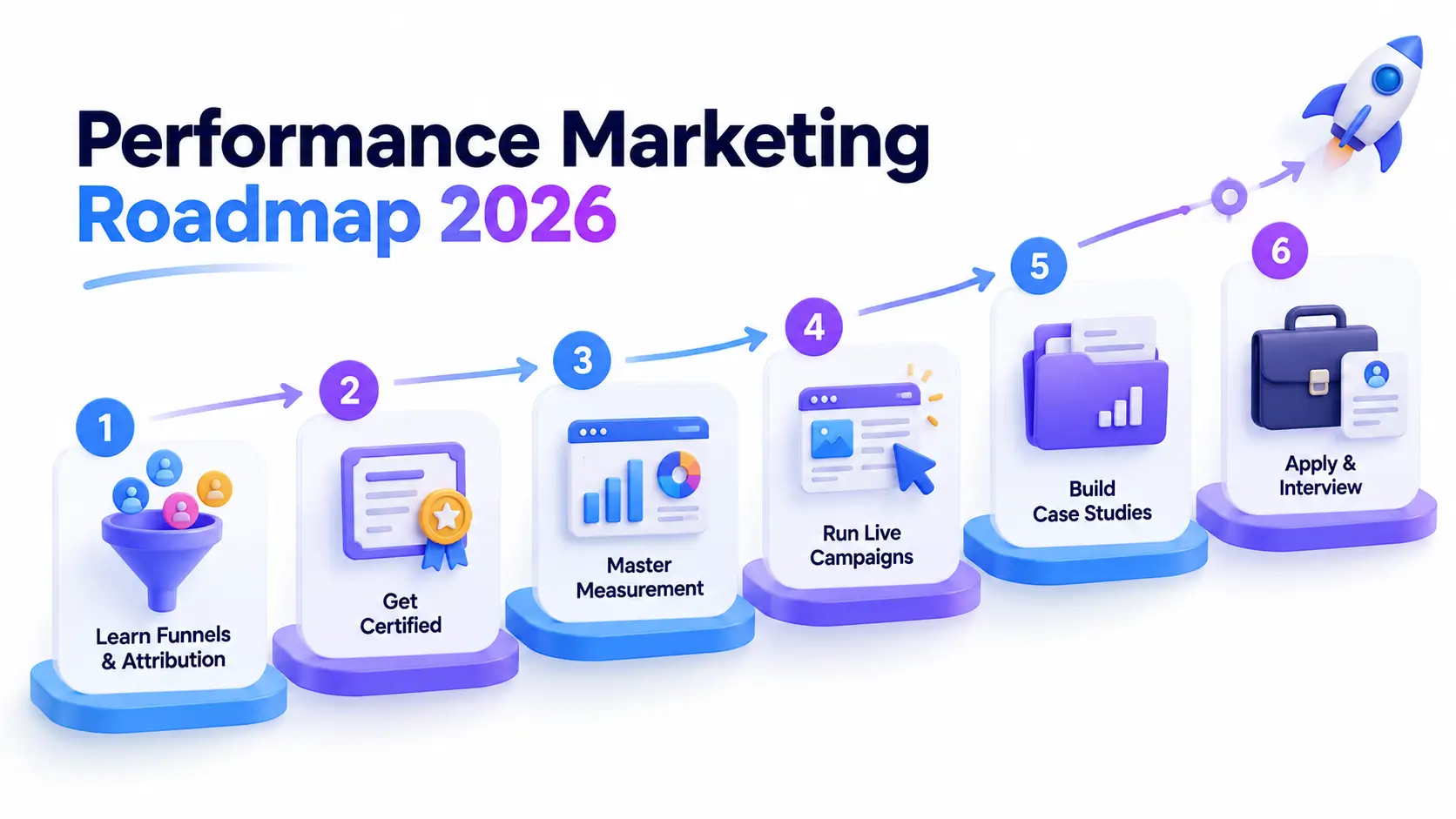
Step 1: Learn funnels and attribution
Understand how awareness turns into conversion, and how attribution models assign credit. Without this, platform dashboards will fool you.
Step 2: Get platform-certified
Complete training and certifications from Google Skillshop and Meta Blueprint. They won’t get you hired alone, but they show initiative and teach platform fundamentals.
Step 3: Master measurement
Set up GA4 and Google Tag Manager on a real site. Track purchases or lead submissions end to end, and learn to debug when numbers don’t match across platforms.
Step 4: Run live campaigns with a small budget
Run campaigns for a personal project, a local business or a nonprofit. A modest, carefully tracked budget teaches more than any course because real money makes you care about the result.
Step 5: Build a portfolio of documented case studies
Write up two or three campaigns using a consistent structure: goal, budget, hypothesis, setup, results and lessons. Include failures. Employers trust candidates who can explain why something didn’t work.
Step 6: Apply, interview and negotiate
Lead with your case studies and show your reasoning, not just your results. In interviews, expect questions on how you’d diagnose a falling ROAS or allocate a budget across channels.
How long does it take?
With a basic marketing background, four to six months of focused practice can make you job-ready. Reaching senior level takes longer, typically three to five years.
Certifications and Courses Worth Your Time
Free platform certifications from Google and Meta are the best starting point because employers recognize them. A GA4 certification adds credibility for measurement skills. Paid courses are worth it only if they include live campaign work, feedback or mentorship. If a course is mostly videos on definitions you can read for free, skip it.
Career Path and Salary
Career ladder
A typical progression runs from specialist (execution and optimization), to senior (profitability, forecasting and leading others), to head of performance or growth (strategy, P&L and hiring). Along the way, you may choose between agency, in-house and freelance routes. Agencies teach breadth quickly, in-house roles offer depth in one business, and freelancing offers flexibility with less stability.
Salary
Pay varies widely by country, seniority and company type, so avoid generic figures. Benchmark using sources for your region, such as national labor statistics, current job listings and salary surveys, and compare agency roles against in-house ones.
Common Mistakes Beginners Make
- Chasing platform metrics instead of profit. A high ROAS means little if margins are thin.
- Ignoring tracking quality. Broken conversion tracking quietly corrupts every decision that follows.
- Scaling before testing. Raising budgets on an unproven campaign magnifies losses.
- Showing a portfolio with no results. Screenshots of dashboards aren’t case studies. Explain the decisions behind the numbers.
Is Performance Marketing a Good Career in 2026?
For people who enjoy data and accountability, yes. Companies keep valuing marketers who can tie spend to revenue. The honest trade-offs are real, though: you depend on platforms that change rules often, the work can be high-pressure, and entry-level competition is stiff. The way to future-proof yourself is to build skills automation can’t replicate: measurement, commercial judgment and creative strategy.
Frequently Asked Questions
How long does it take to become a performance marketer?
Most people with a basic marketing background can become job-ready in four to six months of focused practice. That means learning the ad platforms, analytics and tracking, then running real campaigns with small budgets. Reaching senior level, where you own budgets, profitability and strategy, typically takes three to five years of hands-on experience.
Do you need a degree to become a performance marketer?
No. Employers hiring performance marketers mostly care about proof you can drive measurable results: campaign case studies, platform certifications and fluency in analytics. A degree in marketing, business or statistics can help, but a portfolio of tracked campaigns with clear metrics usually outweighs formal credentials, especially at agencies and startups.
What skills do you need to be a performance marketer?
Core skills are paid media management (Google Ads, Meta Ads), analytics and tracking (GA4, Google Tag Manager), conversion rate optimization, and budget management. In 2026, add creative testing, first-party data handling, and the ability to guide AI-driven campaign types like Performance Max. Strong commercial thinking, understanding CAC, ROAS and margin, ties it together.
Is performance marketing a good career in 2026?
Yes, for people who like data and accountability. Budgets keep shifting toward measurable channels, and companies value marketers who tie spend to revenue. The trade-off is that platform automation is absorbing manual tasks, so the career rewards strategy, measurement and creative judgment over button-clicking campaign setup.
What is the difference between a performance marketer and a digital marketer?
A digital marketer manages several channels, such as SEO, email, social and content, to support broad brand goals. A performance marketer focuses on paid, measurable acquisition where every spend is tied to outcomes like leads, sales or app installs, and optimizes continuously against metrics such as CPA, ROAS and customer lifetime value.
Can you become a performance marketer with no experience?
Yes. Start by earning platform certifications, then run small campaigns for a personal project, local business or nonprofit with tracked results. Document the process: goal, budget, tests and outcomes. Applying with two or three documented case studies shows employers practical ability, which matters more than experience claims on a resume.
Build your digital marketing career with practical training in SEO, Google Ads, Meta Ads, analytics, social media marketing, and performance marketing. Join a Digital Marketing Course in Kochi to develop industry-relevant skills, work on real projects, strengthen your portfolio, and gain the confidence needed to pursue exciting digital marketing opportunities.


