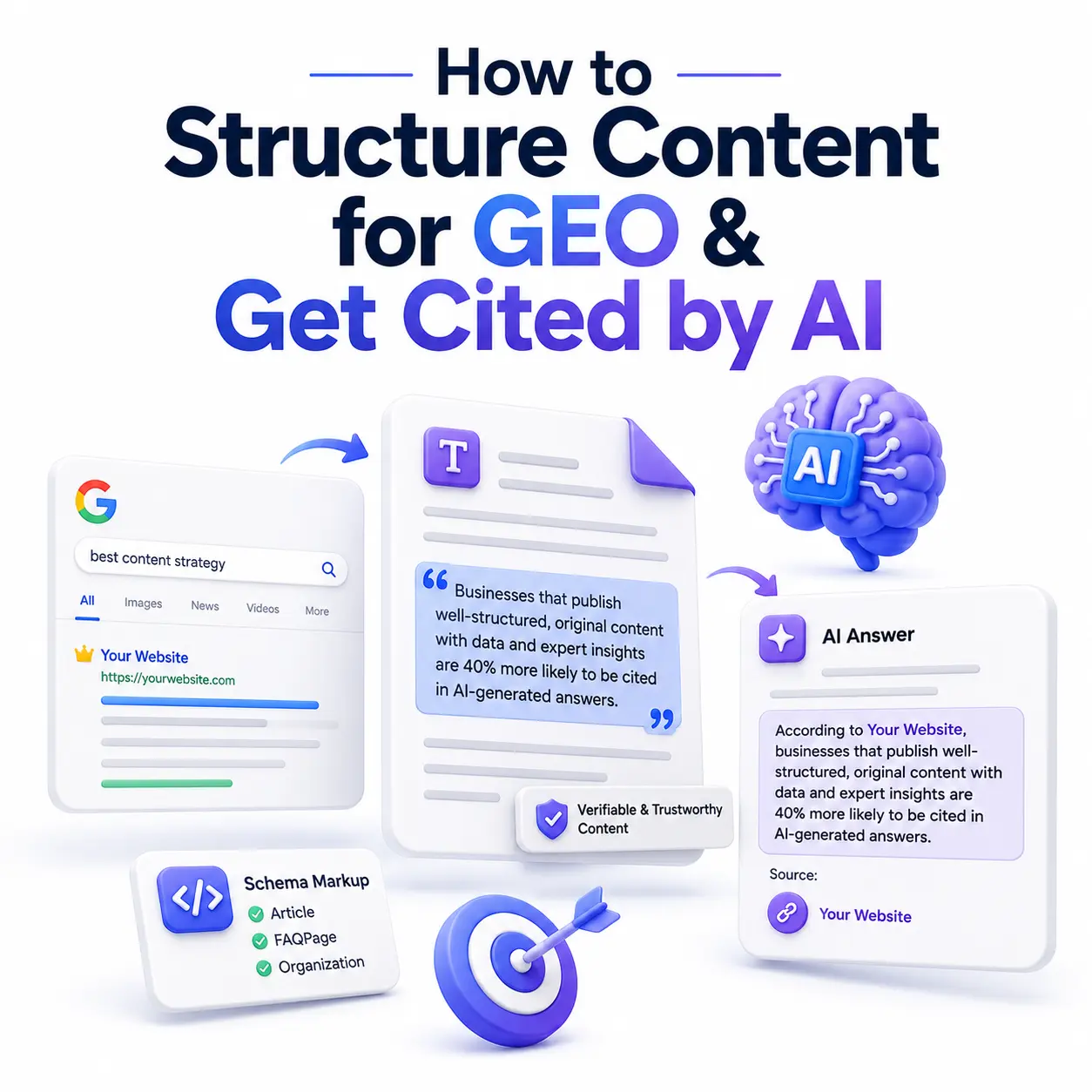
What “Getting Cited by AI” Actually Means Now
When someone searches on Google, they get a ranked list of links and decide for themselves which one to trust. When someone asks ChatGPT, Perplexity, or Gemini a question, they get one synthesized answer, built from a handful of sources the model has already decided to trust on their behalf. That shift changes what “winning” a search means. Ranking first no longer guarantees a visit; being cited inside the answer does
This is the core distinction between SEO and Generative engine optimization (GEO). SEO competes for a ranked position on a results page. GEO competes for a citation inside a generated answer a fundamentally different selection process, governed by different signals, and won or lost at a different unit of content: the passage, not the page.
Why AI Citation Is a Different Game Than Ranking #1
A page can rank on page one and still never be cited, because ranking reflects overall relevance to a query while citation reflects whether a specific passage on that page was clear and verifiable enough for a model to lift and attribute. The practical implication is that structure, not just topical authority, now does real competitive work. Two pages with similar authority and similar rankings can produce very different citation rates purely because of how their content is organized at the sentence and section level.
How AI Models Select and Cite Sources
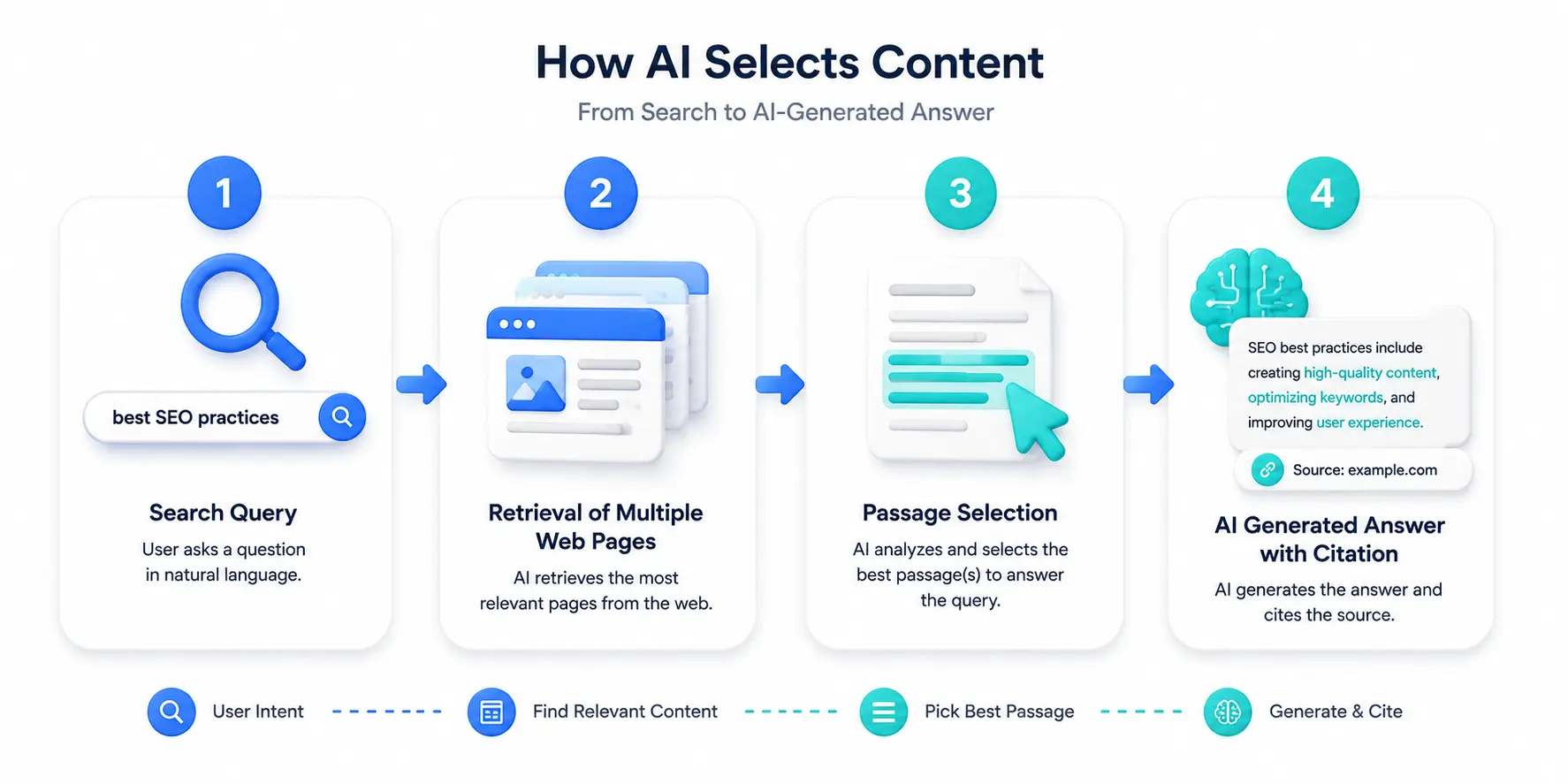
Generative answer engines work in two stages: retrieval, where the system pulls a set of candidate passages relevant to the query, and selection, where it decides which of those candidates to quote, paraphrase, or attribute in the final answer. Most GEO effort should go toward winning the second stage, since retrieval alone doesn’t guarantee inclusion in the answer.
The Passage Is the Unit of Selection, Not the Page
Research from Sprinklr’s competitive GEO study built a controlled testbed that injected exactly two candidate sources into a model’s context and measured, across six large language models and hundreds of thousands of trials, which source got cited first. The framing of that research is instructive on its own: the experiment wasn’t about which domain ranked higher; it was about which specific passage a model chose to reference when given a direct, head-to-head choice. That’s the level content needs to be optimized at.
What Signals Models Weigh Most
Across the current body of GEO research, a consistent pattern emerges. Content that includes specific, sourced statistics, direct quotes attributed to credentialed individuals, and clean, unambiguous sentence structure gets selected more often than content that is vague, keyword-dense, or difficult to parse into a standalone claim. Authority still matters, but on-page clarity and verifiability can meaningfully offset a thinner backlink profile, which is part of why smaller, well-structured sites can now compete for citations against much larger domains.
| Dimension | Traditional SEO | GEO (AI citation optimization) |
| Unit of selection | The page / URL | The passage or sentence |
| Success metric | Ranking position, click-through | Citation/inclusion in the generated answer |
| Primary signal | Backlinks, keyword relevance | Extractability, verifiability, clarity |
| Content shape | Optimized for skimming and scroll depth | Optimized for standalone, quotable passages |
The Structural Framework: Six Elements That Make Content Citable
The tactics below aren’t abstract advice; this article is built using each one of them, so you’re reading a working example rather than only a description of the approach.
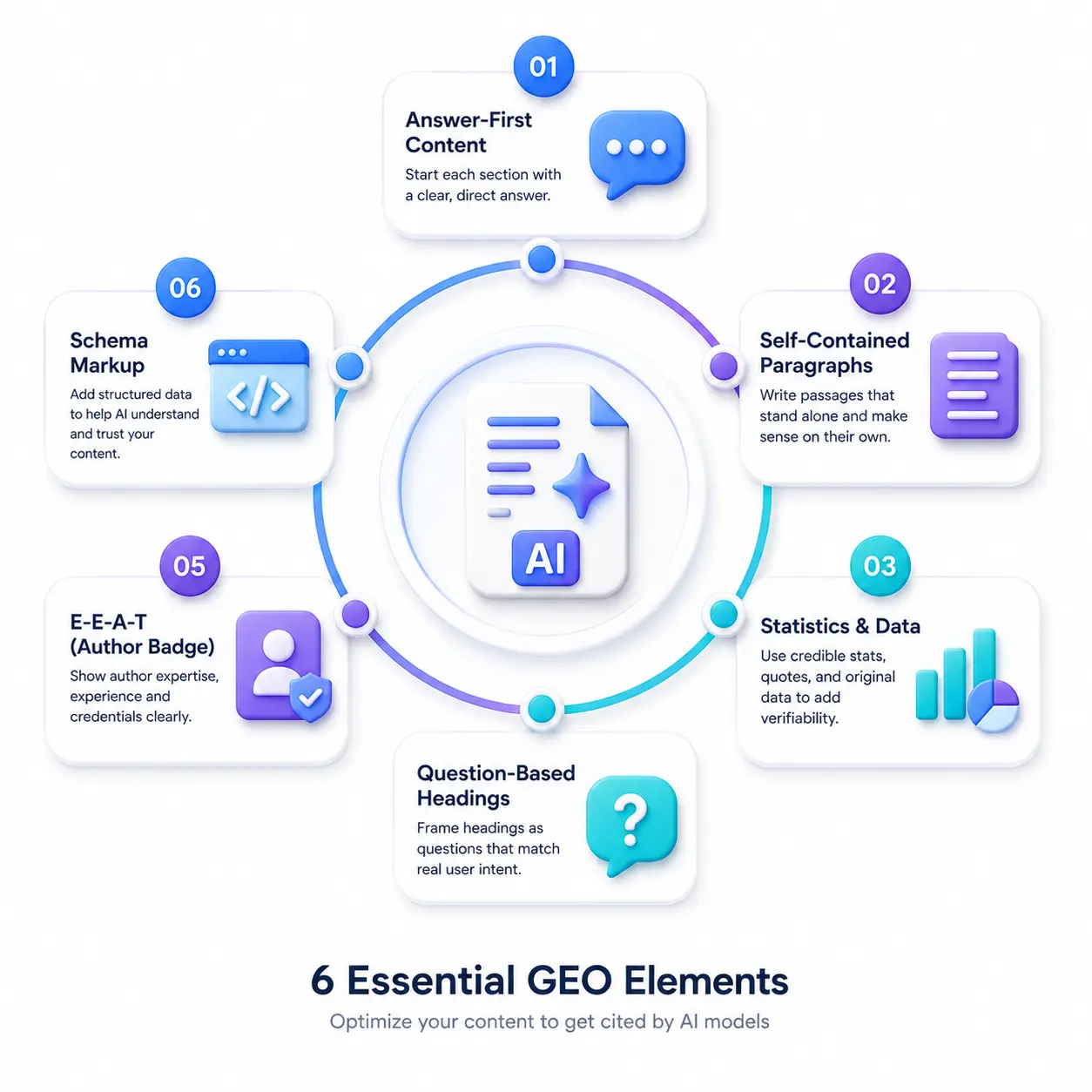
1. Answer-First Formatting
Open each section with the direct answer to the question implied by its heading, in the first one or two sentences, before adding context or nuance. Models extract far more reliably from a paragraph that states its conclusion up front than from one that builds toward it. This also happens to be the same pattern that wins featured snippets, which is not a coincidence; both systems are optimizing for the same thing: a self-contained, quotable answer.
2. Self-Contained, Extractable Passages
Each paragraph should be able to stand on its own if lifted out of the page entirely, with the subject restated rather than referred to only by a pronoun, and without depending on the sentence before it for meaning. Passages that require surrounding context to make sense are structurally harder for a model to safely quote, because doing so risks misrepresenting the source.
3. Statistics, Quotes, and Original Data
The 2024 GEO benchmark study from Aggarwal and colleagues, presented at KDD, found that adding citations, quotations, and statistics lifted a source’s visibility in generative answers by roughly 40 percent across the queries tested, while keyword stuffing performed below an unmodified baseline. Concrete, sourced numbers and named, credentialed quotes are treated as strong verifiability signals; generic claims like “studies show” carry almost none of that weight.
4. Clear Heading Hierarchy That Maps to Sub-Questions
Structure H2 and H3 headings as the actual questions a reader or a model parsing the page would ask, rather than as generic section labels. A heading phrased as a real question (“How do AI models select sources?”) is easier for a retrieval system to match against a user’s query than a heading phrased as a topic (“Selection Mechanics”). This also naturally produces the question-and-answer pairing that generative systems are already primed to extract
5. Author Credentials and E-E-A-T Signals
Generative systems appear to scan for trust indicators bylines, professional titles, relevant credentials early in a piece, often within roughly the first 200 words, to help assess how much weight to give the content. A visible author identity with a clear basis for expertise functions as a citation signal in its own right, independent of the quality of the writing itself.
6. Structured Data and Schema Markup
FAQ schema, Article schema, and Organization/Person schema give machines an explicit, unambiguous map of your content’s structure rather than forcing them to infer it from formatting alone. This doesn’t guarantee a citation, but it removes friction from the extraction process and reduces the chance that a well-written passage gets skipped simply because its structure wasn’t machine-legible.
Formatting Patterns That Increase Extractability
Beyond the six structural elements above, certain formatting patterns consistently correlate with higher citation rates because they package information in a shape generative systems are already optimized to lift.
Tables and Comparison Formats
Tables compress multi-dimensional comparisons into a format that’s trivial for a model to parse and reproduce accurately, which is why comparison-style queries so often pull from tabular content. Where a topic naturally involves comparing options, dimensions, or trade-offs, a table will usually outperform the equivalent information in prose.
TL;DR and Summary Blocks
A summary block near the top of a page three or four sentences capturing the core takeaway gives a model a low-risk, pre-condensed passage to cite even if it doesn’t process the full article. It also serves human skimmers, which is a rare case where the same structural choice benefits both audiences equally.
FAQ Sections Mapped to Real Queries
A well-built FAQ section is close to ideal GEO content by construction: each question-and-answer pair is already isolated, self-contained, and phrased as a real query, and FAQ schema makes that structure explicit to crawlers. Build FAQ questions from actual search queries and People Also Ask data rather than inventing generic ones, since the goal is to match real retrieval patterns, not just to fill out a section.
What to Avoid: Structural Mistakes That Suppress Citations
- Keyword stuffing — controlled tests on Perplexity found keyword-stuffed content underperformed an unoptimized baseline by roughly 10 percent, since density without clarity reads as lower quality, not higher relevance.
- Burying the answer — if a section’s real answer only appears in the third or fourth sentence, most extraction passes will miss it or lift the wrong sentence.
- Thin or stale content — citation rates for a given page tend to drop off sharply once it passes roughly three months without a meaningful update, since generative systems show a strong recency bias.
- Vague, unsourced claims — phrases like “experts agree” or “studies show” without a specific source or number carry little to no verifiability signal and are easy for a model to skip in favor of a more specific competing passage.
- No measurement — treating GEO as a one-time formatting pass rather than an ongoing practice with feedback means structural mistakes go uncorrected indefinitely.
How to Measure Whether It’s Working
GEO measurement is younger and less standardized than traditional rank tracking, but three approaches are already practical today.
- Direct prompting audits — regularly ask the target AI platforms your core topic questions and log whether, and how, your brand or content is cited in the response.
- Brand and content mention tracking — monitor mentions of your brand and content across the wider web, including forums and community platforms, since generative systems draw on signals from across the web, not just your own site.
- Referral traffic segmentation — segment analytics for traffic arriving from AI platforms specifically, since it behaves differently from traditional organic traffic and often converts at a different rate.
Whichever methods you use, treat GEO as an ongoing discipline rather than a one-time audit. The models, their retrieval mechanics, and their citation behavior are all still changing quickly, and structural choices that work today will need to be re-validated as these systems evolve.
FAQ
What is Generative Engine Optimization (GEO)?
GEO is the practice of structuring content so AI systems like ChatGPT, Perplexity, Gemini, and Google AI Overviews cite it directly in generated answers. Unlike traditional SEO, which targets ranking position, GEO targets citation selection — whether a model chooses your passage as source material for its response.
How do AI models decide which sources to cite?
Models retrieve multiple candidate passages, then select the ones that are clearest, most verifiable, and easiest to extract cleanly. Signals like specific statistics, direct quotes from credentialed sources, and unambiguous sentence structure increase the odds a passage gets cited over a competing one.
Does traditional SEO still matter for AI citations?
Yes, but it’s not sufficient alone. Crawlability, indexing, and topical authority still matter, but overlap between top Google rankings and AI-cited sources has narrowed sharply. Winning citations increasingly requires passage-level clarity and extractability on top of standard technical SEO.
Do FAQ sections actually improve AI citation rates?
Yes. FAQ formatting isolates each question and answer as a self-contained, extractable unit, which matches how models parse and quote content. Pairing this with FAQ schema markup makes the question-answer structure explicit to both crawlers and generative systems.
If you want to master these modern SEO techniques along with Google Ads, social media marketing, AI-powered marketing, and practical digital marketing skills, enrolling in a digital marketing course in Thrissur is a smart investment.


