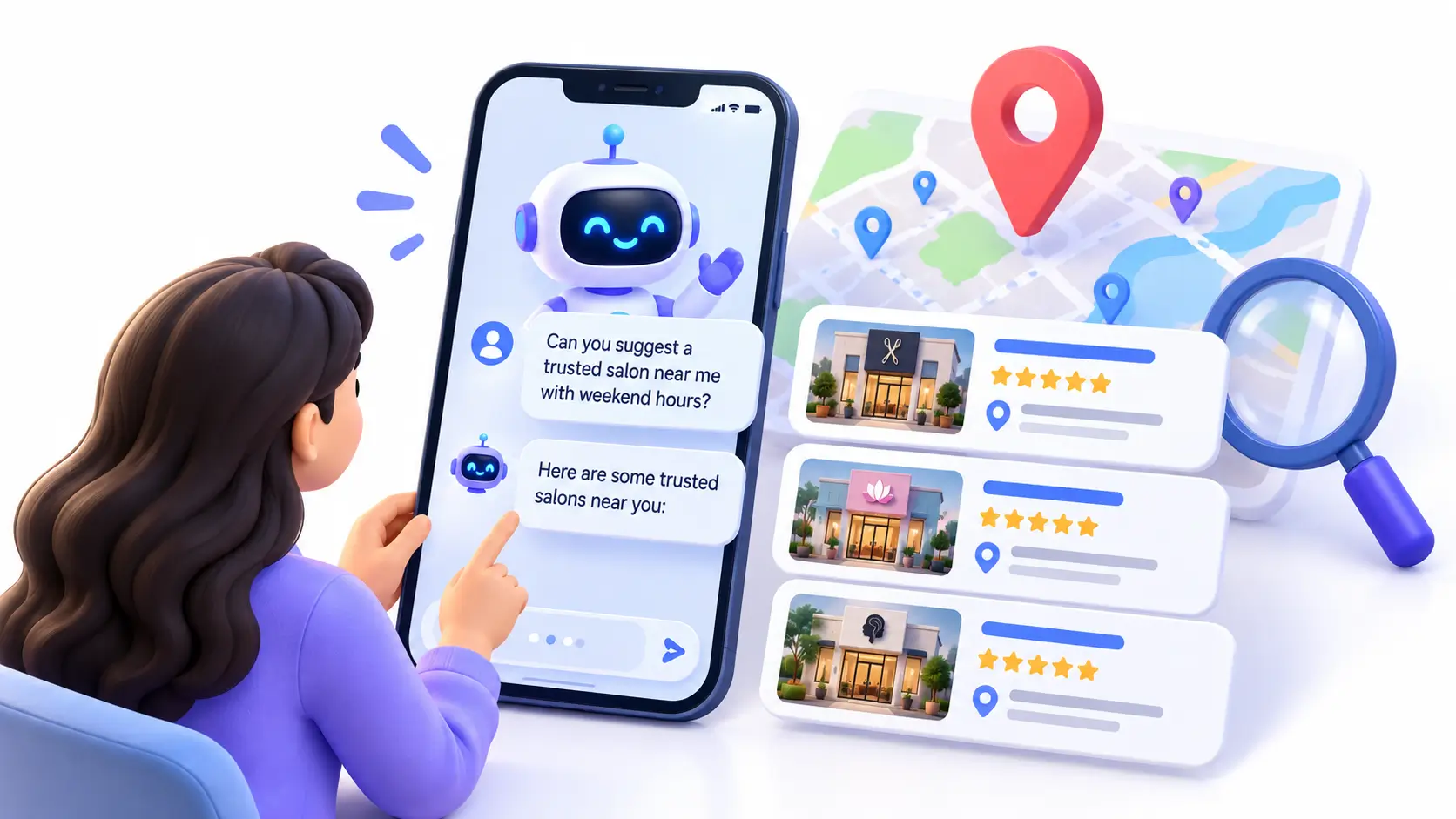
Picture a customer in Thrissur asking an AI assistant for a trustworthy family dentist near Swaraj Round with weekend hours. Instead of ten blue links, they receive three names. If your clinic isn’t one of them, you were never in the running.
This is no longer a fringe habit. BrightLocal’s 2026 research found that 45% of consumers used AI tools for local business recommendations in the past year, up from just 6% twelve months earlier. This guide explains AI search visibility for local businesses and gives you a practical plan you can start this week.
How AI Search Is Changing Local Discovery
Local discovery used to be a ranking contest. You fought for a spot in the map pack and hoped searchers clicked. AI assistants work differently: they compose an answer and name a handful of businesses inside it. Visibility now has three parts: presence (are you mentioned?), accuracy (are you described correctly?) and position (are you named first?).
Where local customers meet AI
Shoppers now meet AI answers in ChatGPT, Gemini, Copilot, Google AI Overviews and AI Mode. In BrightLocal’s July 2026 survey, 23% of consumers used an AI tool during their most recent local search, and 31% use one for local recommendations at least monthly. Google is still where most searches begin, so AI adds a layer on top of the old journey instead of erasing it.
How do AI tools decide which local businesses to recommend?
AI tools recommend local businesses they can verify. They compare your Google Business Profile, directory listings, reviews, website content and mentions on other trusted sites. When these sources agree and stay fresh, AI can describe you confidently. When they conflict or are missing, competitors with cleaner signals get named instead.
Think of it as corroboration. One claim on your own website is easy to ignore. The same claim repeated across your profile, your reviews and a local news article is hard to ignore.
GEO, AEO and local SEO: what’s the difference?

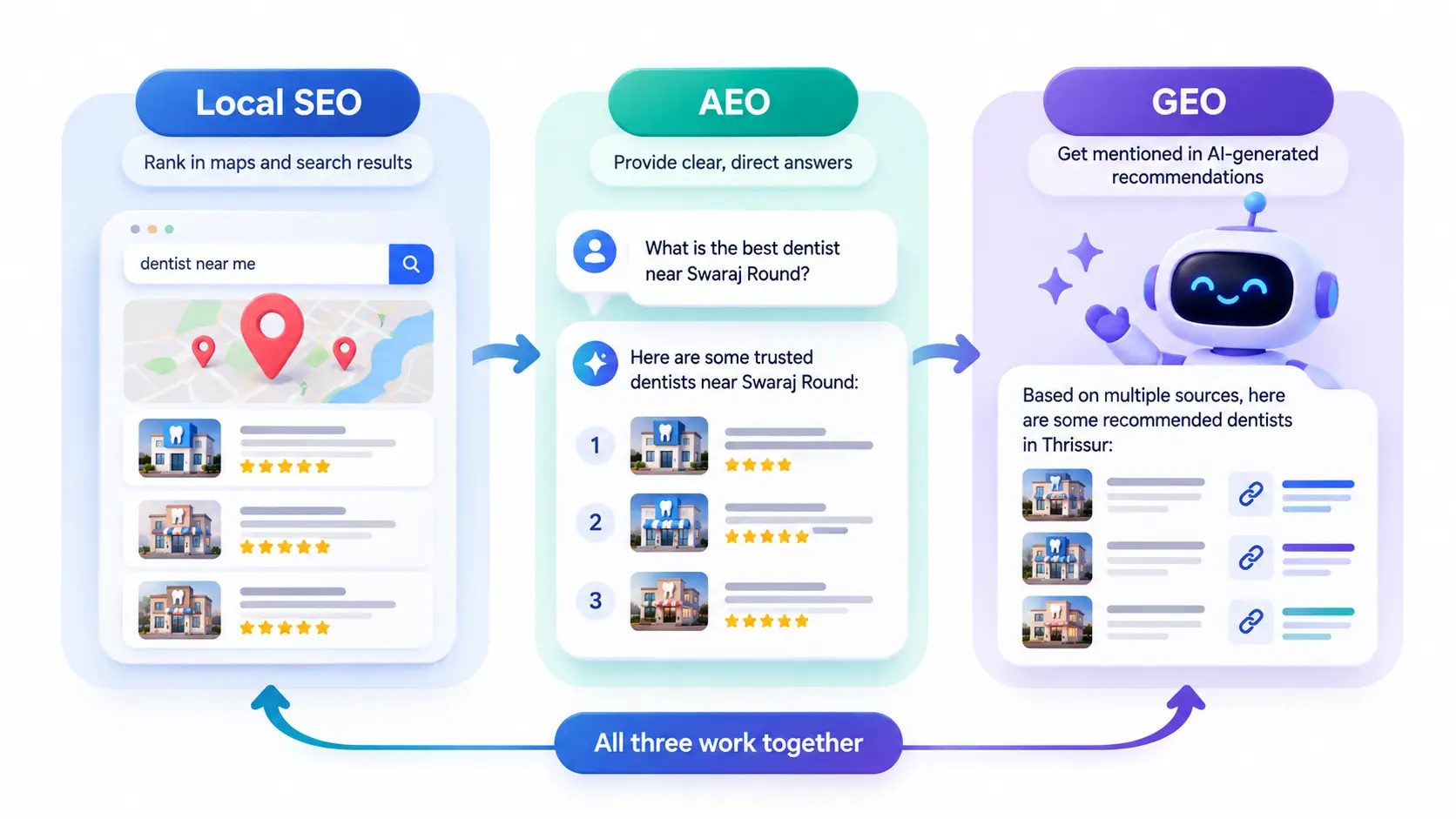
Local SEO earns rankings in maps and organic results. Answer engine optimization (AEO) structures content so assistants can lift clear, direct answers. Generative engine optimization (GEO) is the wider effort to be cited or mentioned inside generated responses. For a small business they overlap heavily: accurate profiles, honest reviews and genuinely helpful pages serve all three.
Lock In the Foundation: Profiles, Listings and Consistency
Before chasing anything new, fix the data layer that AI tools cross-check.
Is Google Business Profile still important with AI search?
Yes, and arguably more than before. BrightLocal’s July 2026 data shows that around three in four consumers who used AI to find a local business still checked Google or Maps before contacting it. Treat your profile as the page customers land on after AI introduces you. Complete every field: primary and secondary categories, services, opening hours (including festival and holiday changes), service areas, fresh photos and regular posts. If you want a deeper walkthrough, read our Google Business Profile optimization guide.
NAP consistency and niche directory listings
Your business name, address and phone number (NAP) should match everywhere. If you present your name in both Malayalam and English, pick one primary format and repeat it exactly across every listing. Then go beyond the big aggregators. In Whitespark’s 2026 expert survey, three of the top five AI visibility factors relate to citations, such as appearing on respected industry directories and in best-of lists. Remember that this is expert opinion rather than measured proof, so use it as a priority guide, not a promise.
Technical prerequisite: make sure your site can be found
None of the content tactics below work if your pages can’t be crawled. Google states that a page must be indexed and eligible to show with a snippet before it can appear as a supporting link in AI Overviews or AI Mode. Verify your site in Search Console, confirm key pages are indexed, and check you aren’t blocking search crawlers by accident.
Make Reviews Your Verification Layer
AI may introduce you, but reviews help customers decide. According to BrightLocal’s 2026 Local Consumer Review Survey, 97% of people who use AI for recommendations at least sometimes cross-check those suggestions against real reviews.
Do Google reviews affect AI recommendations?
Reviews feed the signals AI tools read, including review text and summaries, and they strongly shape what happens after a recommendation. Nobody outside the platforms can promise exactly how much weight a review carries, so focus on what you control: recency, detail and honest responses.
A simple system for earning fresh, detailed reviews
- Ask right after a successful visit or service, while the experience is fresh.
- Share a short link or QR code on the invoice, the counter and WhatsApp follow-ups.
- Invite customers to mention the service and the area, such as “fitted a water purifier in Ayyanthole,” because specific language helps AI summaries.
- Never offer incentives or filter who you ask. It breaks platform rules and erodes trust.
Respond to every review
Reply to praise and complaints alike, using natural wording that names the service. A calm, specific reply to a negative review often persuades more readers than a dozen five-star ratings.
Build Website Content AI Can Quote
AI tools quote pages that state facts plainly. Vague marketing copy gives them nothing to lift.
Service-and-location pages
Create one page per core service, and say who you serve and where. A Thrissur interior designer might publish separate pages for modular kitchens, wardrobes and full-home projects, each naming neighbourhoods served, price ranges, timelines and a few real project examples. Include your NAP, opening hours and a map embed.
Answer-first formatting and on-page FAQs
Open each section with a direct answer of about 40 to 60 words, then add detail. Add an FAQ block that answers the questions customers genuinely ask on the phone. This style helps AI assistants extract a clean answer, and it helps human visitors too. If you are building these skills for yourself or your team, structured local SEO training in Thrissur can shorten the learning curve.
Does schema markup help local businesses appear in AI Overviews?
Not directly. Google’s guidance says no special structured data is needed for AI features. LocalBusiness schema is still worth adding because it clarifies your name, address, hours and services for search engines. Treat it as a clarity measure, not a shortcut.
Earn Mentions on Sources AI Trusts
What others say about you carries more weight than what you say about yourself.
Best-of lists, local press and associations
Pitch local news sites and bloggers who publish “best in Thrissur” roundups. Join trade associations and chambers of commerce that list members online. Sponsor a local event, then make sure the organizer’s page links to you and spells your details correctly. A handful of accurate mentions on credible sites beats hundreds of low-quality listings.
Community presence
Answer questions in local Facebook groups, community forums and Q&A threads without pushing sales. Genuine, helpful participation creates the kind of real-world discussion that AI tools can find.
How do I get my local business to show up in ChatGPT?
There is no switch to flip. Make your information consistent, collect recent reviews, publish clear pages and earn third-party mentions. Do that steadily and the chance of being named rises.
Measure and Monitor Your AI Visibility
How can I check whether AI mentions my business?
Run a manual prompt audit. Write ten prompts customers might type, such as “best [service] in Thrissur,” “[service] open on Sunday near [landmark]” or “affordable [service] with good reviews.” Ask each in ChatGPT, Google AI Mode and Gemini. Score every answer from 0 to 3 for presence, accuracy and sources cited, then repeat monthly because answers change.
What to track
Track your mention rate (how many prompts name you), accuracy (correct hours, address and services), the sources cited and which competitors appear beside you. Google notes that traffic from AI features is included in your overall Search Console reporting, so keep an eye there too. Dedicated tracking tools exist if you manage many locations, but a spreadsheet is enough to start.
A 90-Day Action Plan
| Month | Focus | Key actions |
| 1 | Foundation | Run your baseline prompt audit, complete your Google Business Profile, fix NAP inconsistencies, confirm key pages are indexed |
| 2 | Reviews and content | Launch a review-request routine, reply to all reviews, publish service-and-location pages with FAQs, add LocalBusiness schema |
| 3 | Mentions and measurement | Earn local press and directory mentions, repeat the audit, compare results with your baseline |
How long does it take to improve AI search visibility?
Expect gradual gains. Corrections to listings and profiles can show effects within weeks, while reviews, content and third-party mentions usually take three to six months to compound. That timeline is a practical estimate, not a guarantee.
Frequently Asked Questions
How do I get my local business to show up in ChatGPT?
Make your business easy for AI to verify. Keep your Google Business Profile and directory listings consistent, collect recent reviews, publish clear service and location pages, and earn mentions on trusted local sites. ChatGPT and similar tools draw on web sources, so the more consistent, credible signals exist about you, the likelier a mention becomes.
Does local SEO help with AI search visibility?
Yes, largely. Strong local SEO fundamentals, such as an optimized Google Business Profile, consistent citations, and genuine reviews, also feed AI answers. But the weighting differs: on-page content and third-party citations matter more for AI visibility than they do for the local map pack, so local SEO alone isn’t enough.
Do Google reviews affect whether AI recommends my business?
Reviews influence AI recommendations and the decisions that follow them. AI tools use review content and summaries as trust signals, and shoppers verify AI suggestions against reviews before choosing. Aim for steady, recent, detailed reviews with owner responses rather than a one-time burst. No one can guarantee a specific outcome, though.
Does schema markup help local businesses appear in AI Overviews?
Not directly. Google’s documentation says no special schema or AI-specific file is required to appear in AI Overviews. Still, LocalBusiness schema helps search engines understand your name, address, services, and hours, which supports accuracy. Treat it as a clarity measure, not a ranking lever for AI answers.
How can I check if AI tools mention my business?
Run a manual prompt audit. Ask ChatGPT, Google AI Mode, and Gemini the questions customers would ask, such as “best plumber in [city],” then record whether you appear, how you’re described, and which sources are cited. Repeat monthly, since answers vary, or use a dedicated tracking tool.
How long does it take to improve AI search visibility?
Expect gradual gains, not overnight results. Fixing listings and profile accuracy can show effects within weeks, while building reviews, content, and third-party mentions typically takes three to six months. AI answers vary by platform and query, so no one can promise a timeline. Track progress monthly against a baseline.
Conclusion
AI builds the shortlist, and your profile, reviews and web presence win the click. Start with the foundation, earn trust through reviews and credible mentions, and measure monthly. Want to master these skills with hands-on guidance? Explore our digital marketing course in Thrissur and learn to put local businesses in front of AI-powered customers.


