
For two years, schema markup sat at the top of nearly every “how to get cited by AI” checklist. Add the JSON-LD, mark up your FAQs, watch the citations roll in. It became the reflex answer to a hard question, and an entire cottage industry of plugins and audits grew up around it.
Then, in a single week of May 2026, two things happened. Google deprecated FAQ rich results entirely. And Ahrefs published a study that tracked what actually happens when you add schema to a page with a conclusion that landed like a bucket of cold water.
So it’s worth asking the question plainly, and answering it with data instead of vibes does schema markup actually get you cited by AI? The honest answer is more interesting than either camp shouting about it will tell you.
The short answer
Adding schema to a page that AI systems already see does not produce a measurable lift in citations. The 2026 evidence is fairly clear on that narrow point. But that’s not the same as “schema is useless,” and the difference matters enormously for how you spend your time.
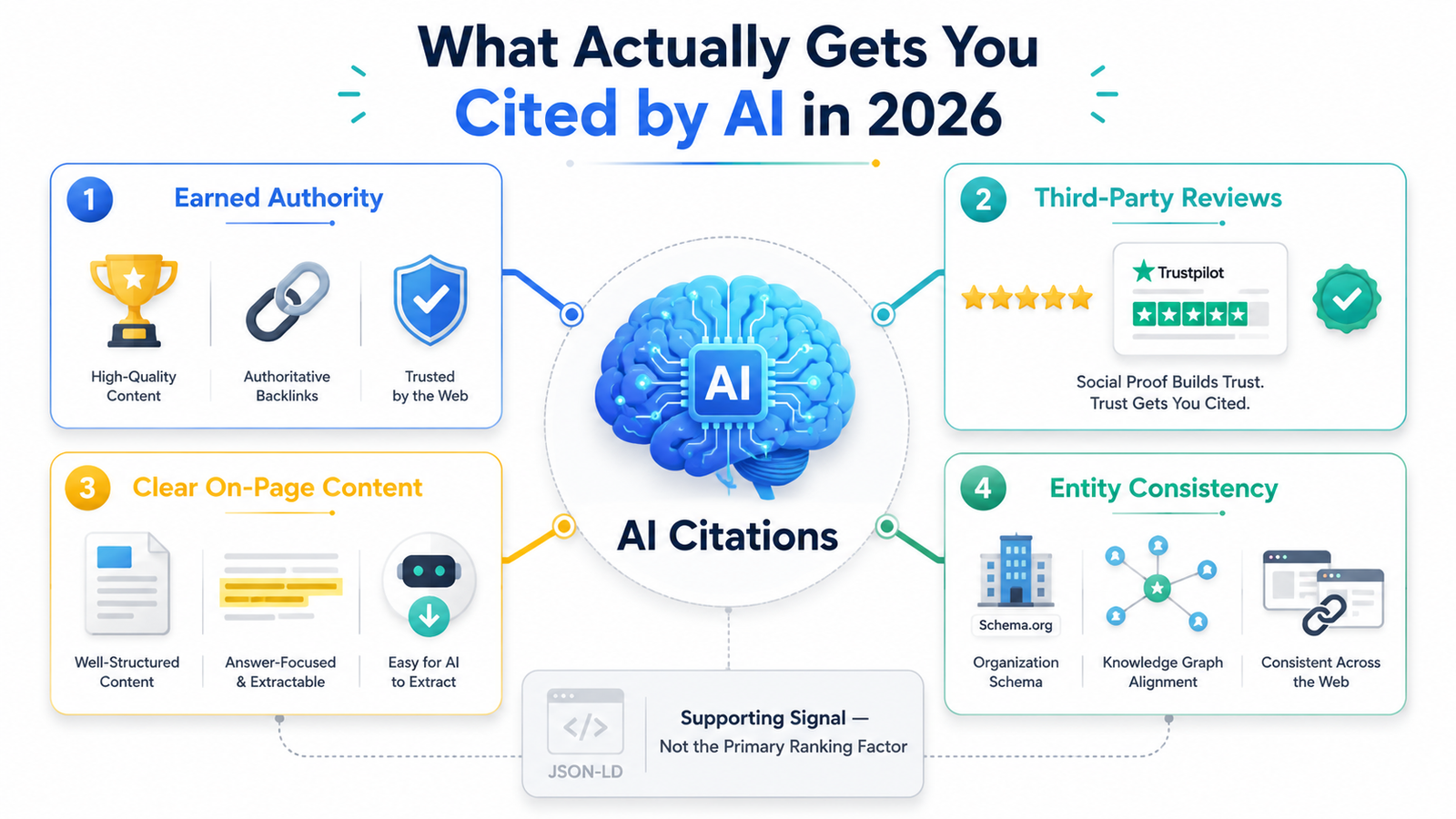
The real citation levers in 2026 are earned authority, third-party trust signals, and clear on-page text that an engine can lift a clean answer from. Schema still does a quieter, more specific job helping machines resolve who you are and what a page is about and one particular kind of schema is a genuine exception worth keeping.
Here’s how the data gets you to that conclusion.
What schema was supposed to do and why everyone believed it
The pitch was intuitive. Structured data is a translation layer. Instead of forcing an AI model to parse your page and guess what it means, you hand it explicit, machine-readable labels: this is a product, this is its price, this is the author, this is a question and here’s the answer. Cleaner signals in, better understanding out, more citations.
And there was a stat that seemed to prove it. Ahrefs’ analysis of roughly six million URLs found that pages cited by AI were almost three times more likely to carry JSON-LD than pages that weren’t cited. Around 53% of AI-cited pages had schema, versus about 18% of the rest. That 3x figure got repeated everywhere as evidence that schema drives AI visibility.
The problem is that “cited pages have more schema” and “schema causes citations” are two very different claims. One is a correlation you can measure in an afternoon. The other requires actually testing what happens when you add the markup. In 2026, people finally ran that test.
What the 2026 studies actually found
The Ahrefs difference-in-differences study
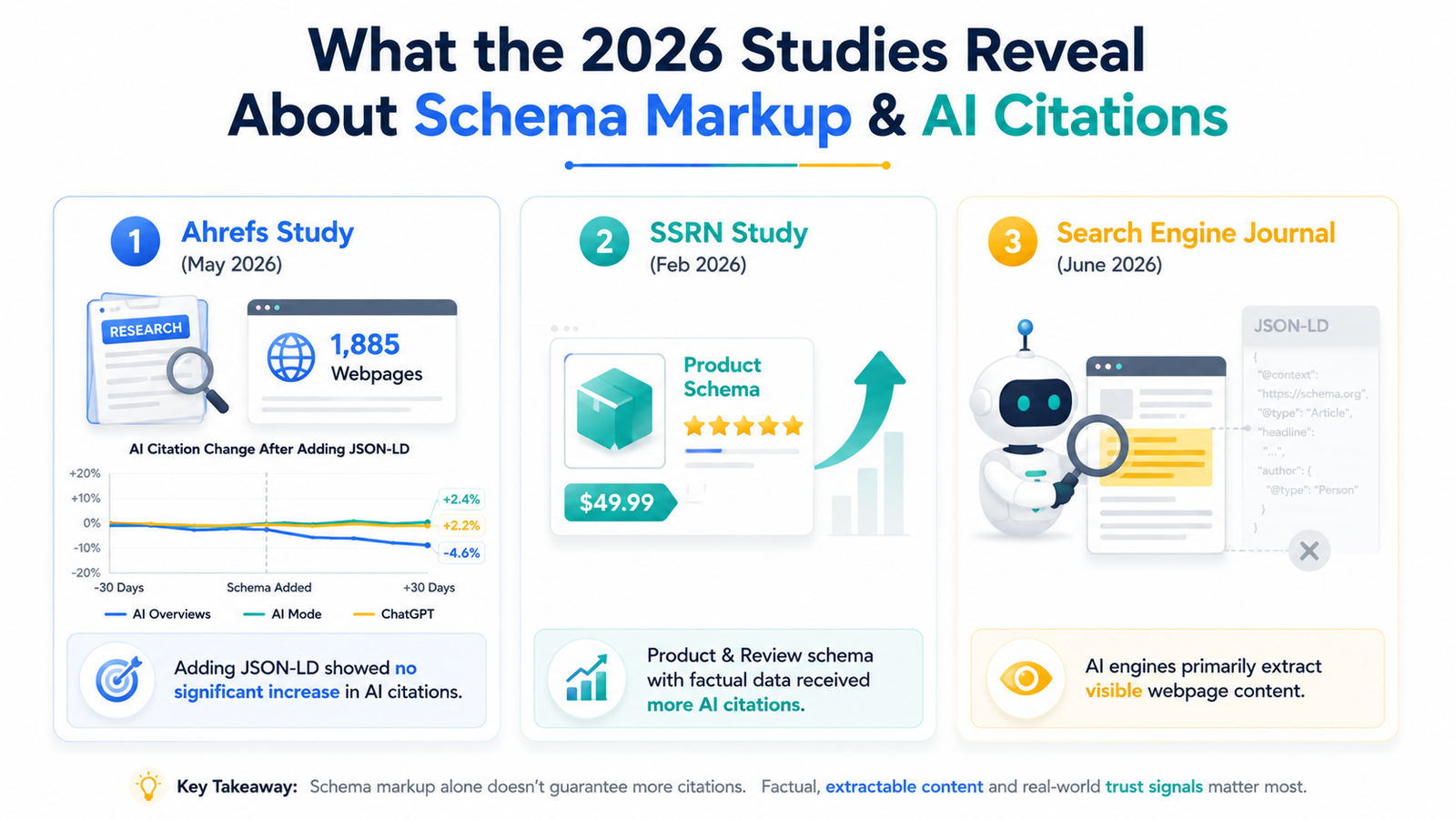
On May 11, 2026, Ahrefs researchers Louise Linehan and Xibeijia Guan published “We Tracked 1,885 Pages Adding Schema. AI Citations Barely Moved.” This was the causal test the industry had been missing.
They identified 1,885 pages that added JSON-LD between August 2025 and March 2026, matched each against control pages with similar citation levels that never added schema, and measured citation changes across Google AI Overviews, AI Mode, and ChatGPT for 30 days before and after. That matched, before-and-after design is specifically built to isolate what the schema itself did.
The result: essentially nothing. AI Mode moved about +2.4% and ChatGPT about +2.2% both close enough to zero that they’re statistical noise across thousands of URLs. AI Overviews actually dropped around 4.6%, a small but real decline the authors were careful not to over-attribute to schema. No platform showed the lift the correlation had promised.
Which schema types get cited the exception in the data
Not every 2026 study pointed the same direction, and the nuance is the whole story. A cross-platform empirical study published on SSRN in February 2026 looked at which kinds of schema correlated with citations, and found a sharp split.
Pages using Product or Review schema populated with concrete, extractable facts pricing, aggregate ratings, specifications were cited at 61.7% versus 41.6% for pages using generic types like Article, Organization, or BreadcrumbList. That gap was statistically significant. The lift, in other words, wasn’t in having schema. It was in schema that carried real, quotable data an engine could pull an answer from.
Do engines even read your JSON-LD?
There’s a third piece that reframes everything. Live testing published in Search Engine Journal in June 2026 found that when an answer engine fetches a page in real time, it routinely ignores the JSON-LD altogether and extracts meaning from the visible HTML text instead. The markup is sitting right there in the source, and the machine reads straight past it to the words a human would actually see.
That fits the mechanics. Citation decisions happen at the passage level can the engine pull a clean, standalone answer out of what’s on the page? Schema answers a different question, what is this page about?, which the major engines already resolve through their own classification systems and knowledge graphs. The markup and the citation are solving two different problems.
The correlation trap most articles miss
So why do schema-heavy pages get cited three times more often, if adding schema does nothing?
Because schema doesn’t live at random. It lives on better-maintained, more technically sophisticated sites the kind of sites that also publish stronger content, earn more links, build more authority, and rank well in ordinary search. The schema is a symptom of a quality operation, not the cause of its visibility.
Ahrefs put this plainly in their own write-up: the correlation reflects overall site quality, not schema’s direct impact. Confusing the two is the single most common mistake in this entire conversation. When you see “AI-cited pages are 3x more likely to have schema,” the correct read isn’t “add schema to get cited.” It’s “the sites winning at AI citations happen to do a lot of things well, and schema is one of them.”
It’s worth being fair to the other side, though. The Ahrefs study only measured pages that were already heavily cited every page in the set had 100+ AI Overview citations before any schema was added. It can’t tell you whether schema helps a brand-new, invisible page get crawled, parsed, and pulled into the candidate pool in the first place. Its 30-day window may also be too short to catch an effect that builds over months. “Schema does nothing” over-reads what the study proved. The defensible claim is narrower adding schema to a page AI already sees doesn’t reliably increase how often it gets cited.
When schema genuinely earns its keep
Given all that, schema isn’t dead it’s just doing a different job than the pitch promised. Three cases where it still pays off:
- Attribute-rich Product and Review schema. This is the real exception. If your page has concrete facts prices, ratings, specs marking them up gives engines clean, quotable data, and the 61.7% figure suggests that actually correlates with getting cited. This is the schema most worth your time.
- Lower-authority and newer pages. If you’re not yet in the citation pool at all, schema may help you get crawled, parsed, and correctly classified the entry ticket, not the win. The big study couldn’t measure this group, so this is the honest “maybe, and probably worth it” bucket.
- Entity disambiguation. Organization schema with sameAs links to your LinkedIn, Crunchbase, or Wikipedia helps AI systems resolve who you are and connect your brand to the same identity across the web. That consistency feeds the knowledge graphs engines lean on when deciding whether you’re a trustworthy source.
Notice what unites all three: schema helps machines understand and classify you. It doesn’t, on its own, convince them you’re worth recommending.
What actually gets you cited in 2026
If markup is the wrong lever, what’s the right one?
- Earned authority and third-party trust. The most striking 2026 data point comes from a Trustpilot analysis of more than 800,000 AI responses across ChatGPT, Gemini, Perplexity, and Google AI Mode. Brands with no active review profile were cited in about 1% of answers. Brands that actively collected and responded to reviews were cited in roughly 75% a 75x gap. Review and trust sites accounted for around 14% of all citations in that sample. No amount of JSON-LD moves a number like that; independent verification does.
- Extractable on-page answers. Since engines read visible text during live retrieval, write for the pull. Question-form headings. The answer in the first two sentences of the section, not buried at the end. Named entities spelled out — the actual brand or product name, not “it” or “the platform.” You’re making it trivial for a model to lift a clean, standalone passage.
- A consistent narrative across independent sources. AI engines favor a coherent story about who you’re for, what you fix, and why you’re different — echoed the same way across sources they trust, not just asserted on your own site. The lever is a clear story a machine can quote and verify, told consistently everywhere it looks.
So should you still implement schema?
Yes, but reprioritize, and stop treating it as your AI-visibility strategy.
- Keep doing: Product and Review schema with real, populated data. Organization schema with sameAs for entity clarity. Basic structured data on new pages to help them get understood and indexed.
- Stop doing: Adding FAQ sections purely to game visibility — Google removed FAQ rich results in May 2026 and is winding down reporting for them, so keep FAQ markup only where the page genuinely serves questions readers ask. And stop expecting that bolting schema onto an already-visible page will lift your citations. It won’t, and the hours are better spent on authority and content clarity.
FAQ
Does schema markup increase AI citations?
Not on its own. A 2026 Ahrefs study of 1,885 pages that added JSON-LD found no meaningful citation increase across Google AI Overviews, AI Mode, or ChatGPT versus matched controls. Schema helps machines classify content, but classification isn’t the same as being chosen and cited.
Do ChatGPT and Perplexity actually read my JSON-LD?
Often not during live retrieval. Testing published in 2026 found that when an answer engine fetches a page in real time, it frequently ignores the JSON-LD and extracts meaning from the visible HTML text instead. Your on-page copy usually does the work, not the markup.
What type of schema actually helps AI visibility?
Attribute-rich schema with concrete facts. A 2026 cross-platform study found pages using Product or Review schema populated with real data pricing, ratings, specifications were cited notably more than pages using generic Article or Organization markup. The value is in the facts, not the label.
Is FAQ schema still worth adding in 2026?
Its search value has collapsed. Google removed FAQ rich results in May 2026 and is phasing out reporting for them. Keep FAQ markup only if the page has genuine question-and-answer content that serves readers, not as a visibility tactic.
If schema isn’t the answer, what gets me cited?
Earned authority and independent verification. A 2026 analysis of 800,000+ AI responses found brands actively managing reviews were cited vastly more often than those without. AI engines favor a consistent, verifiable story about who you are, echoed across trusted third-party sources.
The takeaway
Schema markup was never magic, and in 2026 the data finally caught up with the hype. It’s a classification and disambiguation tool useful, sometimes genuinely so, especially when it carries real product and review data. But it is not the lever that gets you cited by AI. That lever is earned trust, clear extractable content, and a consistent story the machines can verify beyond your own domain. Build those, mark up what deserves marking up, and stop paying for the plugin that promised the rest.
Want to learn how to implement these AI SEO strategies in real projects? Join a digital marketing course in Thrissur to gain hands-on experience in SEO, AI search optimization, content marketing, Google Ads, and the latest digital marketing techniques that help businesses grow online.


