Search is changing faster than it has in two decades. In early November 2026, OpenAI said that ChatGPT now handles search activity equal to a fifth of Google’s. It is a striking claim, and it has dominated SEO news feeds ever since. For marketers, though, the headline matters less than what the number measures, what it leaves out, and how you should respond. This guide explains the claim, sets it against independent data, and shows how to protect and grow your visibility across both Google and AI assistants.
What OpenAI Actually Announced
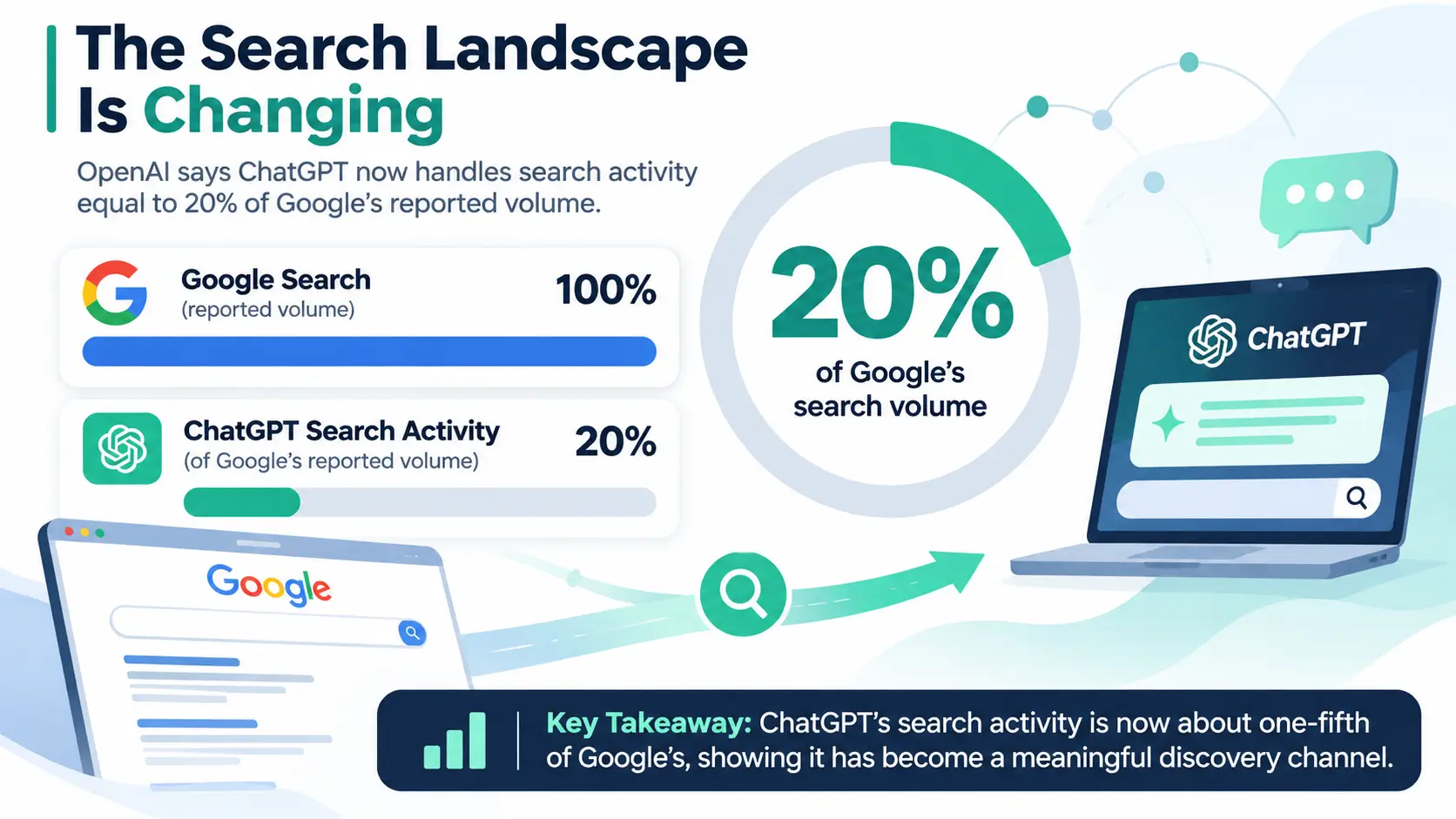
The 20% claim in plain terms
OpenAI says the volume of search queries run through ChatGPT now equals 20 percent of the volume run through Google, a claim made by consumer product lead Adam Fry at a press event. The remark spread quickly through tech and SEO publications. It signals that AI assistants are no longer a curiosity. They are a real discovery channel competing for the moment when someone has a question and needs an answer.
Growth to 1.2 billion weekly users
The claim arrives alongside fast user growth. Weekly active users for ChatGPT grew from 1 billion to 1.2 billion in two months. More users means more questions, and a growing share of those questions trigger live web lookups through ChatGPT search. Each of those lookups is a moment where a brand can be cited, summarised, or ignored.
This is why the announcement matters even if you treat the exact percentage cautiously. The direction of travel is clear: a meaningful slice of everyday information-seeking now happens inside an AI interface instead of a list of blue links.
Why the 20% Figure Needs Context
What counts as a “search”
The definition matters a great deal. The figure covers only queries that trigger a web search, not every ChatGPT prompt. If someone asks ChatGPT to draft an email, brainstorm names, or debug code, that is not counted. So the number is narrower than total ChatGPT usage, but it is also a different kind of activity from a Google query, which is why direct comparisons need care.
Missing methodology
There is also a transparency issue. The company has not disclosed how it calculated the figure or where its Google search volume data comes from, so the reported 20% should not be read as ChatGPT’s share of the search engine market. In other words, it is a self-reported ratio, not an audited market share statistic. For scale, Google has stated that it processes approximately 5 trillion searches annually.
Volume versus referral traffic
The most useful counterweight for marketers is traffic data. One independent study found that ChatGPT sessions accounted for only 0.62% of Google’s organic search sessions, though that is a different metric from the query volume OpenAI published.
Put those two numbers side by side and a pattern emerges. People may ask ChatGPT a great many questions, but far fewer of those questions currently send visitors to websites. Many users get their answer inside the chat and never click. That is the core insight many headlines skip: volume is not value. A query that never produces a visit does not pay your bills, although a citation can still build awareness and trust.
Is ChatGPT Replacing Google?
Where ChatGPT wins
ChatGPT is strong at conversational, multi-step questions. Comparing products, summarising a complex topic, planning a trip, or working through a decision are all tasks where a single synthesised answer beats ten separate links. Adoption is broad as well. In one survey, 44% of adults reported having used ChatGPT, compared with 24% for Google Gemini. That level of familiarity means AI search is no longer limited to early adopters.
Where Google still dominates
Google remains the default for local results, shopping, maps, navigation, and quick factual lookups. It is also building AI-generated answers into its own results, which you can read about in Google’s documentation on AI features in Search. That matters because it means the competition is not simply “ChatGPT versus Google.” Google is adapting too, and its scale and distribution remain enormous.
The realistic picture is not replacement but fragmentation. People pick a tool depending on the task: Google for a nearby restaurant, an AI assistant for a research question, a video platform for a how-to. Marketers who assume one winner will take all risk planning for the wrong future.
How Search Behaviour Is Changing
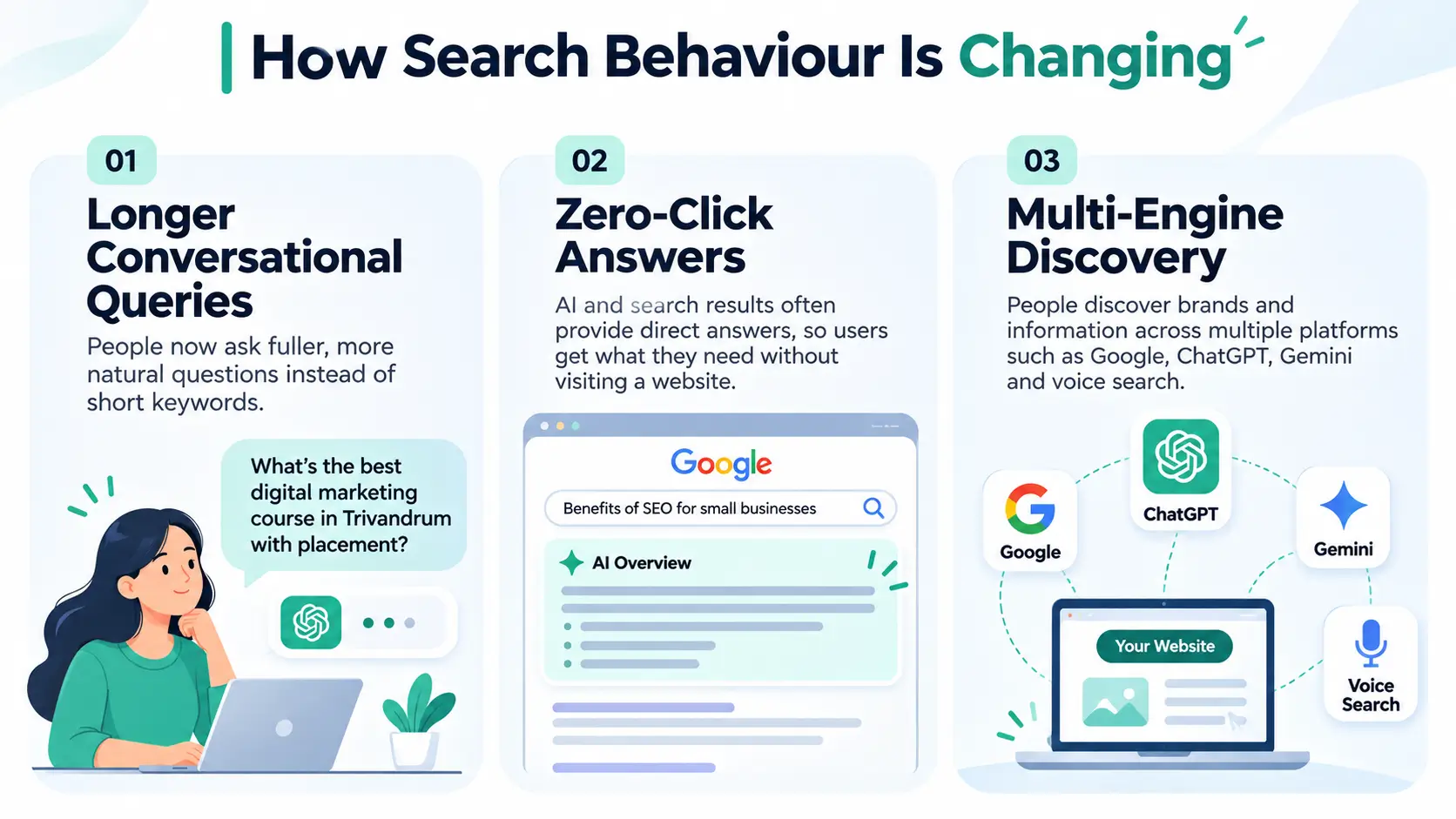
Three shifts stand out for anyone creating content:
- Longer, more conversational queries. People increasingly type or speak full questions rather than short keyword strings. Content that mirrors natural questions and answers them directly has an advantage.
- More zero-click answers. AI summaries often satisfy the user before they visit a site. Your content may influence a decision without ever earning a session.
- Multi-engine discovery. Your audience may first meet your brand in Google, ChatGPT, Gemini, or a voice assistant. Visibility is now spread across several surfaces.
None of this makes SEO obsolete. It widens the job. Classic signals such as relevance, authority, and technical quality still feed the systems that generate AI answers. What changes is the goal. Ranking is still valuable, but being cited as a trusted source has become just as important.
What Marketers Should Do Now
Optimise for both engines
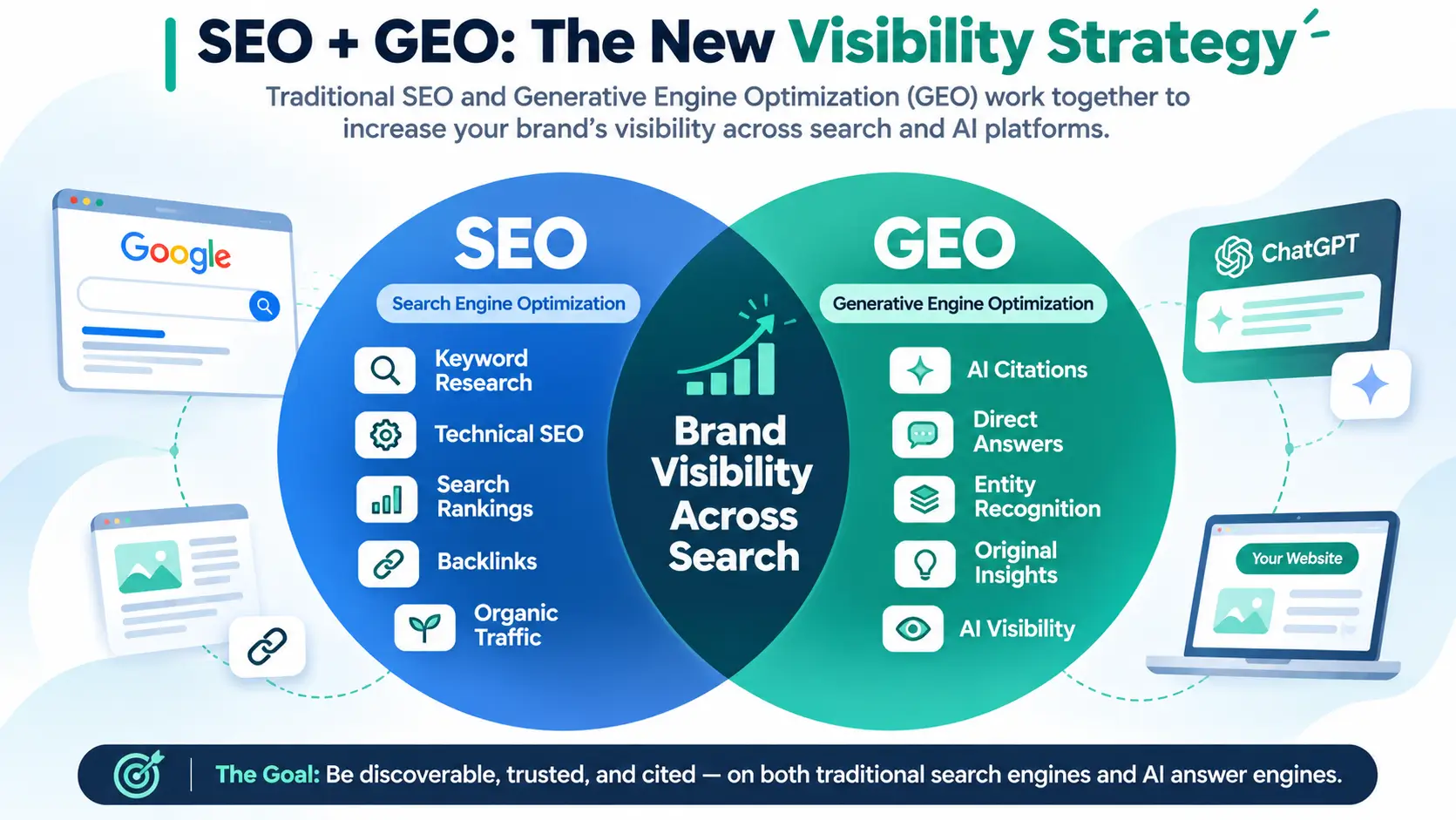
Treat traditional SEO and generative engine optimization (GEO) as one workflow rather than two competing projects:
- Answer questions directly. Open each section with a clear 40 to 60 word answer that an AI model can lift cleanly, then expand with detail and evidence.
- Use structured headings and FAQ schema. A clean H2 and H3 hierarchy plus schema markup helps both crawlers and AI retrieval systems understand your page.
- Demonstrate expertise and cite sources. Original data, named authors, and links to primary sources build the trust that both Google and AI systems favour.
- Keep technical SEO healthy. Fast pages, crawlable content, and clean indexing remain the foundation. Monitor performance in Google Search Console.
- Track AI referrals separately. Segment traffic from AI platforms in your analytics so you measure real impact instead of reacting to headlines. If AI referrals are tiny today, you will know, and you will spot growth early.
- Create content AI cannot easily replace. Original research, first-hand experience, case studies, and clear opinions are harder to summarise away than generic explainers.
Build AI-ready skills
Tools change quickly, but some skills last: search intent analysis, content strategy, analytics, and a working understanding of how answer engines retrieve and cite information. Teams that combine these skills adapt faster than teams chasing every new feature. If you want a structured path, an Advanced Diploma in Digital Marketing can help you build SEO, content, and analytics capabilities for this multi-engine landscape.
Frequently Asked Questions
Is ChatGPT replacing Google search?
Not yet. ChatGPT’s search-style activity is growing quickly, but Google still processes vastly more queries and drives far more website traffic. Most people now use both, choosing by task rather than abandoning one.
How does ChatGPT search volume compare to Google?
OpenAI says ChatGPT’s search query volume equals roughly 20% of Google’s. The figure counts only queries that trigger a web search, and OpenAI has not published its methodology, so treat it as a directional claim.
How many weekly users does ChatGPT have?
Reports from OpenAI’s announcement put ChatGPT at about 1.2 billion weekly active users. That is up from 1 billion roughly two months earlier, showing rapid growth across search and non-search tasks.
Does ChatGPT search send traffic to websites?
Yes, but at a much smaller scale than Google. One independent study found ChatGPT accounted for about 0.62% of Google’s organic search sessions. Citations can still build brand visibility even when clicks are limited.
What is generative engine optimization?
GEO is the practice of structuring content so AI systems can find, understand, and cite it. It builds on SEO by emphasising direct answers, clear structure, original data, and credible sourcing.
Is SEO still worth it?
Yes. Strong fundamentals such as quality content, technical health, and authority also support visibility in AI answers. The difference is that you now optimise for being cited as well as for ranking.
Conclusion
ChatGPT reaching about 20% of Google’s search volume is a real milestone, but it is not a verdict that Google is finished. The figure is self-reported, narrowly defined, and not the same thing as traffic. The smart response is calm and practical: keep your SEO foundations strong, add GEO practices, create content with original value, and measure AI referrals in your own data. Marketers who adapt to both worlds will be best placed as search keeps fragmenting.
If you want to build these skills with hands-on guidance, the fastest route is learning by doing. Joining a practical digital marketing course in Kerala gives you real experience with SEO, generative engine optimization, content strategy and analytics. You learn on live projects, so you’re ready for a world where customers find brands through both Google and AI assistants.


