
Google began rolling out its November 2026 core update on 10 November, and rankings are already moving for many websites. This guide explains what a google core update changes, what Google has confirmed about this release, how it differs from a spam update, and how to read your own data without guessing. It also covers the quality signals Google’s documentation points to and the mistakes that lead site owners to the wrong conclusions.
What Is a Google Core Update?

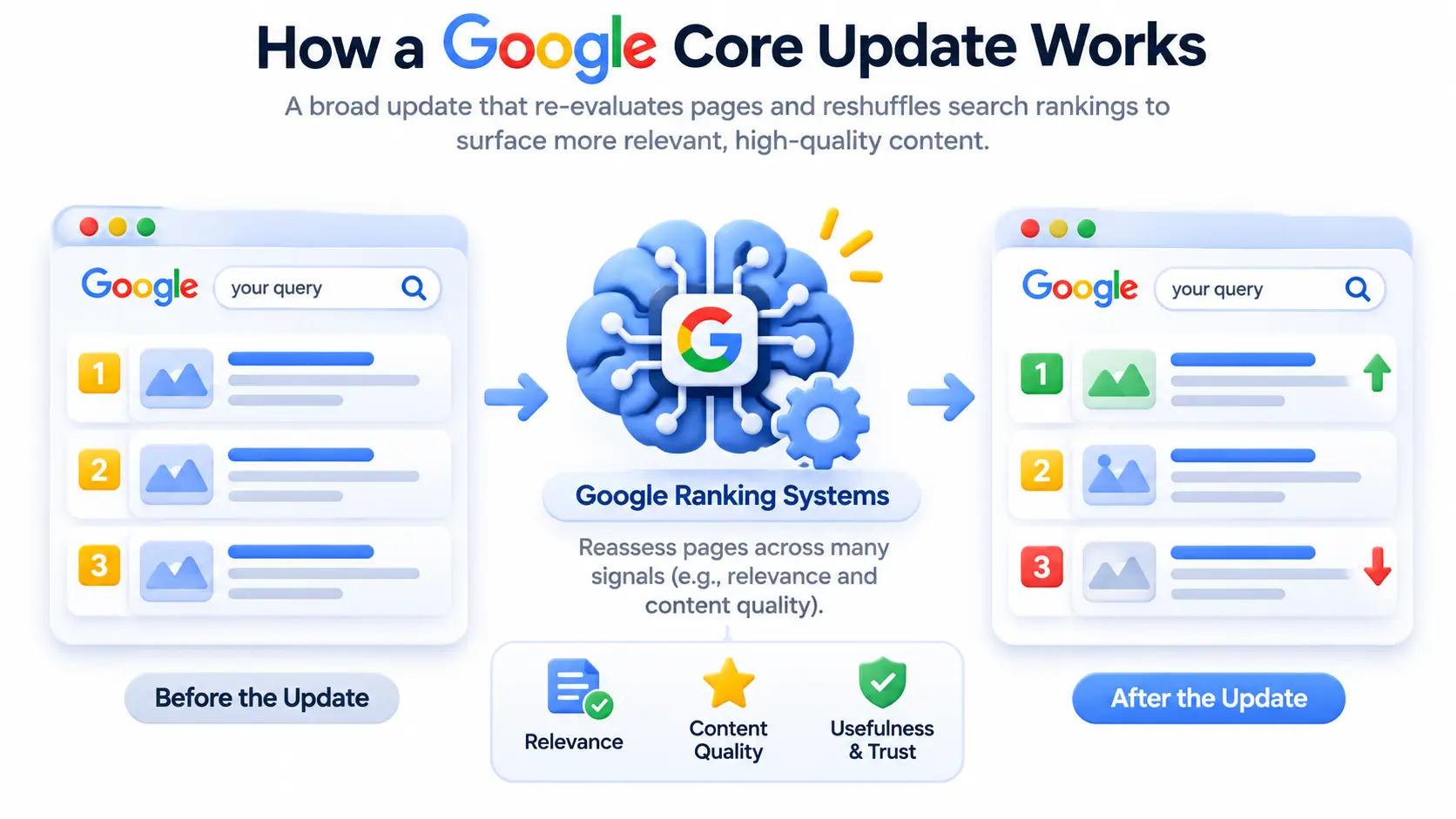
A Google core update is a broad adjustment to the systems Google uses to rank pages. It does not target one tactic or one type of website. It changes how those systems weigh relevance and content quality overall, so the results shown for many queries can shift at the same time.
Google releases these updates several times a year with one stated aim: to surface more relevant, satisfying content. A page that loses position has not necessarily broken a rule. In most cases, other pages are now judged to answer the query better. That is why Google describes core updates as changes to ranking, not as penalties aimed at specific sites.
How a Core Update Differs From Other Ranking Updates
Site owners often lump every ranking change together. Google’s Search Status Dashboard separates them, and the difference affects how you respond.
- Core update: a broad change to ranking systems that reassesses content quality and relevance across many queries.
- Spam update: a change to the systems that detect content violating Google’s spam policies. Sites that follow those policies are not its target.
- Discover update: a change specific to how content is chosen for the Discover feed. Google ran one in February 2026.
- Manual action: a penalty applied by a human reviewer, reported to the site owner in Search Console. A core update never produces one.
Google also makes smaller core changes without announcing them. A ranking shift that does not line up with a dashboard entry is not always a mystery.
What Google Has Confirmed About the November 2026 Update
Google released the update on 10 November 2026 at 10:07 Pacific time, and the Search Status Dashboard says it applies globally and to all languages. Google expects the rollout to take up to two weeks to complete, which puts the likely finish around 24 November.
Several details place this release in context:
- It is the third core update of 2026, after the March update (about 12 days) and the May update (about 12 days).
- It arrived roughly five months after the May update, and it is the eighth ranking update of 2026, counting the February Discover update and spam updates in March, June, August, and September.
Google has confirmed the global scope and expected rollout period but has not announced new ranking requirements or specific optimization measures. That matters. Anyone claiming to know exactly what this update rewards or demotes is working from early data, not from Google.
Timing also deserves attention. Past November core updates have run longer than two weeks, and this one lands just before the holiday shopping period, when demand changes on its own. Rankings and traffic will look unstable for a while, and some of that movement will come from seasonality, not from the update.
What Google Core Updates Tend to Reward
Google has not published a checklist for this update, but its long-standing core update documentation describes what the ranking systems are designed to favor. The themes stay consistent from one release to the next.
Helpful, Original Content
Google’s guidance asks whether a page offers original information, reporting, research, or analysis, and whether it covers the topic completely instead of repeating what already ranks. It also asks whether the content would still serve a reader who arrived from search and wants to leave satisfied. Pages written to match a keyword rather than to answer a question tend to struggle in these comparisons.
Signs of Experience, Expertise, and Trust
Google uses the framework known as E-E-A-T: experience, expertise, authoritativeness, and trust. It is not a single score or a direct ranking factor. It is a way of describing the qualities Google’s systems try to recognize through many signals.
In practice, this means clear authorship, an accurate About page, honest sourcing, and content created by people who know the subject. Trust sits at the center, particularly for topics that affect health, money, or safety.
Rankings Are Comparative
Google core updates reassess pages against each other. If a competitor improved its content between releases, your page can fall even though you changed nothing. The reverse also holds. A site can gain without making an obvious improvement because competing pages weakened.
How to Check Whether the Update Affected Your Site
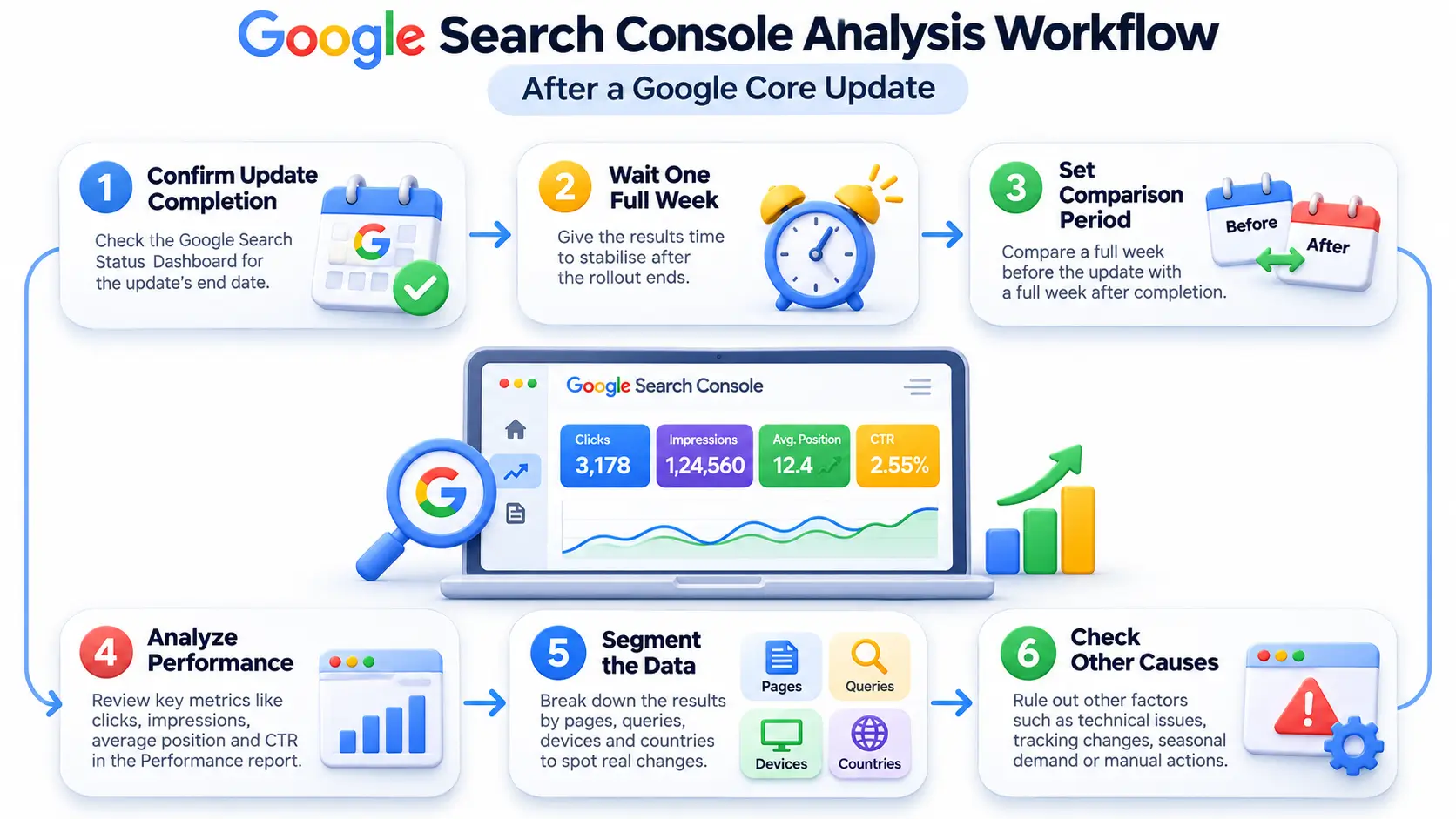
Google recommends waiting until the rollout is complete before drawing conclusions, then comparing data from a full week afterward with a baseline from before the rollout began. Follow this order:
- Confirm completion. Check the Google Search Status Dashboard for the update’s end date. Do not judge results while the rollout is active.
- Wait one full week. Early rankings shift again as the update finishes. If it ends around 24 November, a fair review starts in early December.
- Set the comparison window. Use the week before 10 November as the baseline and the first full week after completion as the comparison period.
- Open the Performance report in Google Search Console. Compare clicks, impressions, average position, and click-through rate across both periods.
- Break the data into segments. Filter by page, query, device, and country. A sitewide total can hide the fact that one section lost ground while the rest held.
- Rule out other causes. Check for technical errors, tracking changes, seasonal demand, and any manual actions reported in Search Console.
Why Timing Matters for Seasonal and E-commerce Sites
Retail, travel, and gifting queries often rise in late November, so comparing an early week with a later one can mislead. A week-on-week gain may reflect shopping demand rather than a ranking improvement, and a dip may reflect the opposite.
Add a year-on-year comparison in Search Console for the same dates in 2025. It will not remove seasonality, but it shows whether your pages moved differently from the demand curve. Review product and category pages separately from blog content, because each answers a different search intent.
Service businesses with local customers should check branded queries and location-based queries as their own groups. Those searches depend heavily on business profile details and reviews, and they often behave differently from informational queries during a ranking update.
What to Do If Your Traffic Dropped
A drop does not call for immediate edits. Changes made mid-rollout make it harder to tell what the update did and what your own edits did.
Once the data is clear, work from the pages that lost the most traffic:
- Compare intent. Search the main query for each affected page and read the pages that now rank above you. Ask whether they answer the question more directly or more completely.
- Improve substance. Add original information, update outdated sections, and remove padding. Light rewording rarely changes how a page is assessed.
- Consolidate overlap. Several thin pages competing on one topic often work better merged into one strong page.
- Strengthen trust signals. Add author details, cite sources, and make sure business information is accurate and easy to find.
Google has said that improvements can take time to be reflected, and some may not show until a later core update. Treat the work as ongoing quality maintenance instead of a quick repair.
Mistakes to Avoid During a Core Update
Most poor decisions come from reacting too early or too broadly.
- Judging results in the first few days. Early volatility often reverses.
- Deleting content in bulk. Removing pages without checking their value can reduce useful coverage.
- Assuming one cause. A traffic change may come from the core update, a spam update, a seasonal shift, or a technical fault. Test each possibility.
- Chasing keyword tweaks. Adjusting titles or repeating phrases does not address a quality gap.
- Copying competitors. Matching a higher-ranking page’s structure adds nothing a reader cannot already find there.
Frequently Asked Questions
How long does a Google core update take to roll out?
Google says the November 2026 update may take up to two weeks. The March and May 2026 updates each took about 12 days. Some earlier November updates ran beyond two weeks, so the dashboard’s completion entry is the only reliable signal.
Can I recover rankings lost in a core update?
Recovery is possible but not guaranteed. Sites that improve content quality and usefulness may see gains over time, though Google has said some improvement may only appear after a later core update.
Should I pause publishing during the rollout?
No. Publishing new, useful content is fine. Avoid large edits to pages you plan to analyze, because they cloud the comparison.
Does a core update affect Google Discover?
It can. Google core updates may change how content appears in Discover and in features such as featured snippets. Google also runs Discover-specific updates, such as the one in February 2026.
How often does Google release Google core updates?
Google has said core updates happen multiple times a year, though the schedule varies. In 2026 they arrived in March, May, and November.
Is every ranking drop caused by the core update?
No. Spam updates, technical problems, seasonal demand, lost links, and changes in competitor pages can all move rankings. Match the timing of your drop to the dashboard before assigning blame.
Conclusion
A Google core update reassesses how well pages satisfy searches, and the November 2026 release follows that pattern. Google has confirmed its scope and timing but offered no new guidance, so patience and clean data matter more than quick fixes. Wait for the rollout to finish, compare a full week against your baseline, and invest in original, trustworthy content.
If you want to learn how to read Search Console data and build content that holds up through updates, a hands-on digital marketing course in Kerala with a strong SEO module is a practical place to start.


