If you run an online store, you’ve probably noticed that generic SEO advice doesn’t quite fit. Blog-focused tips about topic clusters and content calendars are useful, but they don’t address the real challenge of ecommerce: optimizing hundreds or thousands of product and category pages at scale, most of which follow the same template and share the same recurring issues.
That’s where dedicated ecommerce SEO tools come in. This guide breaks down the best options in 2026 organized by what job you actually need done, not just a generic ranked list so you can find the right fit for your store’s size, budget, and platform.
What Makes Ecommerce SEO Different?
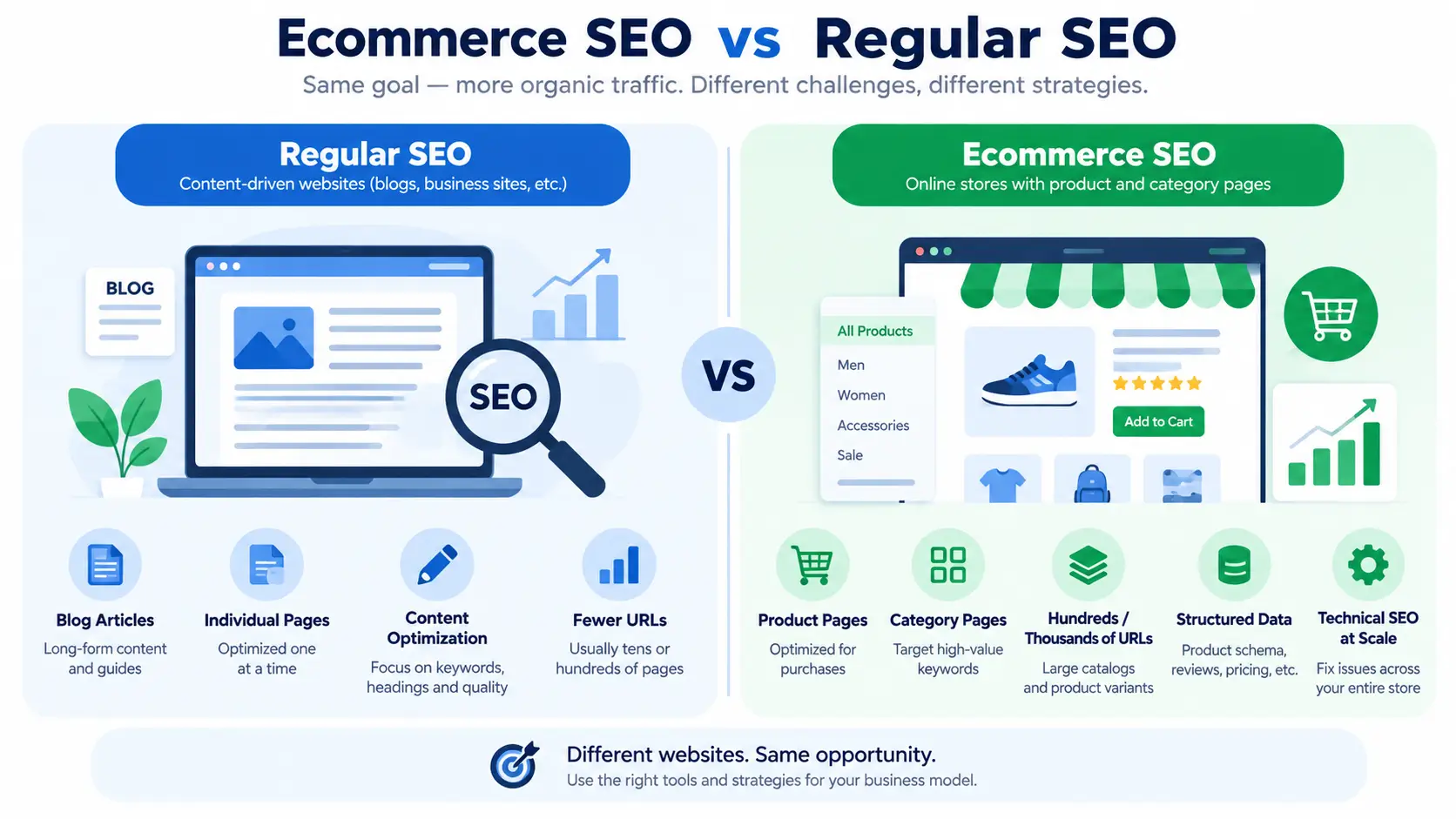
Product & Category Pages vs. Blog Content
Most SEO tools were originally built with content marketers in mind people optimizing articles and blog posts one at a time. Ecommerce stores work differently. Your money pages are usually product and category listings, not long-form articles, and they tend to be short on unique text, heavy on images, and built from templates that repeat across your entire catalog.
That changes what “optimization” even means. Instead of researching one keyword for one article, you’re often mapping keywords to hundreds of product variants at once. Instead of writing 1,500 words of original content, you’re working with a 100-word product description that needs to be unique enough to avoid duplicate content penalties.
Scaling Optimization Across Thousands of SKUs
The second big difference is scale. A single technical issue a broken canonical tag, a missing meta description pattern, an incorrect schema type can affect every product in a category simultaneously. This is why technical SEO auditing and structured data validation matter more for ecommerce than for almost any other type of website. A tool that’s great for auditing a 20-page blog often struggles, or gets prohibitively expensive, at 5,000+ product URLs.
How We Evaluated These Tools
Rather than ranking tools by a single composite score, we grouped them by the specific job they do best: keyword and product research, technical auditing, on-page content optimization, and new for 2026 AI and generative search visibility. We weighed feature depth, pricing relative to store size, ease of use for beginners, and how well each tool handles the scale challenges unique to ecommerce.
Best All-in-One Ecommerce SEO Platforms
If you want one login that covers keyword tracking, site audits, and competitor research, start here.
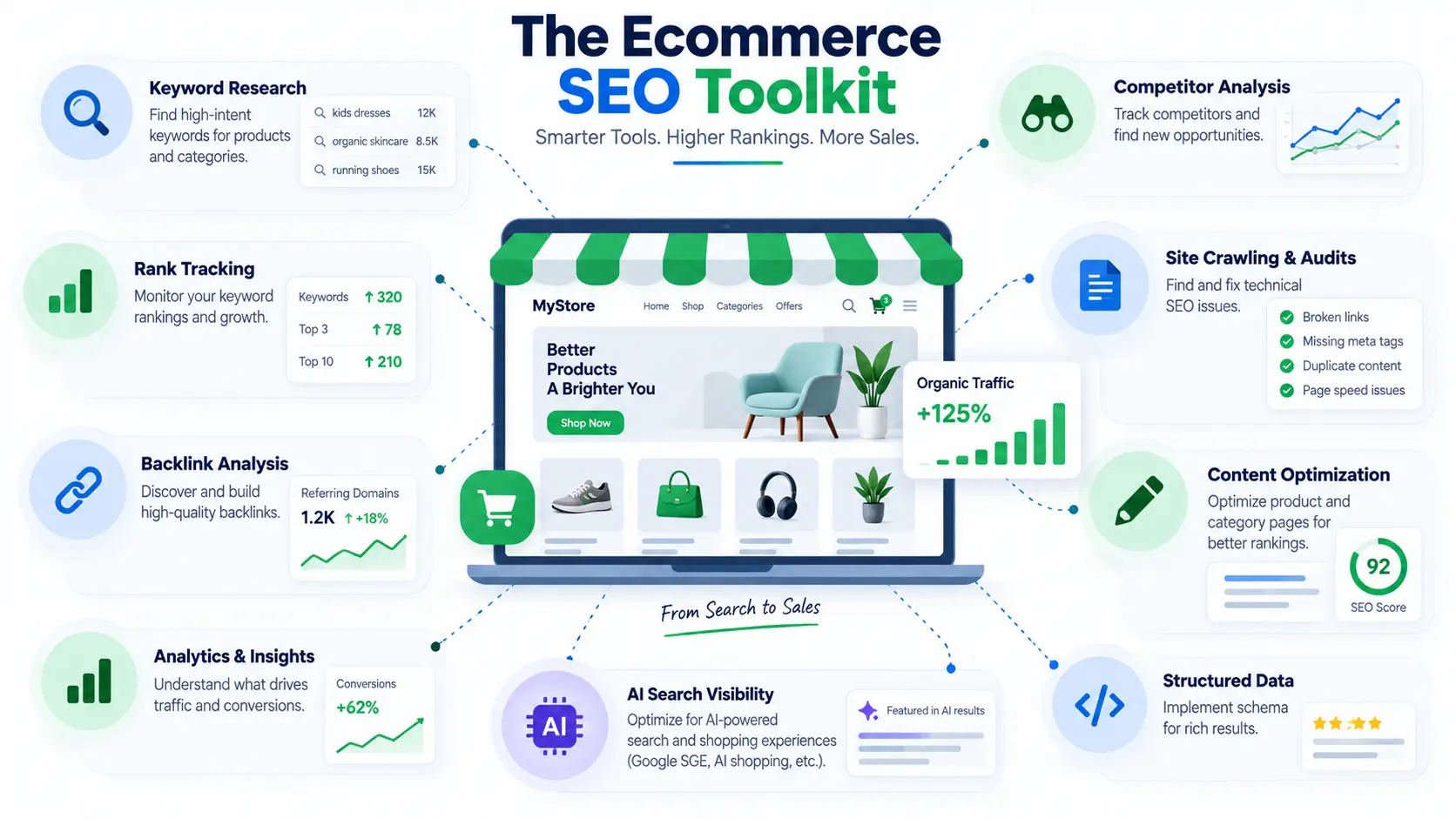
Semrush Best for Multi-Channel Stores
Semrush remains a strong choice for stores that run organic search, paid search, and content marketing together. Its keyword database is extensive, and having everything under one roof makes it easier to see how your paid and organic efforts overlap useful if you’re running Google Shopping campaigns alongside SEO.
Ahrefs Best for Backlink & Keyword Depth
Ahrefs is generally the pick when backlink analysis and deep keyword research matter most. Its keyword explorer is particularly good at surfacing the long-tail, specific phrases shoppers actually type when they’re close to purchasing “waterproof hiking boots size 11 wide” rather than just “hiking boots.” For competitive research and understanding which pages are sending your competitors traffic, it’s hard to beat.
SE Ranking Best Budget All-in-One Suite
For growing stores that need solid rank tracking, site audits, and reporting without enterprise-level pricing, SE Ranking is a strong middle-ground option. Several providers in this tier now offer unlimited keyword tracking on all plans, which matters if you’re managing a large catalog competitors that meter tracking by credit can get expensive fast as your keyword list grows.
Best Tools for Keyword & Product Research
Ahrefs Keywords Explorer
Beyond general keyword volume, Ahrefs’ Keywords Explorer is particularly useful for uncovering the specific product and category search phrases customers use the kind of long-tail queries that convert well precisely because they signal strong purchase intent.
Google Keyword Planner (Free Option for Beginners)
If you’re just starting out, Google Keyword Planner remains a solid, no-cost way to explore keyword volume and get a rough sense of competition, especially since it’s built directly on Google’s own search data. It’s more limited than paid tools but genuinely useful for early-stage research.
Best Technical SEO & Site Audit Tools
Screaming Frog for Deep Crawls
When something is broken across your site duplicate titles, broken links, missing alt text, redirect chains Screaming Frog remains the standard for crawling and diagnosing it, even at the scale of a large Shopify ecommerce catalog. It’s not the most beginner-friendly interface, but the depth of diagnostic detail it provides is difficult to match.
Google Search Console (Free Foundation)
Every store, regardless of budget, should have Google Search Console connected before spending money on anything else. It’s first-party data straight from Google, showing exactly which queries are driving impressions and clicks, flagging indexing problems, and as of 2026 increasingly reflecting some visibility data from Google’s AI-generated search results too.
Best Tools for On-Page & Content Optimization
Surfer SEO for Category-Page Content
Category pages often need just enough original content to rank without turning into bloated walls of text that hurt the user experience. Surfer SEO and similar content-optimization tools help by analyzing top-ranking pages for a given keyword and suggesting the terms and structure your page should include to compete.
Bulk Description Tools for Large Catalogs
If your store has 200 or more products, especially across multiple languages, writing every product description by hand becomes impractical. AI-assisted bulk description tools can generate unique copy at scale though for smaller catalogs under 50 products, writing descriptions manually is often faster and produces better results.
Best Free Ecommerce SEO Tools for Beginners
You don’t need to spend anything to get started. A combination of Google Search Console and Google Analytics gives you a genuinely useful foundation: search performance data, indexing status, and on-site behavior, all for free. Pair that with a free technical audit tool or rank checker, and you have the fundamentals covered before committing to a paid subscription.
2026’s Newest Category: AI Visibility & Generative Search Tools
This is the section that didn’t exist in ecommerce SEO guides even a year or two ago and it’s arguably the most important development of 2026.
What Google’s Universal Commerce Protocol Means for Your Schema
In January 2026, Google introduced its Universal Commerce Protocol (UCP), which allows AI agents to autonomously find and purchase products by reading a store’s Schema.org structured data. In practical terms, this means your product schema isn’t just a nice-to-have for rich search results anymore it’s the mechanism by which an entirely new class of AI shopping agents discovers your products at all. If your JSON-LD structured data is broken or incomplete, you’re effectively invisible to this emerging purchase channel, regardless of how well you rank in traditional search.
Google’s free Rich Results Test remains a useful starting point: paste in a product URL, and it validates your structured data, flagging any errors or warnings with specific line references so you know exactly what needs fixing.
Tools That Track AI Overview and AI Shopping Visibility
A small but growing category of tools now specifically monitors how often your store shows up in AI-generated search results a different metric from traditional keyword rank tracking. Some established platforms have folded this in as a built-in feature at no extra cost, while newer, more specialized entrants offer it as a standalone add-on. It’s worth noting this category is still young: AI-search return on investment can be genuinely hard to attribute directly to revenue, and integration with existing analytics stacks varies a lot between providers. Treat these tools as a useful early signal rather than a mature, fully proven channel just yet.
How to Choose the Right Tool for Your Store
By Catalog Size
Under 50 products, you can likely get by with free tools and manual optimization. Between 50 and 500 products, an all-in-one platform starts to earn its cost. Above that, dedicated technical crawling and bulk content tools become close to essential.
By Budget
If you’re at zero budget, Google Search Console and Analytics cover the fundamentals. Mid-tier stores investing $100–$200 a month typically get the most value from an all-in-one suite. Larger operations may justify specialized add-ons, including AI-visibility tracking, on top of a core platform.
By Platform
Shopify, WooCommerce, and Magento stores all have platform-specific quirks canonical URL handling, variant page structures, and app conflicts differ enough that it’s worth confirming a tool explicitly supports your platform before committing to an annual plan.
Frequently Asked Questions
What is the best free SEO tool for ecommerce websites?
Google Search Console is the strongest free option. It shows which search queries drive traffic to your store, flags indexing issues, and increasingly reflects some AI Overview impression data a genuinely useful starting point before spending anything.
Is Semrush or Ahrefs better for ecommerce SEO?
Both are strong, and the right choice depends on your priorities. Semrush suits stores that want organic, paid, and content tools in one login, while Ahrefs is often preferred for deeper backlink analysis and long-tail product keyword research.
How much do ecommerce SEO tools typically cost?
Costs vary widely. Free tools like Google Search Console cost nothing, mid-tier all-in-one platforms typically run $100–$200 per month, and specialized AI-visibility add-ons can start around $89 per month, with enterprise suites priced much higher.
What SEO tools do I need for a Shopify store?
Start with Google Search Console and Analytics for free baseline data. As you grow, add a keyword research tool and a technical audit tool since Shopify’s templated structure means one fix often affects hundreds of product pages simultaneously.
How do I track my store’s visibility in Google AI Overviews?
A growing set of tools now include dedicated AI-visibility tracking that monitors how often your store appears in generative search results, separately from traditional keyword rankings a category that barely existed before 2026.
What’s the difference between ecommerce SEO and regular SEO?
Ecommerce SEO focuses on optimizing product and category pages at scale rather than individual articles, with heavier emphasis on structured data, site architecture, and technical health across large, templated page counts.


