Keyword rankings used to be the scoreboard. In 2026, they are only half the game. Google’s AI Overviews now answer a large share of informational queries directly in the search results, and a growing volume of research and discovery has migrated to ChatGPT, Perplexity, and Gemini. None of these systems retrieve “pages that match a query string.” They retrieve entities and the relationships between them, and they assemble an answer from whichever sources demonstrate the clearest, most trustworthy understanding of the topic.
This shift is why semantic SEO and its foundation, entity-based content strategy, have moved from a nice-to-have to the central organizing principle for any serious content operation. This guide lays out what that actually means in practice: how AI search systems evaluate content, how to restructure your content architecture around entities instead of keywords, and how to measure success in a search landscape where the click is no longer the primary unit of value.
Why Keyword-Only SEO Is Failing in the AI Search Era
A page built to rank for one exact-match phrase can still perform reasonably well in traditional blue-link search. It performs far worse as a source for an AI-generated answer, because AI Overviews, ChatGPT, and Perplexity are not scanning for phrase frequency. They are building a compressed, synthesized answer out of the entities, facts, and relationships they can extract with confidence, and a page that only demonstrates surface-level keyword coverage gives them very little to extract.
How AI Overviews and LLM-powered search actually retrieve answers
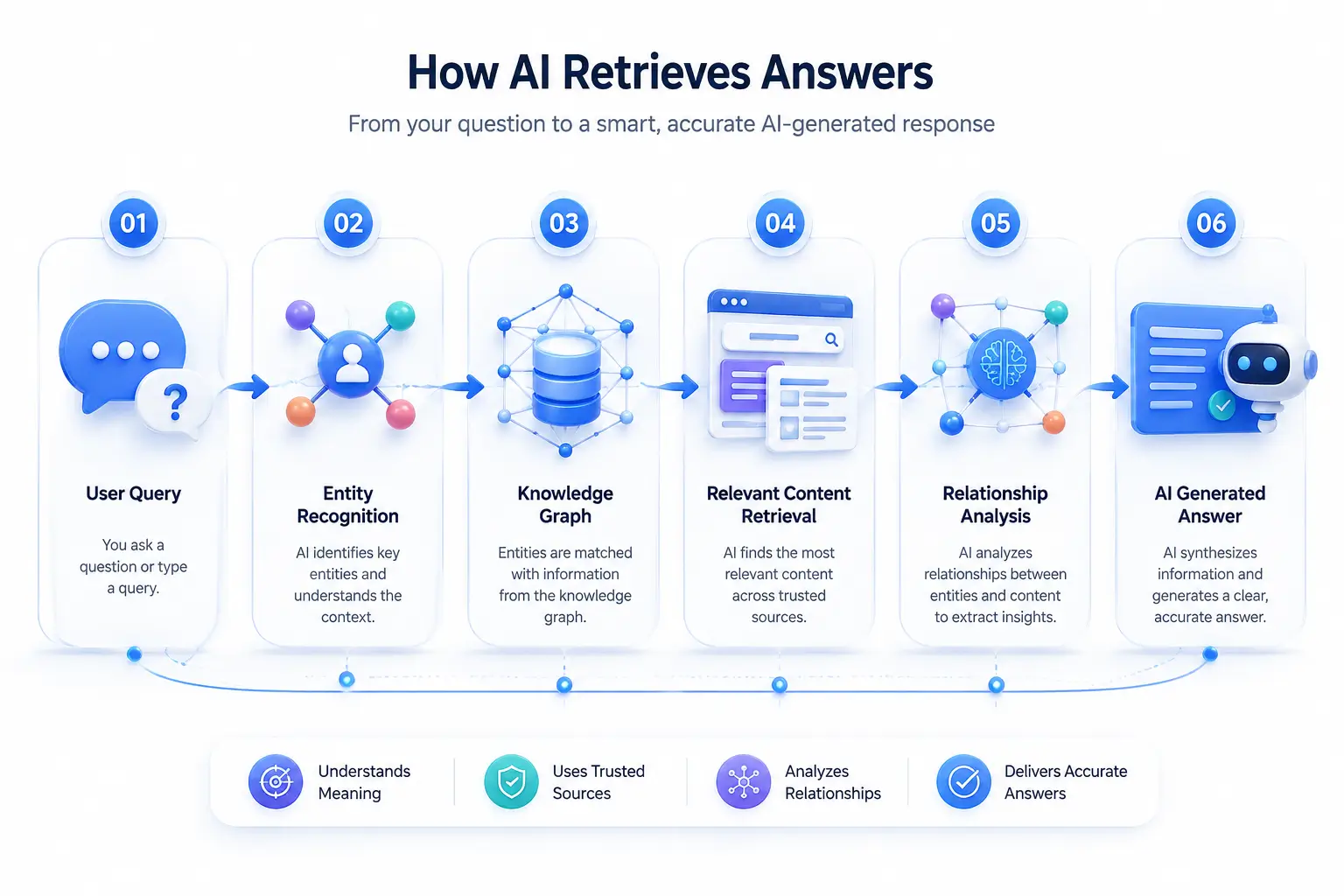
Retrieval-augmented systems work by identifying the entities in a query, pulling content that clearly relates to those entities and their known attributes, and then generating a synthesized response. The sources most likely to be pulled into that response are the ones where the entity relationships are stated explicitly in the prose, in the structured data, and in the way the content links to related concepts. Ambiguous, thin, or purely keyword-repetitive content is simply harder for these systems to extract with confidence, so it gets passed over even when it technically ranks for the target term.
The data behind the shift
The scale of this shift is easy to underestimate. Google’s Knowledge Graph, the underlying system that maps entities and their relationships, has grown from roughly 570 million entities to more than 8 billion entities and 800 billion facts in under a decade. That is the infrastructure AI Overviews and Google’s broader search stack now reason with by default. At the same time, AI Overviews have moved from an experiment to a fixture: they now trigger on a substantial share of informational queries in the US, compressing traditional click-through opportunities and raising the stakes for being the source an AI system chooses to cite rather than merely rank.
What Semantic SEO Actually Means
Semantic SEO is the practice of structuring content, metadata, and site architecture around meaning, context, and the relationships between concepts rather than around isolated keyword phrases. Where traditional SEO treats a page as a vehicle for one target term, semantic SEO treats an entire content library as an interconnected network of topics that both search engines and AI models can interpret, trust, and cite.
Semantic SEO vs. traditional SEO
Traditional SEO optimizes at the page level: one primary keyword, supporting variations, and enough content depth to satisfy that phrase’s intent. Semantic SEO optimizes at the entity and topic-cluster level: what does this brand, product, or concept mean, what does it relate to, and does the content library as a whole demonstrate comprehensive, credible coverage of that meaning? The two approaches are not mutually exclusive; keyword research still tells you what people search for, but semantic SEO uses that research to build an entity map rather than a flat list of pages.
Semantic SEO vs. Generative Engine Optimization (GEO)
GEO is often described as a separate discipline focused specifically on getting cited inside AI-generated answers. In practice, GEO is best understood as a subset of semantic SEO rather than a competing framework. The same entity clarity, structured data, and topical depth that earns strong semantic SEO performance is exactly what earns AI citation. GEO simply narrows the success metric from “ranking” to “being selected as a source.” Treating them as separate strategies leads to duplicated work; treating GEO as an outcome of good semantic SEO keeps the strategy unified.
The Entity: The New Unit of SEO
If the keyword was the atomic unit of traditional SEO, the entity is the atomic unit of semantic SEO. An entity is any distinct, nameable thing a search or AI system can recognize and reason about, and content strategy in 2026 increasingly starts by mapping these before a single article is outlined.
What counts as an entity
Entities include people (authors, founders, experts), organizations and brands, products and services, concepts (like “entity salience” itself), places, and events. A single article typically touches several entities at once, and semantic SEO asks whether the content makes each of those entities — and how they relate to one another unambiguous.
Entity disambiguation and why it matters
Many terms carry multiple meanings. A word like “Apple” could refer to a fruit, a technology company, or a record label, and a search or AI system needs a clear signal to resolve which one a page is actually about. Disambiguation happens both contextually, through the surrounding language and related terms an article uses, and explicitly, through structured data that states the entity type directly. Content that leaves this ambiguous is inherently harder to trust and cite.
Entity salience – how “known” your content makes an entity
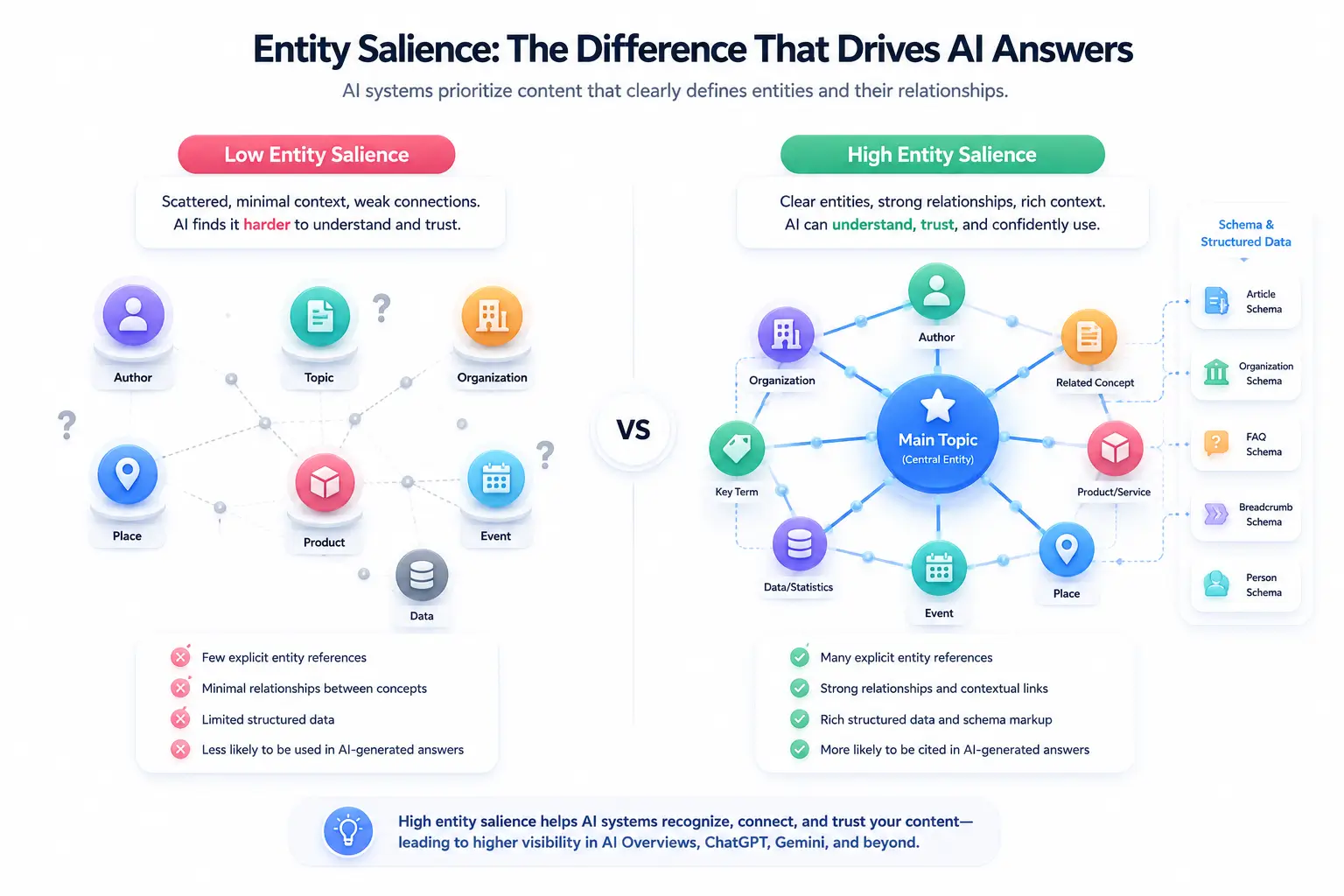
Entity salience refers to how clearly and consistently a page establishes the prominence of its core entities. A page that mentions a concept once in passing has low salience for that entity; a page that defines it, explains its attributes, and connects it to related concepts throughout the content has high salience. Higher salience is one of the clearest levers available for improving both traditional relevance and AI citation likelihood.
Building an Entity-Based Content Architecture
The practical shift from keyword lists to entity maps is where most content teams get stuck, because it requires rethinking the unit of planning itself. Instead of asking “what keyword should this page target,” the entity-based approach asks “what entity does this page own, and how does it connect to the rest of our content?”
Mapping your core entities and sub-entities
Start by identifying the handful of core entities your content library should own: your brand, your primary product or service categories, and the two or three concepts most central to your expertise. From each core entity, branch out into sub-entities and related concepts the way a subject-matter expert would explain the topic to a colleague. This map becomes the blueprint for what content to create and, just as importantly, what gaps currently exist in your coverage.
Topic clusters vs. keyword silos
A keyword silo groups pages by shared phrasing. A topic cluster groups pages by shared meaning, organized around a pillar page that comprehensively covers a core entity, supported by cluster content that goes deep on each sub-entity. This structure does double duty: it satisfies searchers who want depth on a subtopic, and it gives search and AI systems an unambiguous signal about which page is the authoritative hub for the broader entity.
Internal linking as relationship signaling
In an entity-based model, internal links are not just navigation or authority-passing; they are explicit statements of relationship. Linking a pillar page to its cluster content, and cluster content back to related concepts elsewhere in the library, tells search and AI systems how your entities connect to one another. Anchor text should describe the relationship in plain language rather than defaulting to generic phrases like “read more.”
Technical Implementation: Schema and Structured Data
Structured data is the most direct, unambiguous line of communication a site has with the knowledge graph, because it bypasses the need for a language model to infer meaning from prose alone. For advanced practitioners, schema is not a bonus; it is the mechanism that turns an entity map into something machine-readable.
Which schema types matter most for entity clarity
- Organization/Corporation Schema – establishes your brand as a unique, recognizable entity, helping search engines clearly identify and distinguish it from others.
- Person schema — connects named authors and experts to their content, reinforcing E-E-A-T
- Article / BlogPosting schema — defines authorship, publication data, and topical classification
- FAQPage schema — structures question-and-answer content for both featured snippets and AI extraction
- BreadcrumbList schema — reinforces site architecture and topical hierarchy
Common schema mistakes that create ambiguity
The most frequent errors are inconsistency rather than absence: an author name spelled differently across schema and byline, an organization entity that doesn’t match the name used in Google Business Profile or Wikidata, or FAQ schema that doesn’t match the visible on-page text. Each inconsistency reintroduces the ambiguity that structured data exists to eliminate, so consistency across every surface matters as much as implementation itself.
Signaling Trust: E-E-A-T in an Entity-Driven System
As content is judged less by exact phrasing and more by entity coverage and demonstrated expertise, E-E-A-T signals experience, expertise, authoritativeness, and trustworthiness become the mechanism by which an entity earns trust rather than a soft guideline layered on top of good writing.
Author entities and consistent identity signals
Every piece of expert content should be attributable to a clearly defined author entity, with a consistent name, credentials, and a bio that connects to the author’s presence elsewhere: a professional profile, prior publications, or an organizational role. This turns a byline into a verifiable entity rather than a label.
Cross-platform entity consistency
Search and AI systems build confidence in an entity by seeing it described consistently across multiple independent sources: your website, business listings, social profiles, and third-party citations. Inconsistent naming, descriptions, or affiliations across these surfaces weakens the very entity clarity that semantic SEO depends on.
Measuring Success Beyond Rankings
A ranking position on a results page that increasingly shows an AI-generated answer above the links is an incomplete success metric. Advanced teams are adding a second measurement layer built around visibility inside AI-generated answers themselves.
Tracking AI citation frequency and share of voice
This means periodically querying AI Overviews, ChatGPT, and Perplexity with the questions your target audience actually asks, and logging whether and how your brand or content is cited. Several emerging tools track this systematically, but manual sampling on a monthly cadence is a reasonable starting point for most teams.
New KPIs for a zero-click, AI-summarized search landscape
Alongside traditional organic traffic and rank tracking, consider tracking branded search volume (a proxy for AI-answer-driven awareness), AI citation share against named competitors, and downstream engagement from the smaller but more qualified traffic that does click through from an AI-generated answer.
A Practical Rollout Plan for 2026
- Audit your existing content library and map it against your core entities; identify what’s covered, what’s thin, and what’s missing entirely.
- Build an entity map for your two or three highest-priority core entities, branching into sub-entities and related concepts.
- Restructure priority topics into pillar-and-cluster architecture, with internal links that explicitly signal relationships.
- Implement and audit structured data across Organization, Person, Article, and FAQPage schema for consistency.
- Standardize author and brand entity signals across your site and third-party platforms.
- Establish a monthly AI citation tracking process alongside traditional rank tracking to measure the new success metric directly.
FAQ
What is semantic SEO?
Semantic SEO is the practice of structuring content around entities, meaning, and contextual relationships rather than isolated keyword phrases. It helps search engines and AI models understand what a page is about, how concepts connect, and why the content is authoritative, not just what terms it repeats.
How is semantic SEO different from traditional SEO?
Traditional SEO optimizes individual pages for specific keyword phrases and frequency. Semantic SEO treats an entire content library as an interconnected network of topics and entities, prioritizing comprehensive topical coverage, contextual relationships, and demonstrated expertise over exact-match phrasing.
Why does semantic SEO matter for AI search specifically?
AI systems like ChatGPT, Perplexity, and Google’s AI Overviews retrieve and synthesize entities and their relationships rather than simply matching query strings to pages. Content that doesn’t explicitly model those relationships is far less likely to be surfaced or cited in AI-generated answers.
Do I still need to do keyword research in 2026?
Yes. Entities and keywords work together, not against each other. Keyword research still reveals search demand and phrasing, but it should inform an entity map rather than a list of pages built one-to-one around a phrase.
What role does schema markup play in entity-based SEO?
Schema markup gives search engines explicit, unambiguous data about your entities, disambiguating terms with multiple meanings and clearly defining relationships, such as author to article. It bypasses reliance on inference alone, strengthening AI citation eligibility.
How do I know if my entity-based strategy is working?
Track AI citation frequency and brand mentions in AI Overviews and chatbot answers, not just keyword rankings. Share of voice within AI-generated answers is becoming a core KPI alongside traditional organic traffic and position tracking.


