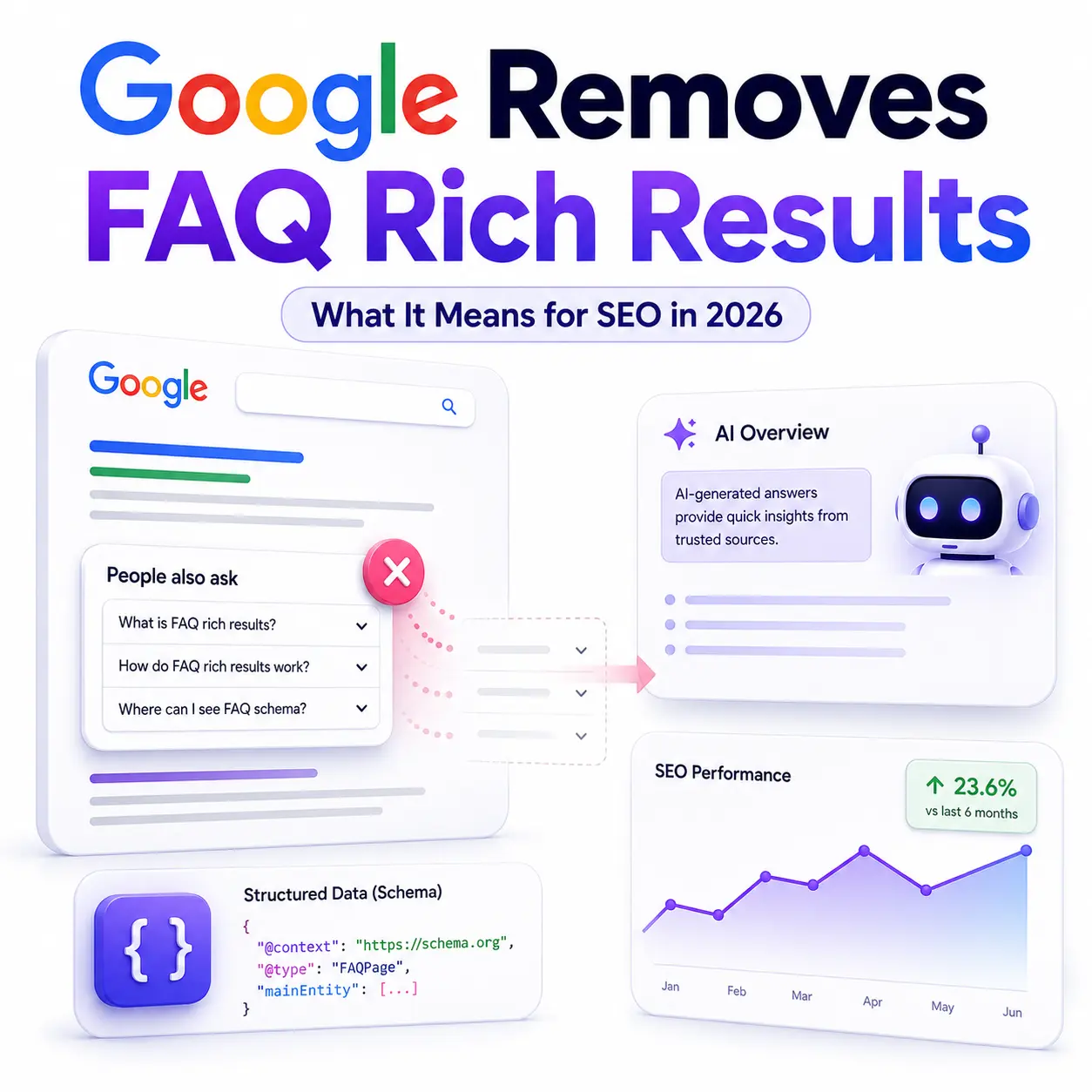
Google officially removes FAQ rich results on May 7, 2026. If you logged into Search Console recently and noticed your FAQ performance data thinning out, or if you spotted the announcement in your feed and felt a flicker of panic take a breath. This post will tell you exactly what changed, what it means for your traffic, and where to direct your structured data energy going forward.
What are FAQ rich results and why did they matter?
When a page had FAQ Page schema markup implemented correctly, Google could display a collapsible Q&A dropdown directly beneath the organic listing in search results. Users could expand individual questions and read answers without clicking through to the page.
For SEOs, the appeal was obvious. A standard organic result takes up roughly two lines of SERP real estate. A page with three or four FAQ dropdowns could occupy six to ten lines. More visual space meant higher visibility, and in competitive niches, that translated directly into better clickthrough rates even without moving up a single ranking position.
At peak adoption, FAQ schema became one of the most commonly deployed structured data types on the web. Schema.org data shows approximately 45 million of the world’s 362 million registered domains use Schema.org markup, and FAQ Page was among the most popular types.
That popularity, as it turned out, was exactly the problem.
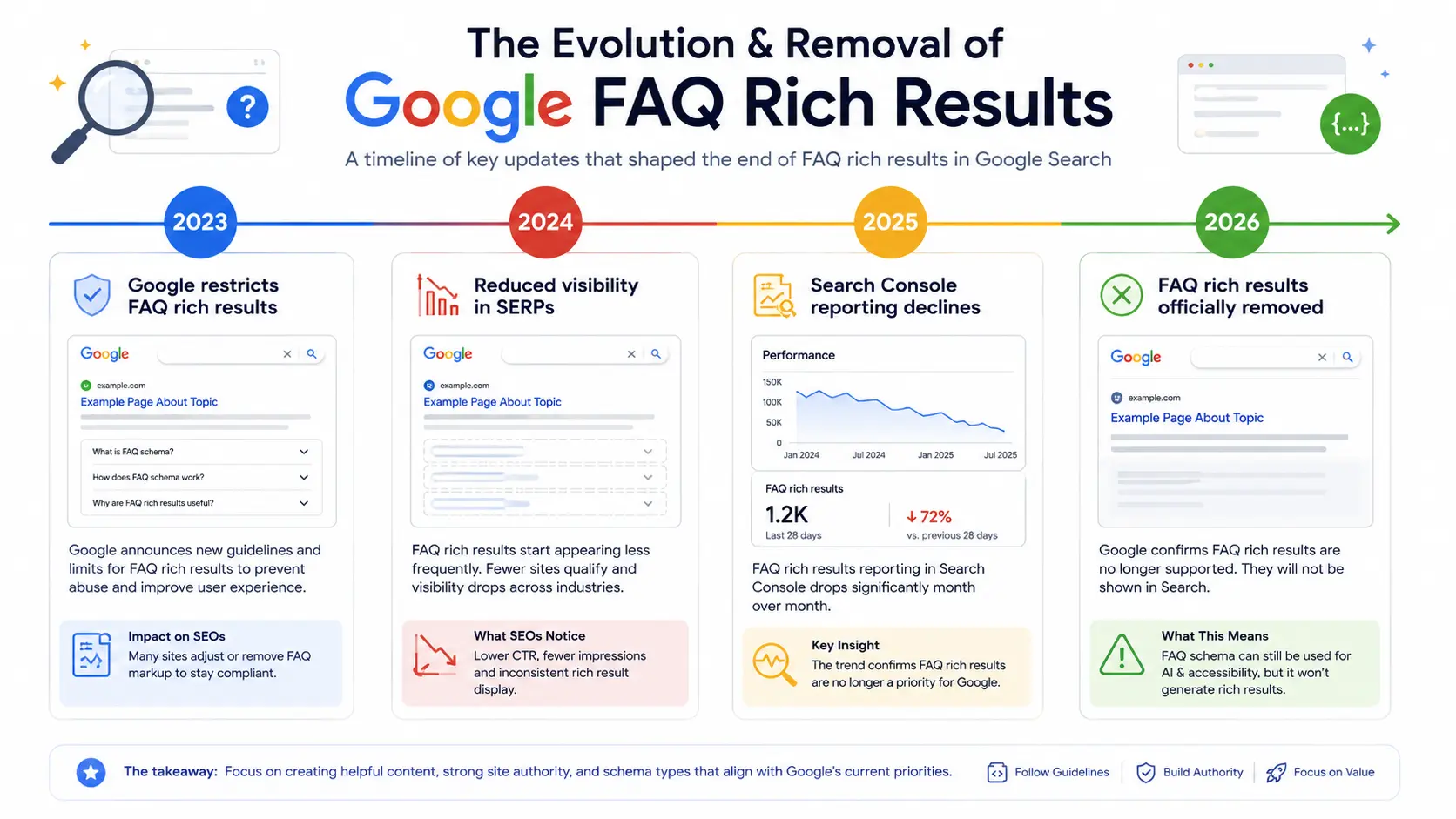
Why did Google restrict FAQ rich results in 2023?
The reasoning was straightforward: the feature was being systematically abused. Sites were adding FAQ Page schema to product pages, homepages, and contact pages not to answer genuine user questions, but to inflate their SERP footprint. Questions were often irrelevant or artificially constructed. Answers existed only to occupy more pixels on the results page.
Google’s position was that FAQ rich results had become an SEO manipulation tactic rather than a user experience feature. Restricting access to government and health sites where FAQ content tends to address genuine public information needs — was the compromise before full removal.
What Changed in Google’s May 2026 FAQ Update?
The May 2026 announcement closes the loop. Even the narrow exception for authoritative government and health sites is gone. Google also stated it will continue to use FAQ structured data to better understand pages internally but that understanding will no longer translate into a visible rich result.
One line in the deprecation notice deserves close attention: Google confirmed it will still process FAQ Page markup even though it will no longer display it. That distinction matters, and we will come back to it.
FAQ Rich Results vs Rankings: What’s the Difference?
FAQ schema was never a ranking signal. Google has confirmed this explicitly. It did not help pages rank higher in organic results. What it did was change how a ranking page appeared in search. Removing the display feature does not alter the underlying ranking calculation at all.
If your page ranked fifth before May 2026, it still ranks fifth. Nothing in your page authority, content quality score, or E-E-A-T signals changed. The only thing that changed is the visual presentation of that fifth-place result.
Will FAQ Schema Affect Your Click-Through Rate?
For the vast majority of commercial sites, the answer is: barely, if at all. FAQ rich results were already suppressed for non-government, non-health sites since August 2023. If your business falls outside those categories and it almost certainly does you lost this feature nearly three years ago. The May 2026 update formalises what was already true in practice.
The exception is the rare health information site or government-adjacent organisation that was still seeing FAQ dropdowns in search. Those sites should monitor CTR closely over the next two months, comparing week-over-week performance for pages that previously showed rich results.
For everyone else, if your FAQ snippets disappeared in 2023, your CTR already absorbed whatever impact there was. This update should register as a near-zero change in your analytics.
What Happens to FAQ Reports in Search Console?
This is where you do need to take action. Search Console will stop reporting FAQ rich result data in June 2026. If you have dashboards, reports, or automated alerts built around FAQ structured data performance, update them before then. The data will stop populating, and stale dashboards create confusion.
Should You Remove FAQ Schema From Your Website?
Google’s official guidance is clear: there is no need to remove it. Leaving FAQ Page markup in your codebase causes no problems and has no visible negative effects in Google Search. The more interesting question is whether there is still a reason to keep it.
Does FAQ Schema Still Help With AI Search and GEO?
This is where you will encounter a lot of confident, conflicting claims. Some generative engine optimisation practitioners argue that FAQ schema is now more valuable than ever, because AI platforms like ChatGPT, Perplexity, and Google AI Overviews rely on structured Q&A pairs to extract citable information.
The honest answer is that the evidence here is genuinely mixed. FAQ Page structured data remains crawlable by Bingbot, PerplexityBot, and the retrieval-augmented generation crawlers indexing the open web. That much is confirmed. What is not confirmed is whether having FAQ Page markup materially increases your citation rate in AI-generated answers versus having the same content in clean, well-structured prose.
The Truth About FAQ Schema and AI Citations
Recent data from Ahrefs challenged the claim that schema markup broadly boosts AI citations, with the test pooling all schema types and measuring AI citation outcomes. The conclusion was not that schema is worthless — it was that the specific pitch of “add schema to increase AI citations” lacks strong supporting data at scale.
What does appear to help AI parsing is simpler and more fundamental: write clear question-and answer formatted content in your page body. Use question-based H2 and H3 headings. Give direct, complete answers in the first sentence or two beneath each heading. Whether schema is layered on top of that content or not, the human-readable structure is what AI systems and human readers can actually use.
If you have accurate, well-maintained FAQ Page markup: keep it. If you were planning to add it purely to chase AI citations: focus on writing quality Q&A content in your page body instead. The content is the signal. The schema is the label.
What Schema Types Should You Focus on Instead?
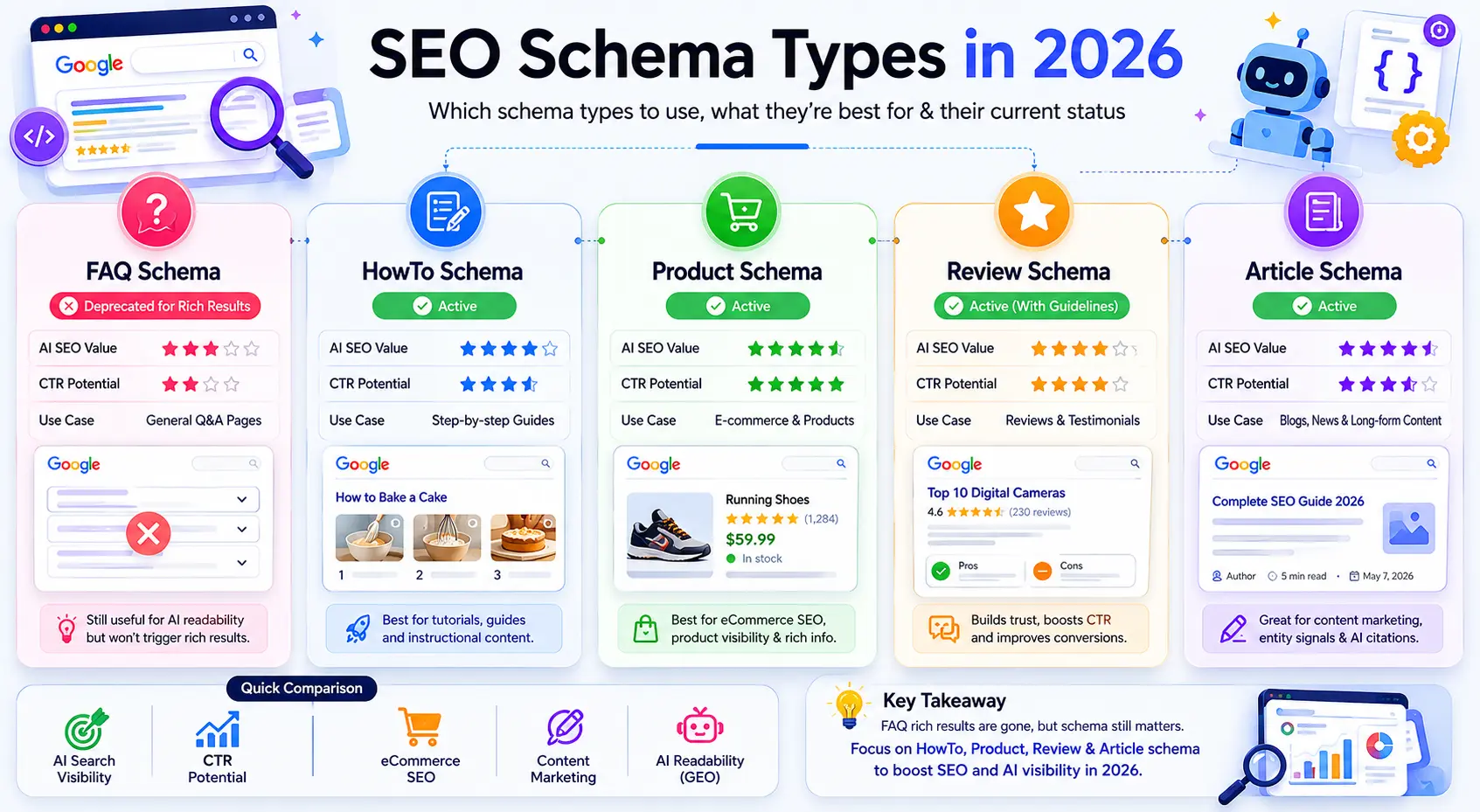
The FAQ deprecation is a useful prompt to audit your overall structured data strategy. Here are the schema types that still produce active rich results and deserve your attention.
HowTo Schema for Instructional Content
HowTo schema still generates rich results for instructional, step-by-step content. If your site publishes guides, tutorials, or process-oriented content which describes a large percentage of content marketing output HowTo is arguably the most underused schema type in the commercial space. It directly addresses user intent for “how to” queries and produces results that expand visually in search.
Product and Review schema for e-commerce and SaaS
Product schema surfaces pricing, ratings, availability, and review counts directly in search results. For e-commerce and SaaS companies, this is one of the most conversion-relevant structured data types available. Review schema works in combination with Product to display
star ratings a trust signal that meaningfully influences click decisions before a user ever lands on your page.
Article and Entity schema for authority and AI citation
Article schema combined with clean Organization and Person markup is increasingly important for entity disambiguation helping both Google and AI platforms confidently identify who is behind the content. Sites with clean entity schema, including SameAs attributes pointing to authoritative identifiers like LinkedIn, Wikidata, and Crunchbase, are better positioned for Knowledge Graph recognition and AI citation consistency.
What This Update Means for the Future of SEO in 2026
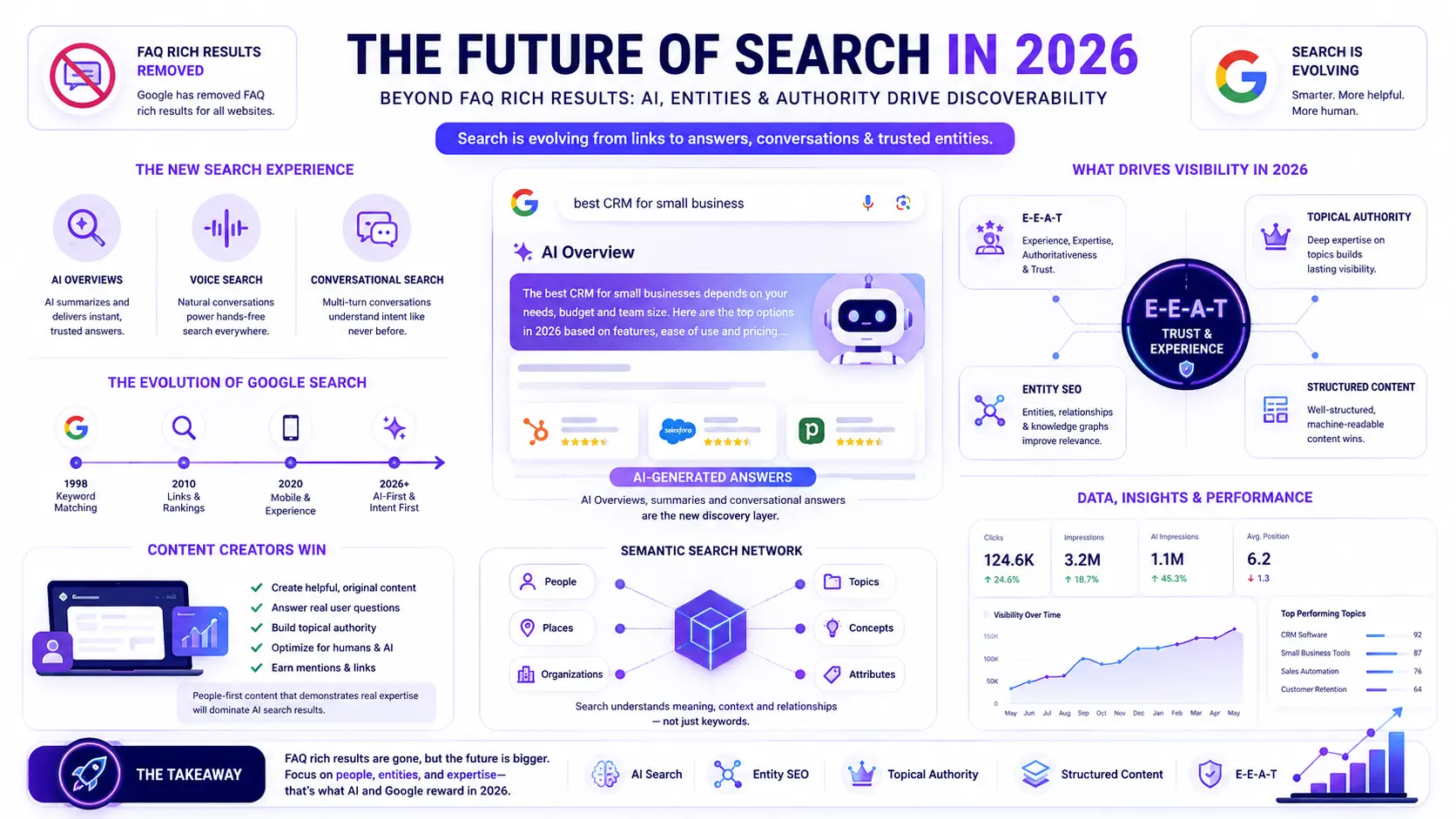
The FAQ deprecation is not an isolated event. It is part of a deliberate, multi-year reduction in publisher-controlled SERP enhancements. How-To rich results were pulled from mobile in 2023. Review schema has been progressively restricted. Each time, the pattern is the same: a feature becomes popular, gets abused, and Google removes or limits the reward.
The direction Google is moving in is clear: less space for publisher-driven visual enhancements, more space for Google’s own AI-driven formats like AI Overviews, featured snippets, and conversational results. Visibility in 2026 is becoming less about which SERP feature you can unlock and more about whether your content genuinely answers questions better than your competitors.
That is not a pessimistic conclusion. It is a clarifying one. Chasing schema-based SERP features has always been a diminishing returns game. The durable SEO strategy high-quality content, genuine authority, clean technical structure was always the right one. Google is just making it harder to shortcut around it.
As AI-powered search continues to evolve, staying updated with the latest SEO trends, Google algorithm changes, AI search optimization, and structured data strategies is becoming more important than ever. If you want to learn practical, industry-focused SEO skills and stay ahead of updates like these, enrolling in a digital marketing course in Kochi can help you gain hands-on knowledge in modern SEO, AI-driven search, content marketing, and performance marketing strategies.
Frequently asked questions
Does removing FAQ rich results affect my Google rankings? No. FAQ structured data was never a direct ranking signal. The change removes the visual Q&A dropdown in search results, not your page’s position. Pages that ranked well before will continue to rank based on content quality, relevance, and authority.
Should I delete FAQ schema from my website? Google advises against removing it proactively. FAQ Page schema remains a valid Schema.org type, is still crawled by AI and search engine crawlers, and may support entity understanding internally. Unless the markup is inaccurate or cluttering your codebase, leave it in place.
When will FAQ data disappear from Google Search Console? Search Console reporting and Rich Results Test support for FAQ markup end in June 2026. Search Console API support is scheduled for removal in August 2026.
Does FAQ schema help with AI search engines like Perplexity or ChatGPT? The evidence is mixed. Clear Q&A-structured content in your page body using question-based headings and direct answers appears to help AI parsing regardless of whether schema is present. Schema itself is one signal among many, and not the most impactful one for AI visibility.
What schema types should I use instead of FAQ? HowTo schema for instructional content, Product and Review schema for e-commerce and SaaS, and Article plus Organization schema for entity authority and AI citation positioning.
The FAQ rich results era lasted roughly five years from mainstream adoption to full removal. The lesson it leaves is the same one structured data has always taught: features that reward gaming get gamed, then get removed. What remains is the content.


