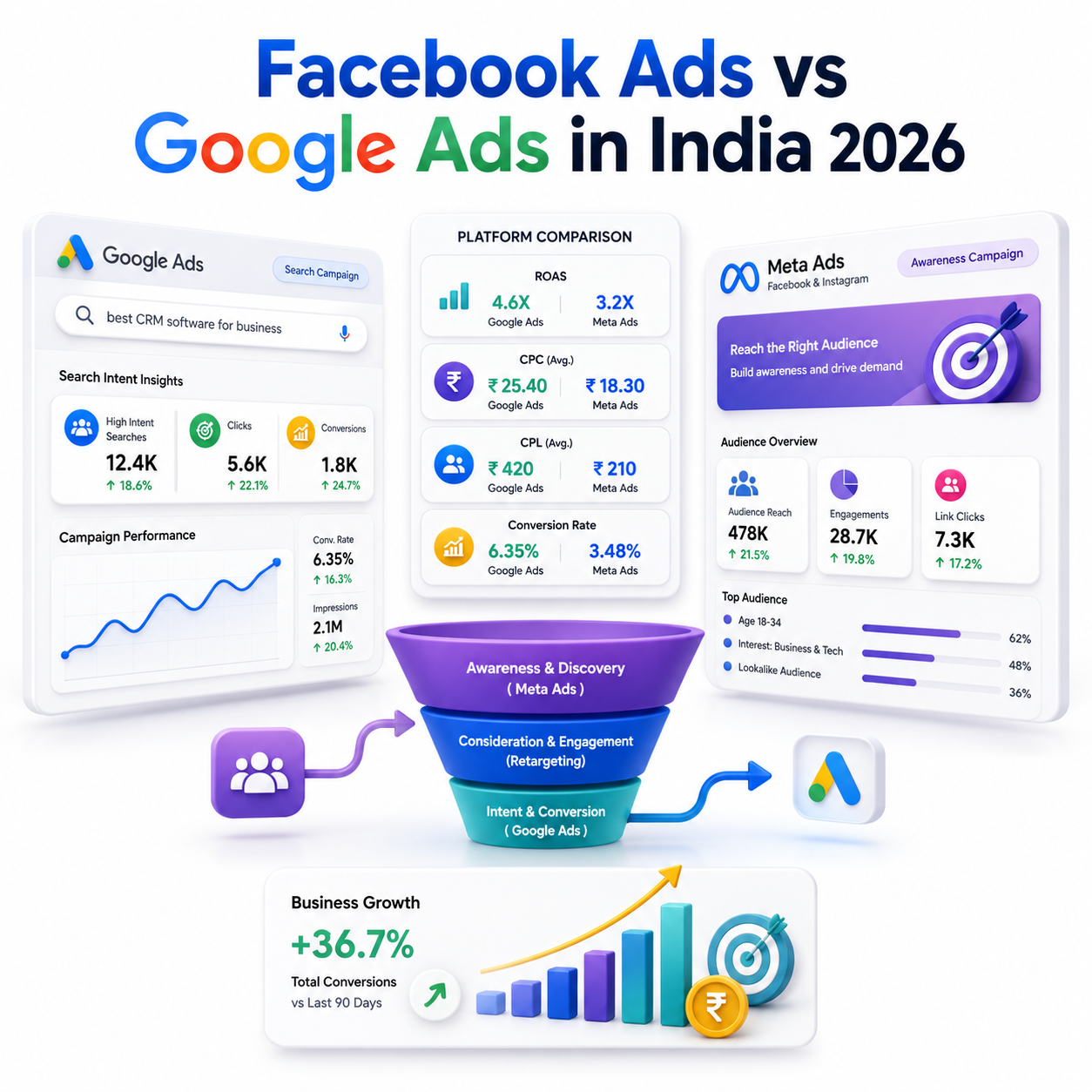
If you’re deciding where to put your next advertising money, “Facebook Ads vs Google Ads” feels like it should have a clean answer. It doesn’t and in 2026, it’s more complicated than ever. Both platforms now run on aggressive AI automation, and Meta has quietly changed
how it even counts conversions. That means the old habit of lining up two ROAS numbers and crowning a winner now compares two moving targets measured with two different rulers.
This guide does something more useful it shows you the real 2026 costs, how each platform actually returns money, and a framework
for deciding which one fits your business. The short version? Google captures demand, Facebook creates it and the highest-ROI advertisers usually run both.
The One Difference That Explains Everything
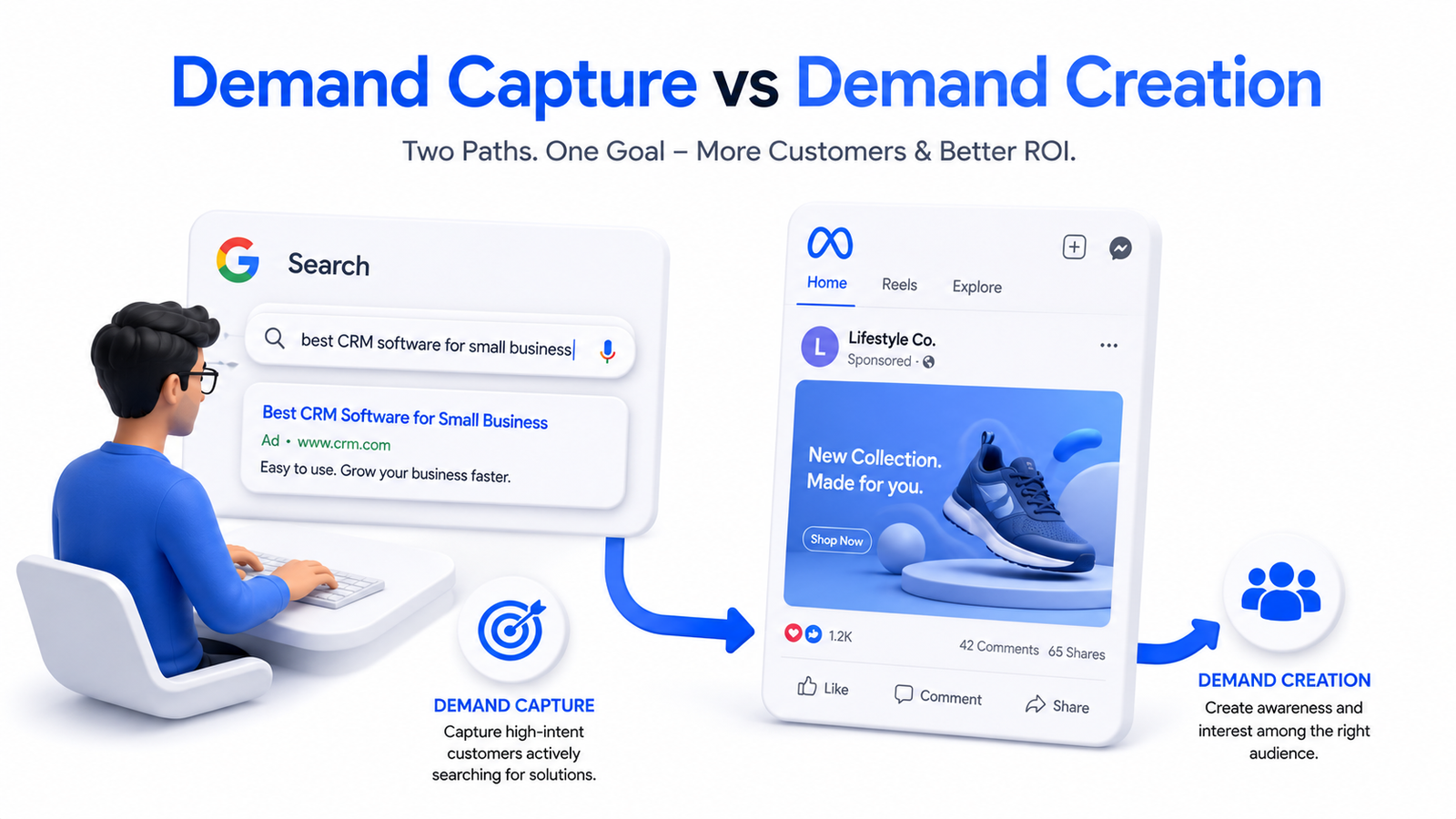
Before you look at a single number, understand this Google and Meta are not two versions of the same thing. They are built on opposite principles, and every difference in cost, conversion, and ROI flows from this one distinction.
Google Ads — catching demand that already exists
On Google, someone types a query. They are actively looking for a product, service, or solution. When a person searches “best CRM for small business” or “dentist in Kochi,” they have already decided they want something Google simply puts you in front of them at
that exact moment. This is high-intent, demand-capture advertising.
Meta Ads — creating demand before the search
On Meta (Facebook and Instagram), nobody is searching. They’re scrolling through photos, reels, and updates. Your ad interrupts that scroll based on their interests, behaviour, and demographics. This is demand generation you’re showing people things they didn’t
know they wanted yet. It’s interest-based, not intent-based.
Hold onto this distinction. It explains why Google clicks cost more, why Meta is better for discovery, and why so many smart brands eventually run both.
What Each Platform Actually Costs in India (2026)
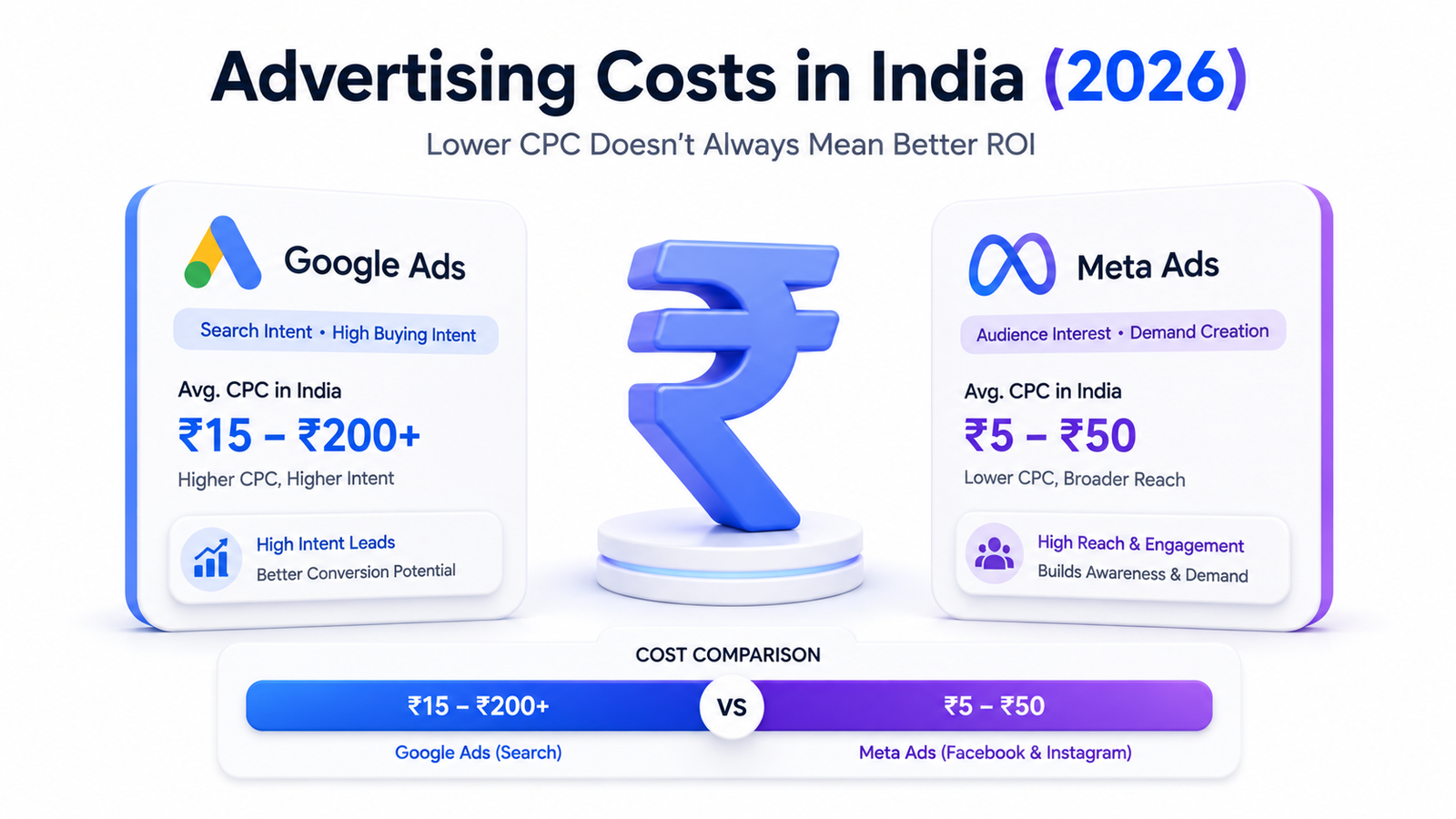
Most comparison articles quote global averages and stop there. But India is a unique “high volume, low margin” market where costs swing dramatically by city tier, industry, and targeting. A lead in South Mumbai can cost up to 10x a lead in Tier-3 India. Here are the real
rupee benchmarks for 2026.
Meta Ads (Facebook + Instagram)
- Average CPC: ₹5 – ₹50
- Best For: Discovery campaigns, retargeting, visual products, brand awareness
- Main Cost Driver: Creative quality, audience targeting, and engagement signals
Google Search Ads
- Average CPC: ₹15 – ₹200+
- Best For: High-intent users, lead generation, service businesses, direct conversions
- Main Cost Driver: Keyword competition, Quality Score, and industry demand
Google Ads CPC in India
Google is generally the more expensive platform. The average cost per click on Google Search ranges from ₹15 to over ₹200, depending entirely on your sector. Competitive industries finance, legal, real estate, insurance, and education sit at the high end because every advertiser is bidding on the same valuable, high-intent keywords.
Meta Ads CPC and CPM in India
Meta remains the budget-friendly option for most Indian businesses, with CPCs typically between ₹5 and ₹50 and CPMs starting around ₹20. Cheaper clicks make it ideal for building reach and feeding the top of your funnel but cheaper clicks are not the same as cheaper customers.
Why cost per click is the wrong metric
Here’s the trap: comparing platforms on CPC alone leads you to the wrong conclusion. A ₹10 Meta click that never converts is far more expensive than a ₹150 Google click that turns into a paying customer. If lead generation is your goal, your cost per lead (CPL) and cost per acquisition (CPA) are the only numbers that matter. Always evaluate down the funnel, not at the click.
ROI and ROAS — The Comparison That Matters
Cost is only half the equation. Return is the other half, and this is where the real decision lives.
What is a good ROAS in India?
For well-managed campaigns in competitive niches, return on ad spend (ROAS) in India typically lands between 3X and 8X. Anything above 4X is generally profitable for most ecommerce and lead-generation businesses. But “good” is relative to your margins a high-margin coaching program can stay profitable at 3X, while a thin-margin ecommerce product may need 6X or more just to break even.
How intent affects conversion rate
Because Google captures people who are already searching, its traffic usually converts at a higher rate for bottom-funnel goals. Meta’s traffic is colder you’re catching people earlier in their journey so conversion rates are often lower per click, but the lower cost and
massive reach can balance the equation, especially when paired with strong retargeting.
The hidden cost nobody mentions
Platform spend is not your total cost. Factor in creative production (Meta is creative-hungry and needs fresh visuals constantly), campaign management or agency fees, and the “learning phase” the first few weeks where the algorithm burns budget figuring out your audience. Budgeting only for ad spend is how businesses end up disappointed by both platforms.
Which Platform Wins for Your Business Type
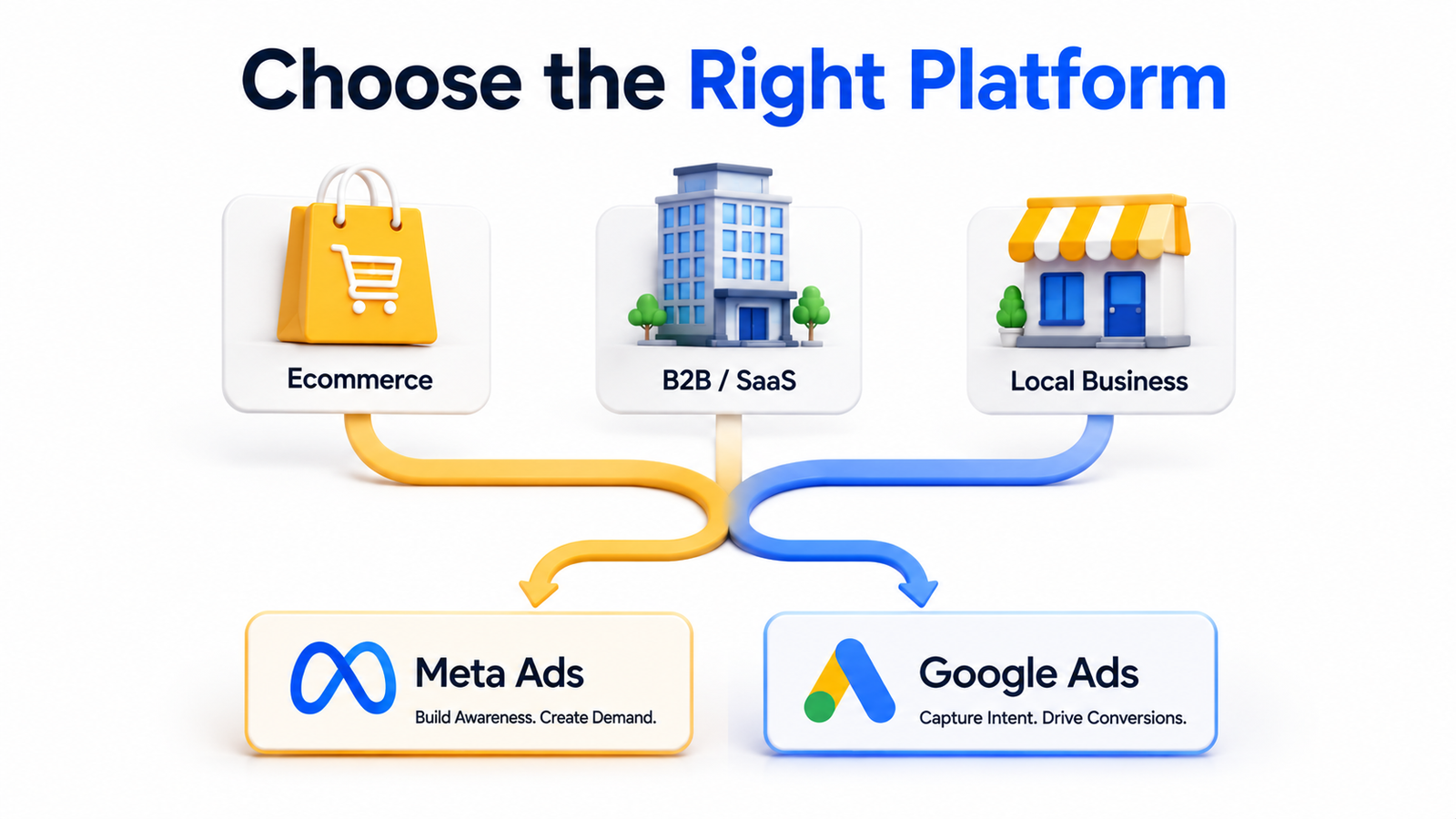
This is where the answer finally stops being “it depends” and starts being specific.
Ecommerce and D2C brands
Meta usually leads for ecommerce discovery visual creative and interest-based targeting surface your products to people who weren’t searching yet. Google Shopping and Performance Max then capture buyers with clear purchase intent. This matters more than
ever in 2026, with commerce-led advertising the fastest-growing segment in India at 24.2% annual growth. Most successful Indian D2C brands run both, leading with Meta.
Local service businesses (clinics, salons, real estate)
Google wins for immediate local leads. When someone searches “physiotherapist near me” or “2BHK flat in Calicut,” they want to act now, and Google’s local targeting and call extensions capture that intent directly. Use Meta to build local awareness and stay top-of mind.
B2B, SaaS, and high-ticket services
Google generally wins here too. Decision-makers research solutions through search, and the high intent justifies higher CPCs because a single closed deal can cover months of ad spend. Meta plays a supporting role for retargeting and thought-leadership content.
Coaching, education, and lead-gen businesses
This is the most genuinely split category. Meta excels at filling the funnel with low-cost leads through compelling creative and lookalike audiences, while Google captures warmer prospects actively searching for courses and training programs. For example, students looking for a digital marketing course in Trivandrum often begin their journey through Google Search, whereas Meta Ads can create awareness among potential learners who have not yet started searching. The winner depends on your offer price, audience awareness, and how warm a lead you need before conversion.
When Running Both Is the Smarter Move
For most growing businesses, the honest answer to “Facebook Ads vs Google Ads” is both used as a single full-funnel system rather than two separate experiments.
The most effective paid-media strategy in India in 2026 isn’t choosing a side. It’s using Meta to create demand and reach new audiences, then Google to capture the high-intent searchers ready to buy with retargeting connecting the two.
A sample full-funnel split for ₹50,000/month
A practical starting allocation might look like: ₹ 25,000 to Meta for top-of-funnel discovery and retargeting, ₹ 20,000 to Google Search for bottom-funnel capture, and ₹ 5,000 held back for testing and scaling whatever performs. Adjust based on data after the first month never set and forget.
How to attribute results across both platforms
Running both makes attribution trickier, since a customer might discover you on Instagram and convert via a Google search later. Use UTM parameters, a unified analytics view, and don’t judge each platform in isolation Meta often “assists” conversions that Google gets
full credit for.
How to Decide in Under 5 Minutes
Skip the analysis paralysis. Ask yourself three questions:
- Does demand for your product already exist as searches? If people are actively Googling what you sell — lean Google.
- Is your product visual, impulse-driven, or new with healthy margins? If you need to create demand and your creative can stop a scroll — lean Meta.
- Is your sales cycle long or considered (B2B, high-ticket)? Use Google to capture the researchers and Meta to nurture them with retargeting.
Frequently Asked Questions
Is Facebook or Google better for ROI in India? Neither wins universally. Google Ads typically delivers stronger ROI for high-intent goals like lead generation and local services, while Meta Ads wins for ecommerce discovery, brand-building, and retargeting. The
better-ROI platform depends on your business type, margins, and where your buyers sit in their decision journey.
Which is cheaper, Meta Ads or Google Ads in India? Meta Ads are almost always cheaper per click, with CPCs of roughly ₹5-₹50 versus Google Search’s ₹15-₹200+. But cheaper clicks don’t mean cheaper customers. Google’s higher-intent traffic often converts better, so judge platforms on cost per lead, not cost per click.
Should I run both Facebook and Google Ads together? Yes, for most growing businesses this delivers the best results. Use Meta to create demand and reach new audiences, then Google to capture high-intent searchers ready to buy. Running both as a full-funnel strategy, with retargeting between them, usually beats relying on either alone.
Which platform is better for ecommerce in India? Meta usually edges ahead for ecommerce discovery, thanks to visual creative and interest-based targeting that surfaces products to people not yet searching. Google Shopping and Performance Max then capture buyers with purchase intent. Most successful Indian D2C brands run both, leading with Meta.
Conclusion: Your 2026 Ad Budget Verdict
There is no universal winner in the Facebook Ads vs Google Ads India debate, and anyone who tells you otherwise is selling something. Google Ads owns high-intent demand capture, Meta Ads owns demand creation and discovery. The smartest Indian advertisers in
2026 don’t pick a side they build a full-funnel system where Meta finds the audience and Google closes the deal.


