
You publish blog posts, send newsletters, and maybe record the occasional video. Then someone asks the question every content creator dreads: “Is it actually working?”
ROI (Return on Investment) helps you understand whether your content marketing efforts are generating meaningful results. When you publish blog posts, send newsletters, or create videos, measuring ROI allows you to compare the revenue your content generates with the total cost of creating and distributing it. Instead of relying only on page views and traffic numbers, you can evaluate your content’s actual business impact.
This guide walks you through the process in plain language. You’ll get a simple formula, a worked example, the metrics that matter, and a free setup you can use today. No data science degree required.

What Is Content Marketing ROI?
Content marketing ROI (return on investment) is the revenue your content generates compared with what you spend creating and distributing it. It is expressed as a percentage: (return minus investment) divided by investment, times 100. A 100% ROI means every dollar spent came back with one extra dollar of profit.
Why Is Content ROI Hard to Measure?
Content rarely works like a checkout button. A reader might find your blog post through Google, leave, return through an email three weeks later, and only then buy. Revenue arrives late, credit is shared across several touchpoints, and many benefits, such as trust and brand awareness, don’t come with a price tag.
That’s why many beginners fall back on traffic numbers. They’re easy to find, but they don’t tell you whether content makes money. The five steps below solve this by connecting every piece of content to a specific business outcome.
How to Measure Content Marketing ROI in 5 Steps

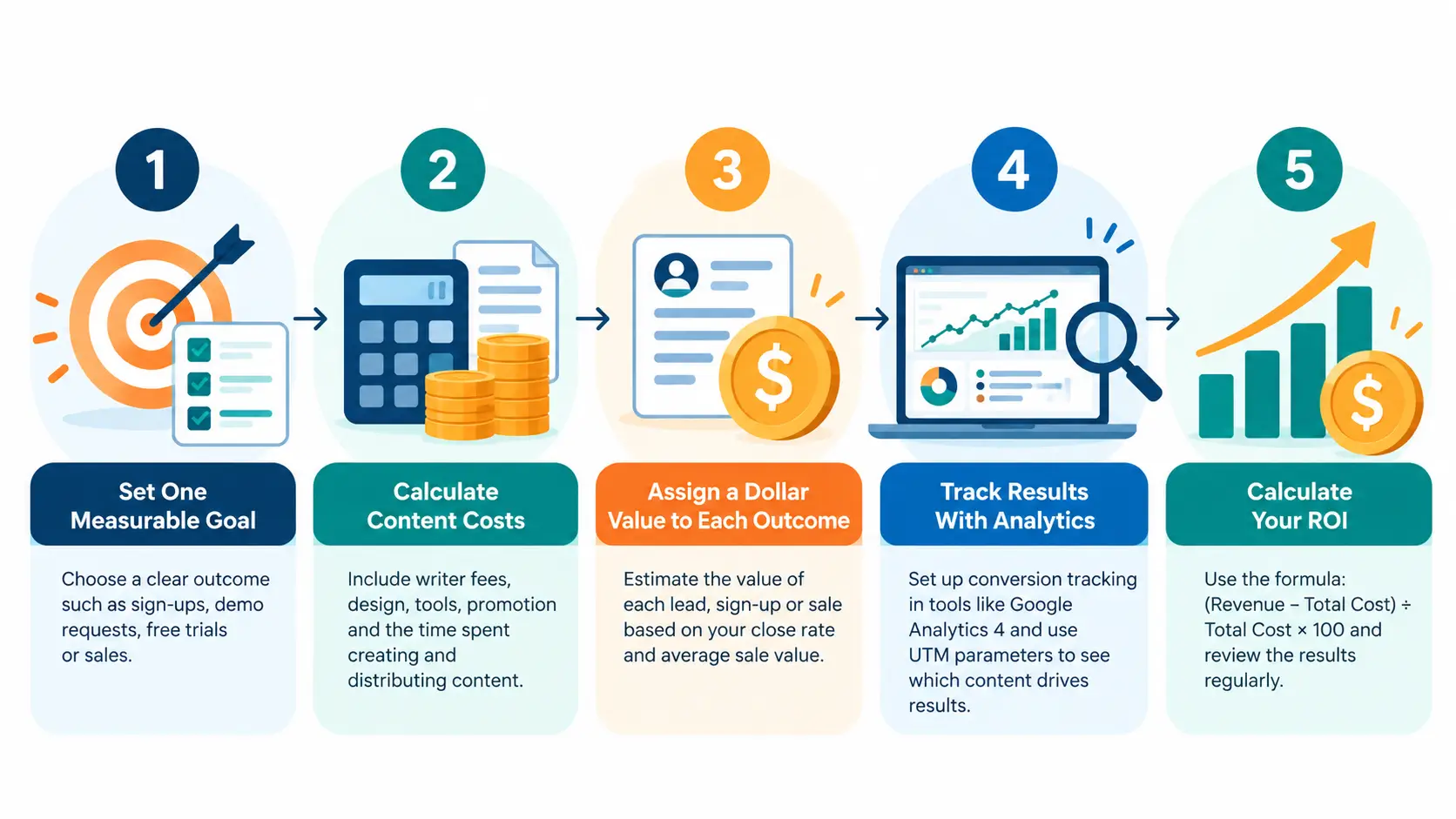
Step 1: Set One Measurable Goal
Start with a single outcome that matters to the business: newsletter sign-ups, demo requests, free trials, or sales. Vague goals like “more awareness” can’t be turned into a dollar figure. Pick one goal per piece of content or campaign, and write it down before you publish.
Step 2: Add Up Your Total Content Costs
Most beginners undercount here, which inflates ROI. Include everything: writer or freelancer fees, design and video costs, software subscriptions, paid promotion, and the staff time spent planning, editing, and publishing. To value your own time, multiply hours worked by an hourly rate. Your annual salary divided by working hours is a fair estimate.
Step 3: Assign a Dollar Value to Each Outcome
Not every conversion is a sale, so you’ll need to estimate what each one is worth. For leads, use this calculation: lead value = close rate × average sale value. If 10% of leads become customers and the average sale is $1,000, each lead is worth $100.
The same logic works for newsletter sign-ups. Ask how many subscribers eventually buy, and how much they spend. Use your own historical numbers wherever possible.
Step 4: Track Results With Analytics and Attribution
Set up conversion tracking in Google Analytics 4 so it records sign-ups, form submissions, or purchases. Add UTM parameters to links you share in emails and social posts so you can see which channel sent each visitor.
Attribution is the process of giving content credit for a conversion. Beginners can keep it simple: credit the last piece of content a customer read before converting, then note any posts that appeared earlier in the journey.
Step 5: Calculate Your ROI
Plug your numbers into the formula below, record the result in a spreadsheet, and repeat monthly. The trend over time matters more than any single month’s figure.
The Content ROI Formula (With a Worked Example)
Content marketing ROI (%) = (Revenue from content − Total content cost) ÷ Total content cost × 100
How Do You Calculate Content Marketing ROI?
Here’s a hypothetical example. A small software company spends $5,000 over three months on four blog posts and a lead magnet, covering freelancer fees, design, and staff time. Those assets bring in 120 leads. At $100 per lead, that’s $12,000 in attributed value.
- Revenue from content: 120 × $100 = $12,000
- Total content cost: $5,000
- ROI: ($12,000 − $5,000) ÷ $5,000 × 100 = 140%
Every dollar spent returned $2.40. If some of those leads also read other content before converting, note it separately rather than double-counting the revenue.
How Do You Measure ROI on a Single Blog Post?
Use the same formula at post level. Take the actual cost of that post, then count only the conversions that began or passed through it. If one $500 post generated 8 leads worth $100 each, its ROI is ($800 − $500) ÷ $500 × 100 = 60%.
Key Metrics to Track Alongside ROI
ROI is the headline number, but other metrics explain why it moves up or down.
What Metrics Should Beginners Track?
- Outcome metrics: conversions, revenue attributed to content, cost per lead, and customer acquisition cost. These feed directly into your ROI calculation.
- Engagement metrics: engagement rate, average engagement time, scroll depth, and email click-through rate. They show whether readers actually care about what you publish.
- Visibility metrics: organic traffic, keyword rankings, and search impressions. They show whether the right people can find your content.
Why Traffic Alone Is a Vanity Metric
A post with 50,000 visits and no conversions costs you money, while a post with 500 visits and 40 leads may be your best asset. Always pair visibility numbers with an outcome so you know which content deserves more investment.
Free and Low-Cost Tools for Tracking Content ROI
How Do You Measure Content ROI Without Expensive Tools?
You only need three free tools. Google Analytics 4 tracks conversions and traffic sources. Google Search Console shows which queries bring people to your pages and how your rankings change. A simple spreadsheet logs costs, outcomes, and ROI by month. Add UTM tags to every shared link and you have a working measurement system.
When to Upgrade to Paid Attribution Software
Consider paid tools, such as a CRM or marketing analytics platform, once you publish at volume, run several channels, or have long sales cycles where tracking customers across touchpoints by hand becomes unreliable. Until then, free tools are enough.
What Is a Good Content Marketing ROI?
There is no universal benchmark. Any positive ROI means content earns more than it costs, and some marketers use a 3:1 ratio as a rough target. Results vary by industry, content type, and sales cycle, so compare against your own baseline first.
How Long Does It Take to See ROI?
Most content takes three to six months to show measurable returns, and SEO-driven content often needs six to twelve. That’s why a single monthly snapshot can mislead. It helps to think of content value in three buckets:
- Direct revenue: purchases or sign-ups traced straight to the content.
- Assisted value: leads who read the post before converting elsewhere.
- Compounding value: evergreen posts that keep earning long after month twelve.
Tracking all three gives a fairer picture than direct revenue alone.
5 Common Mistakes Beginners Make
- Measuring too early. Content needs time to work. Wait before judging.
- Ignoring staff time. Unpaid hours are still a cost.
- Tracking only traffic. Visits without conversions don’t prove ROI.
- Having no baseline. Record your starting numbers so you can see progress.
- Skipping conversion tracking. Set it up before you publish, not after.
Frequently Asked Questions
What is content marketing ROI?
Content marketing ROI is the revenue your content generates compared with what you spend creating and distributing it. It’s expressed as a percentage: (return minus investment) divided by investment, times 100. A 100% ROI means every dollar invested returned two dollars, covering the original dollar plus one dollar of profit.
How do you calculate content ROI?
Subtract your total content costs from the revenue attributed to that content, divide the result by the costs, then multiply by 100. Include writer fees, design, tools, promotion, and staff time in costs. For example, $5,000 of content that drives $12,000 in attributed revenue returns (12,000 − 5,000) ÷ 5,000 × 100 = 140%.
What is a good content marketing ROI?
There’s no universal benchmark, but any positive ROI means content earns more than it costs. Some marketers use a 3:1 ratio as a rough target, though results vary by industry, content type and sales cycle. Content compounds over time, so judge performance over 6–12 months rather than weeks, and compare against your own baseline.
How long does it take to see content ROI?
Most content takes 3–6 months to show measurable returns, and SEO-driven content often needs 6–12 months to reach its full potential. Paid promotion or email can produce faster signals. Track leading indicators like rankings, engagement and subscribers early, then measure revenue-based ROI once enough time has passed.
Which metrics matter most for content ROI?
Start with metrics tied to business goals: conversions (leads, sign-ups, sales), revenue attributed to content, cost per lead and customer acquisition cost. Support them with organic traffic, engagement rate and email subscribers. Traffic alone is a vanity metric unless it connects to a conversion, so always pair visibility numbers with outcomes.
Can you measure content ROI without paid tools?
Yes. Free tools cover the basics: Google Analytics 4 tracks conversions and traffic sources, Google Search Console shows search performance, and a simple spreadsheet logs costs and revenue. Set up conversion goals first, use UTM parameters on shared links, and review results monthly. Paid attribution software is only needed as volume grows.
Conclusion and Next Steps
Measuring content marketing ROI comes down to three habits:
- Pick one goal and put a dollar value on it.
- Count every cost, including your time.
- Track results monthly, and judge them over months, not days.
Start with a spreadsheet and Google Analytics 4 this week. Even a rough ROI figure beats guessing.


