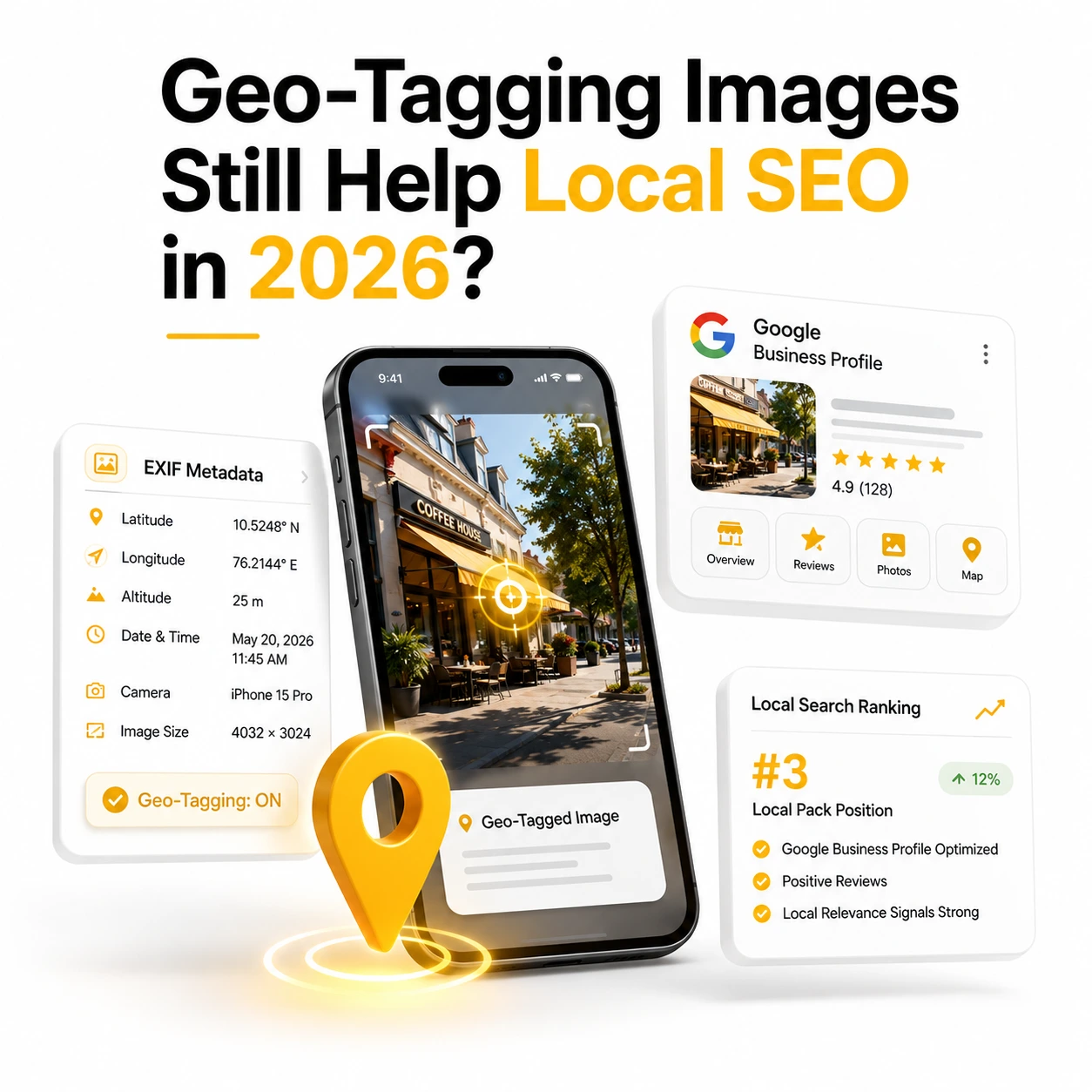
If you’ve spent any time in local SEO forums recently, you’ve seen the debate play out in real-time. On one side agency owners swearing that geotagging their Google Business Profile photos moved the needle on local rankings. On the other researchers running controlled tests and finding precisely zero impact. Both groups are confident. Both groups have anecdotes.
So what’s actually true? And more importantly should you be spending time on this in 2026?
This article cuts through the noise. We’ll explain what geo-tagging actually does at a technical level, walk through the best evidence available, and give you a clear answer on where your time is better spent.
Quick Verdict
Geo-tagging images has no measurable effect on Google or Google Business Profile rankings. Multiple controlled studies confirm this. It may help slightly for “near me” queries in a narrow context, and it does work on Bing. For your website images and GBP strategy, there are much higher-ROI actions to prioritize.
What Is Image Geo-Tagging, and How Does It Work?
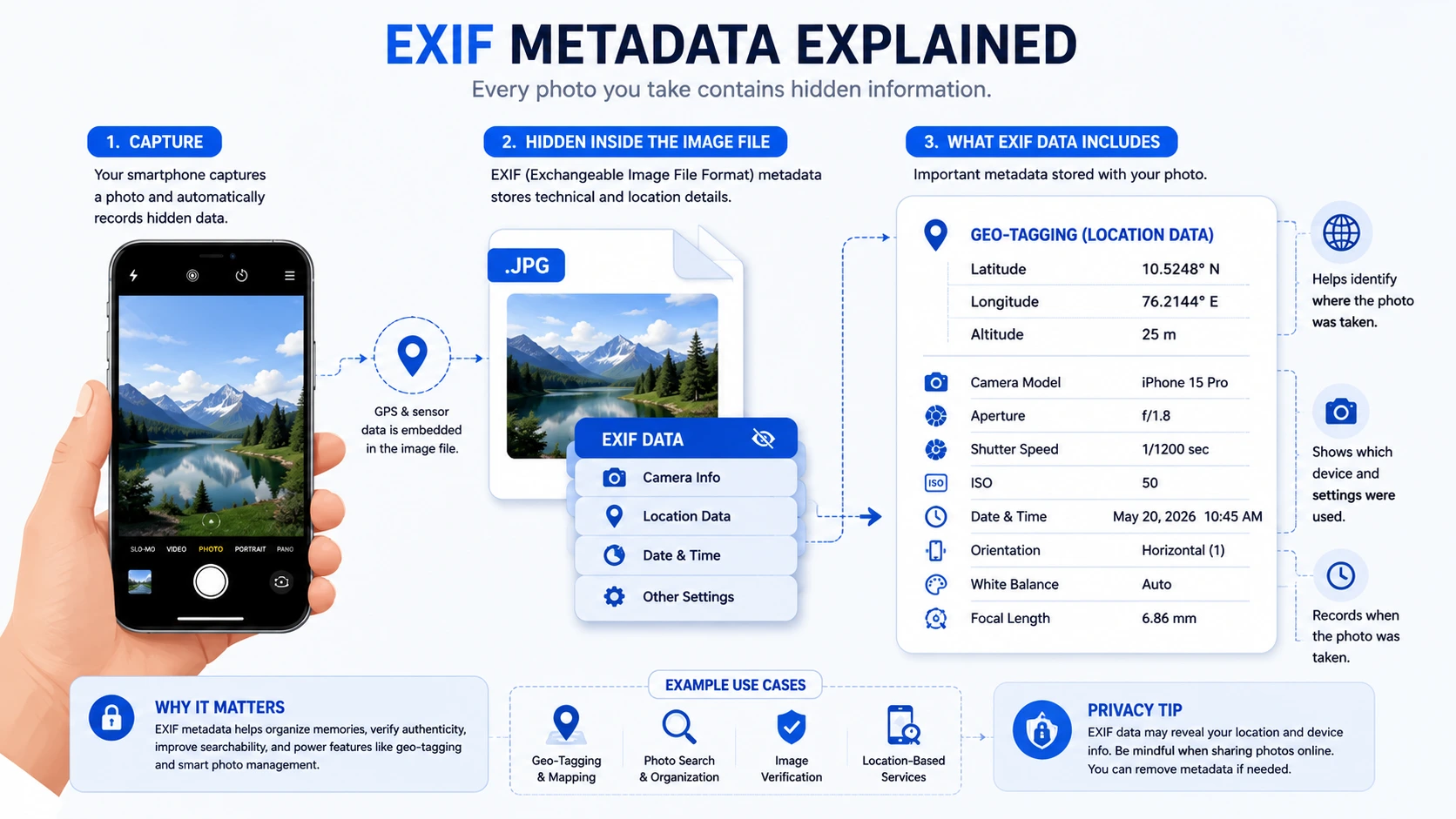
Every digital photo contains hidden data called EXIF metadata information like the camera model used, shutter speed, aperture, and timestamp. When your smartphone has location services enabled, it also records GPS coordinates: latitude, longitude, and sometimes altitude. The result is a photo that “knows” where it was taken.
Geo-tagging is the process of embedding this location data into an image file, either automatically via GPS at the time of capture, or manually using tools after the fact. Common tools include GeoImgr (a desktop app), ExifTool (command-line, great for batch processing), and various smartphone apps like GPS Map Camera.
The appeal for local SEO is intuitive. If a photo of your restaurant kitchen was taken at your restaurant’s exact coordinates, shouldn’t that reinforce to search engines that your business is genuinely located there? That’s the theory. Reality, as it turns out, is messier.
Why SEOs Believed This Would Work
The logic behind geo-tagging as a ranking signal was always reasonable on the surface. Local SEO is fundamentally about proximity and relevance Google wants to serve results that are physically close to the searcher and genuinely relevant to the query. Location data embedded in images seemed like a supporting signal for both.
The tactic gained traction in the early 2010s alongside the rise of smartphones with built-in GPS. By the mid-2010s, it had become standard advice in many local SEO checklists. A cottage industry of geo-tagging tools sprang up specifically marketing to local businesses and agencies. The pitch was simple tag your images with your business coordinates before uploading them to your Google Business Profile, and watch your local rankings improve.
It was easy to implement, cost nothing, and critically hard to disprove without controlled testing. Anecdotal “it worked for me” stories filled the void where data should have been.
What the Evidence Actually Shows
This is where things get interesting and where the SEO community should pay close attention, because the answer is more nuanced than a simple yes or no.
The Sterling Sky test
Joy Hawkins, owner of local SEO agency Sterling Sky and one of the most credible researchers in the space, ran a controlled test in January 2024 across five Google Business Profile locations. Her conclusion: no measurable ranking increase over several weeks of geotagged uploads. A subsequent independent test by Tim Kahlert, CEO of Hypetrix, confirmed the same finding “this tactic currently has no effect on local rankings.”
More recently, reporting has referenced expanded Sterling Sky testing across 27 GBP locations, with the same result no ranking impact from geotagged photos. Some locations actually declined.
What ex-Google engineers say
Google’s John Mueller stated on Reddit that geotagging images is unnecessary for SEO purposes. Joel Headley, formerly of Google, has confirmed that geotagged photos have no effect on local rankings. These aren’t anonymous forum comments these are named, credentialed people with direct knowledge of how Google processes image data.
In October 2025, Evergrow Marketing published a controlled study that produced a notably different finding. Their research found that geotagged GBP images improved rankings for “near me” queries 70% of the time, with 97% statistical confidence but showed mixed or negative results for city-plus-service searches (e.g., “plumber in Kochi”).
This is an important distinction. If you operate a hyper-local business that relies heavily on “near me” discovery think a cafe, a nail salon there may be a narrow case for geo-tagging. But for businesses targeting broader geographic areas or specific city-based keywords, the data suggests it could actually hurt your visibility.
What about Bing and Yahoo?
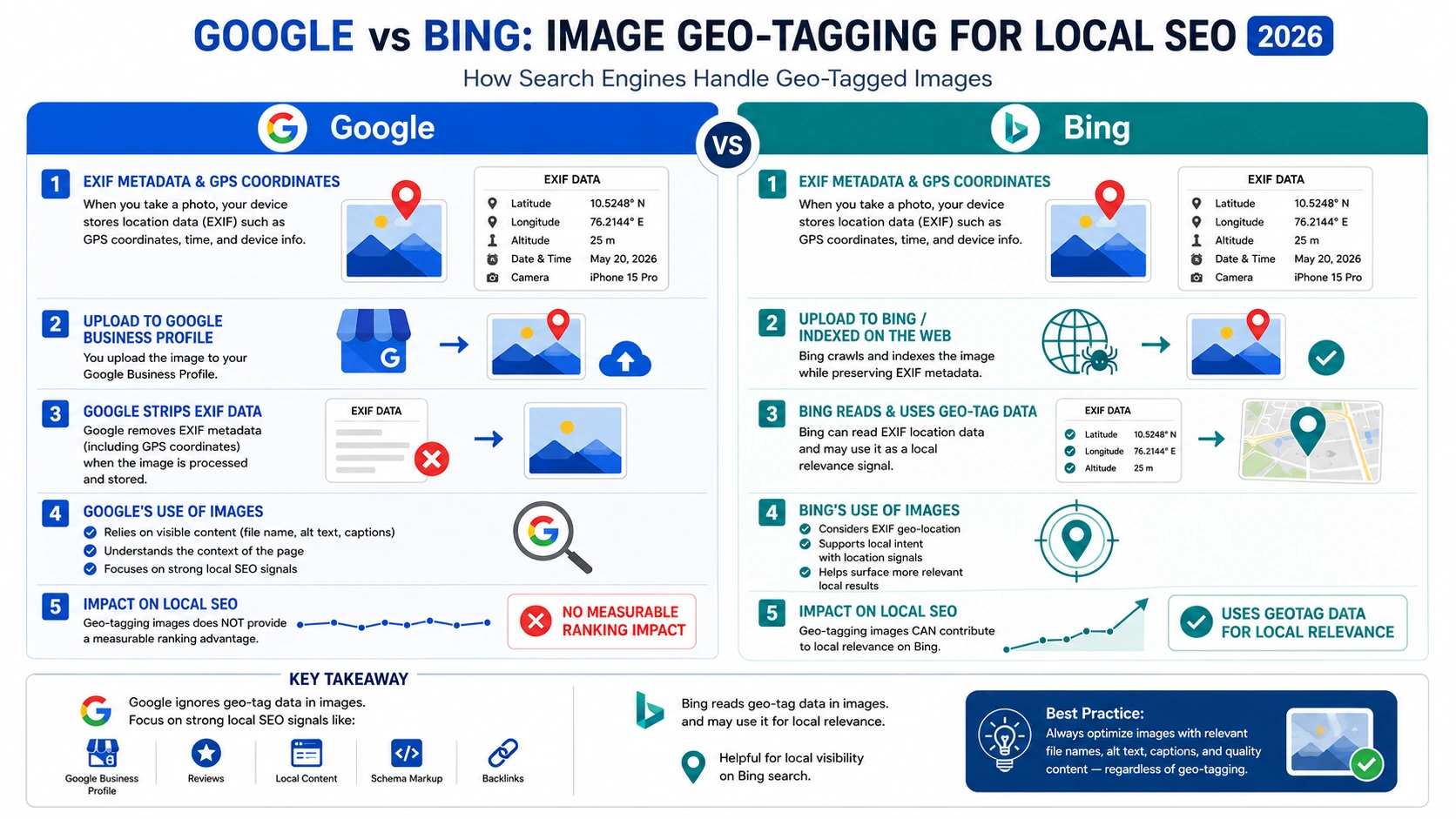
Here’s something most geo-tagging articles skip entirely the answer is different depending on which search engine you’re asking about. Unlike Google, Bing actively uses EXIF geotag data as a local relevance signal. If your business serves a market where Bing has meaningful share particularly in certain enterprise or desktop-heavy industries geo-tagging your website images is a low-effort tactic worth keeping.
Why Google Almost Certainly Ignores Geotags
Understanding the “why” here is more useful than just accepting the finding because it helps you build a durable mental model for evaluating future SEO tactics.
The core problem is manipulation. EXIF metadata can be edited by anyone with a free tool in under a minute. A business in Bengaluru can geotag photos with coordinates from a different city, or embed multiple locations into the same image. When a signal is trivially easy to fake, Google’s incentive is to stop relying on it entirely. This is precisely the same reason keyword-stuffed meta keywords tags were abandoned in the early 2000s.
There’s also a technical reality Google strips EXIF data when images are uploaded to GBP and when they’re processed through Google’s infrastructure. Even if Google wanted to use geotag data, it actively discards it during ingestion. Some researchers argue that Google reads the data during the initial upload before stripping it which might explain the Evergrow “near me” finding but this remains unconfirmed.
What Actually Moves Local Rankings in 2026
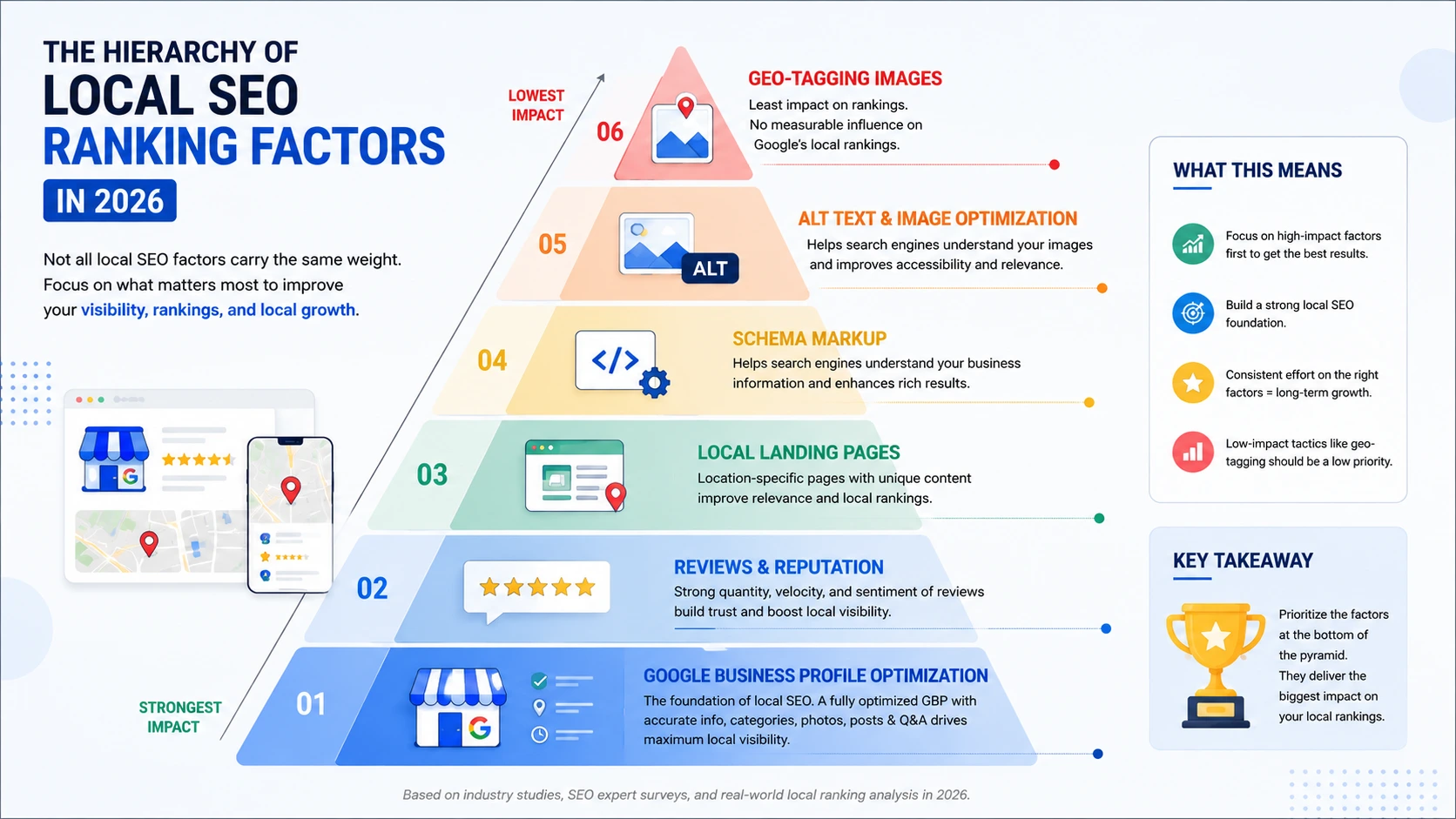
If geo-tagging isn’t worth your time, where should that time go? The Whitespark 2026 Local Search Ranking Factors survey gives the clearest picture of what actually works. Proximity (how close the business is to the searcher), GBP signals, review velocity and quality, and on-page local SEO dominate the findings.
For images specifically, here are the tactics with real evidence behind them:
- Keyword-rich, location-specific file names. Rename images before upload using a format like
pipe-repair-kozhikode-2026.jpg. This reinforces local relevance and improves visibility in Google Image Search. - Descriptive alt text with local keywords. Alt text is the single highest-leverage image SEO signal it’s what Google actually reads, and it’s what AI-powered search assistants like ChatGPT and Perplexity consume when indexing images.
- LocalBusiness schema markup on your site. Structured data tells Google your name, address, phone number, hours, and service area in a format it can parse unambiguously. Far more reliable than EXIF coordinates.
- Consistent, high-quality GBP photo uploads. Regular uploads of genuine, original images signal an active, legitimate business. Aim for complete coverage across Exterior, Interior, Team, Products, and At Work categories.
- Review velocity and response rate. Crossing review count thresholds produces measurable ranking lifts. Responding to reviews (including negative ones) also contributes to prominence signals.
- Manual geo-tagging for Google/GBP. No reliable evidence of benefit. Not worth the time investment when competing priorities exist.
The 2026 Verdict: Should You Bother?
Here is the clearest way to think about it geo-tagging images is a zero-harm, near-zero-benefit tactic for Google. If your smartphone already embeds GPS data automatically, there’s no reason to strip it. But deliberately spending time manually geo-tagging images before uploading them to GBP? The opportunity cost is real.
Every hour spent geo-tagging is an hour not spent generating reviews, writing city-specific landing pages, or optimizing your GBP categories all of which have strong evidence behind them.
The exception worth flagging if you operate in a market where Bing drives meaningful traffic, or if your business depends almost entirely on “near me” discovery (think locksmith, food delivery, emergency plumber), the Evergrow data suggests a narrow case for geo-tagging. Even then, treat it as a supporting tactic, not a primary strategy.
This practical understanding of what truly works in SEO is exactly the kind of industry-focused knowledge covered in a professional digital marketing course in Thrissur.


