The latest Meta Ads Updates 2026 are changing two things advertisers touch daily: how video creative gets made and who actually sees your acquisition ads. At Advertising Week New York in October, Meta opened Customer Lifecycle Strategy to everyone and made AI video generation from static images generally available. This guide explains how both work, what is still in testing, and how to use them together. If you’re newer to the platform, start with our guide on how to run Facebook ads in 2026.
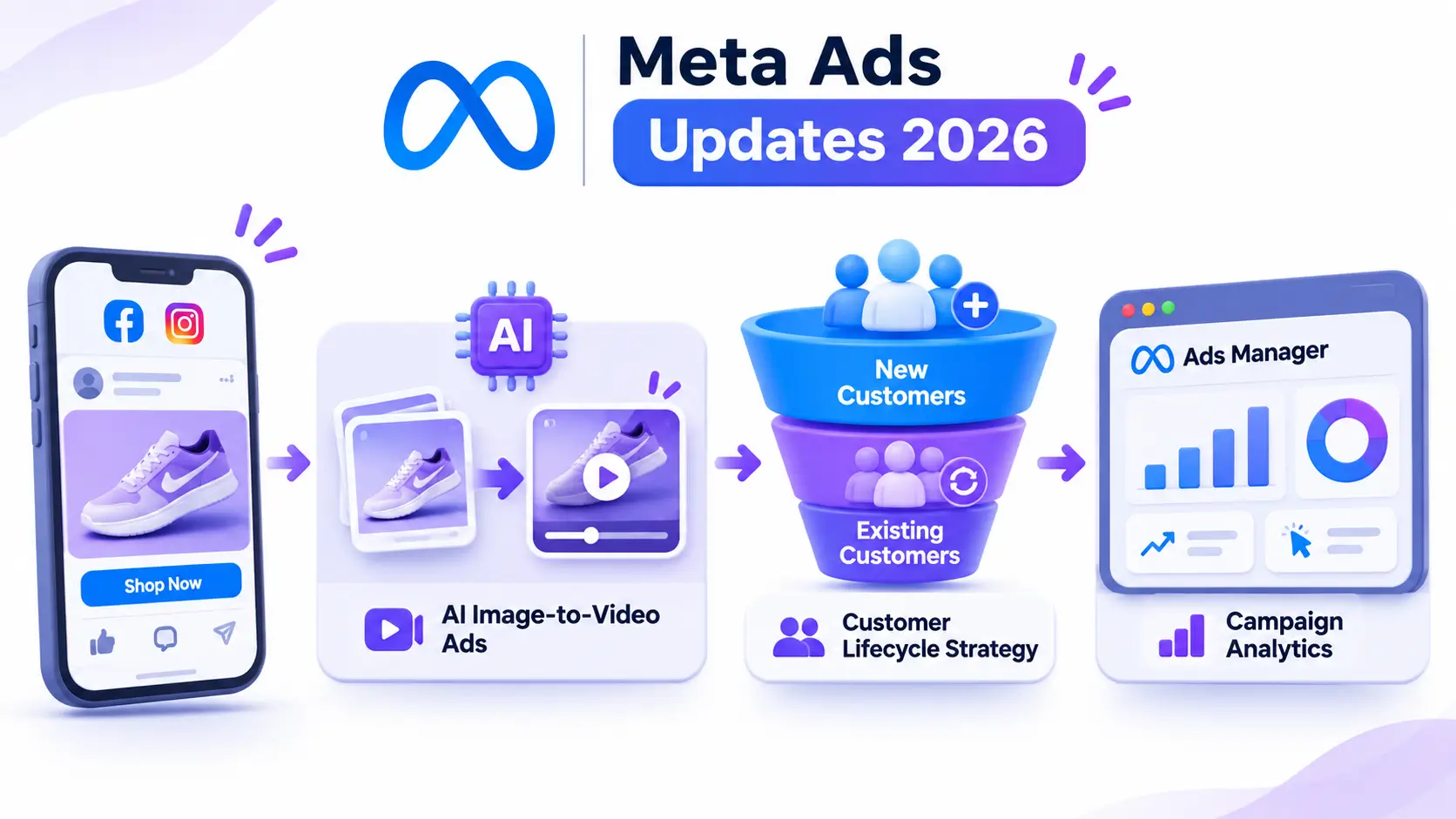
These Meta Ads Updates 2026 introduce new opportunities for advertisers to improve creative production and customer acquisition.
Key takeaways
- Video generation from static assets in Advantage+ creative is generally available.
- Customer Lifecycle Strategy lets you optimise for new customers only, at ad set level.
- Its automatic customer exclusions can’t be switched off.
- Use the two together: different generated creative for new and existing customers, judged on new customer acquisition cost (nCAC).
What’s New in Meta Ads in 2026: The Short Version
As part of the Meta Ads Updates 2026, on 6 October, Meta announced that Customer Lifecycle Strategy is open to all advertisers and that video generation from static assets in Advantage+ creative is generally available. The full list is in Meta’s Advertising Week New York 2026 post. The wording matters, because “available” and “testing” mean very different things for your account. relevantaudience
| Feature | Status |
| Customer Lifecycle Strategy | Available to all advertisers |
| Advantage+ creative video from static assets | Generally available |
| Ads Creative Studio | Rolling out gradually |
| Catalog product video | Beta, eligible advertisers only |
| Agentic assistant actions | Beginning to be tested |
| AI audience discovery in Detailed Targeting | Promised by end of 2026 |
Meta’s post lists no countries for any item, so check Ads Manager directly instead of assuming access. relevantaudience
How Meta’s AI Image-to-Video Ads Work
What Is Meta’s Image-to-Video Feature?
One of the major Meta Ads Updates 2026 is the image-to-video tool, which uses generative AI to turn still product photos into short, multi-scene video ads inside Ads Manager. Advertisers can upload up to 20 images, and the tool adds music and overlaid text. That removes the shoot, the editor and the agency invoice from the first draft of a video ad. stocktwits
Meta’s reason is simple: it says more than 60% of the time people spend on Facebook and Instagram is spent with video. That’s Meta’s own figure, and it gave no measurement period. relevantaudience
How to Create an Image-to-Video Ad

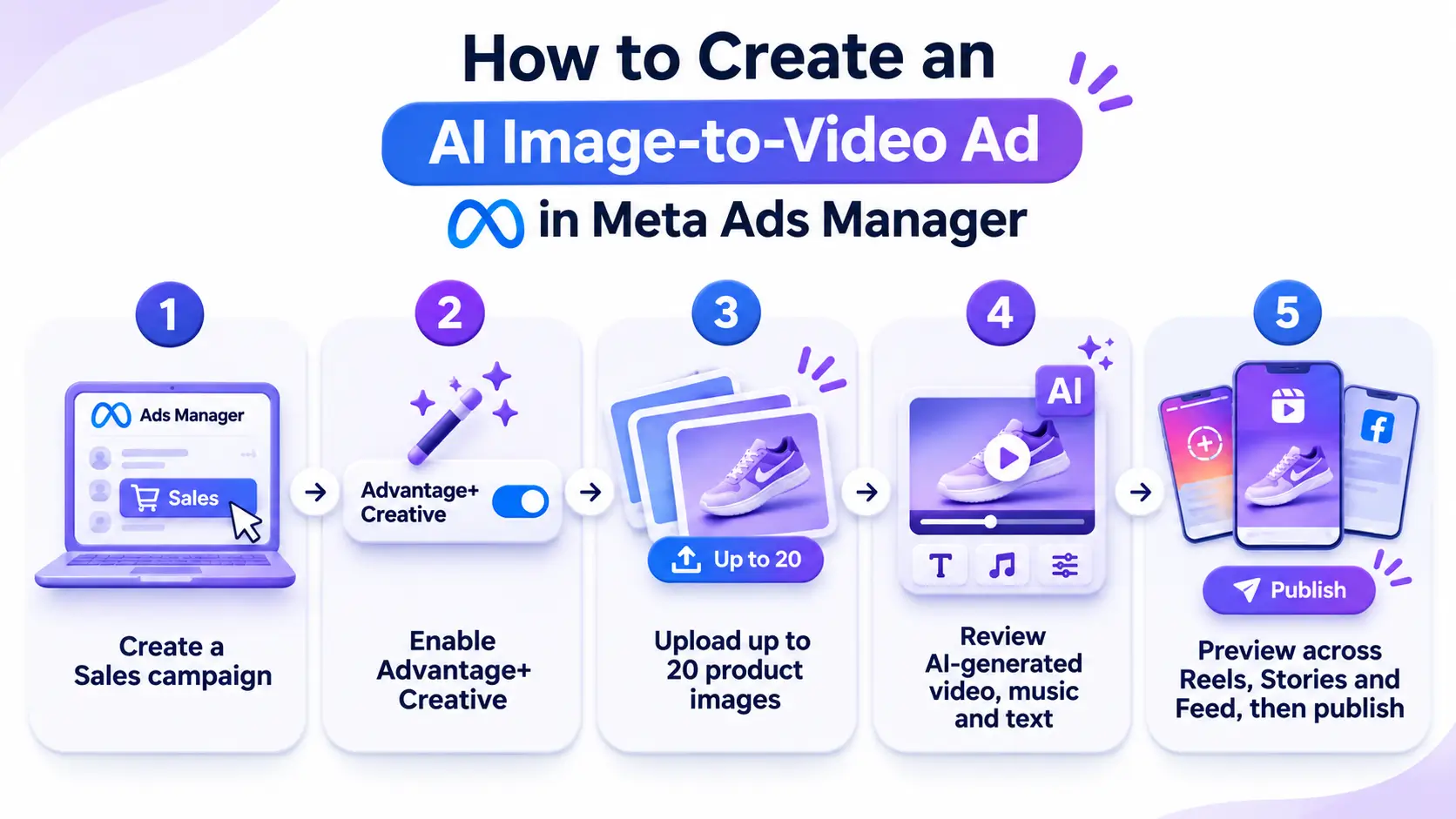
Menu labels vary by account, but the flow looks like this:
- Create a Sales or other eligible campaign in Ads Manager.
- At the ad level, turn on Advantage+ creative and enable video generation from your static assets.
- Upload or select your best product images (up to 20).
- Review the generated video, editing text, music and clip order where the tool allows.
- Preview across Reels, Stories and Feed, then publish.
Choosing Source Images That Perform
The output is only as good as the input. Use sharp, uncluttered product shots with consistent lighting, and include a mix of angles, in-use scenes and detail close-ups so the AI has variety to build scenes from. Avoid images with heavy text baked in, since the tool adds its own overlays.
AI-Generated vs Traditional Video
| Factor | Image-to-video (AI) | Traditional video |
| Production time | Minutes | Days to weeks |
| Cost | Low | Higher |
| Best for | Testing hooks, catalog and product ads | Brand storytelling, emotional campaigns |
| Creative control | Limited | Full |
Among the latest Meta Ads Updates 2026, AI video generation can serve as a testing engine. Use it to find angles quickly, then invest in filmed production for what wins.
Customer Lifecycle Strategy Explained: What Is It?
One important addition in the Meta Ads Updates 2026 is Customer Lifecycle Strategy, a setting in the ad set of Sales campaigns. It offers two choices: get conversions from all audiences, or acquire new customers. It isn’t a new objective or bidding strategy. Sales stays the objective, and this adds a layer of audience control. jonloomer
“All Audiences” vs “New Customers”
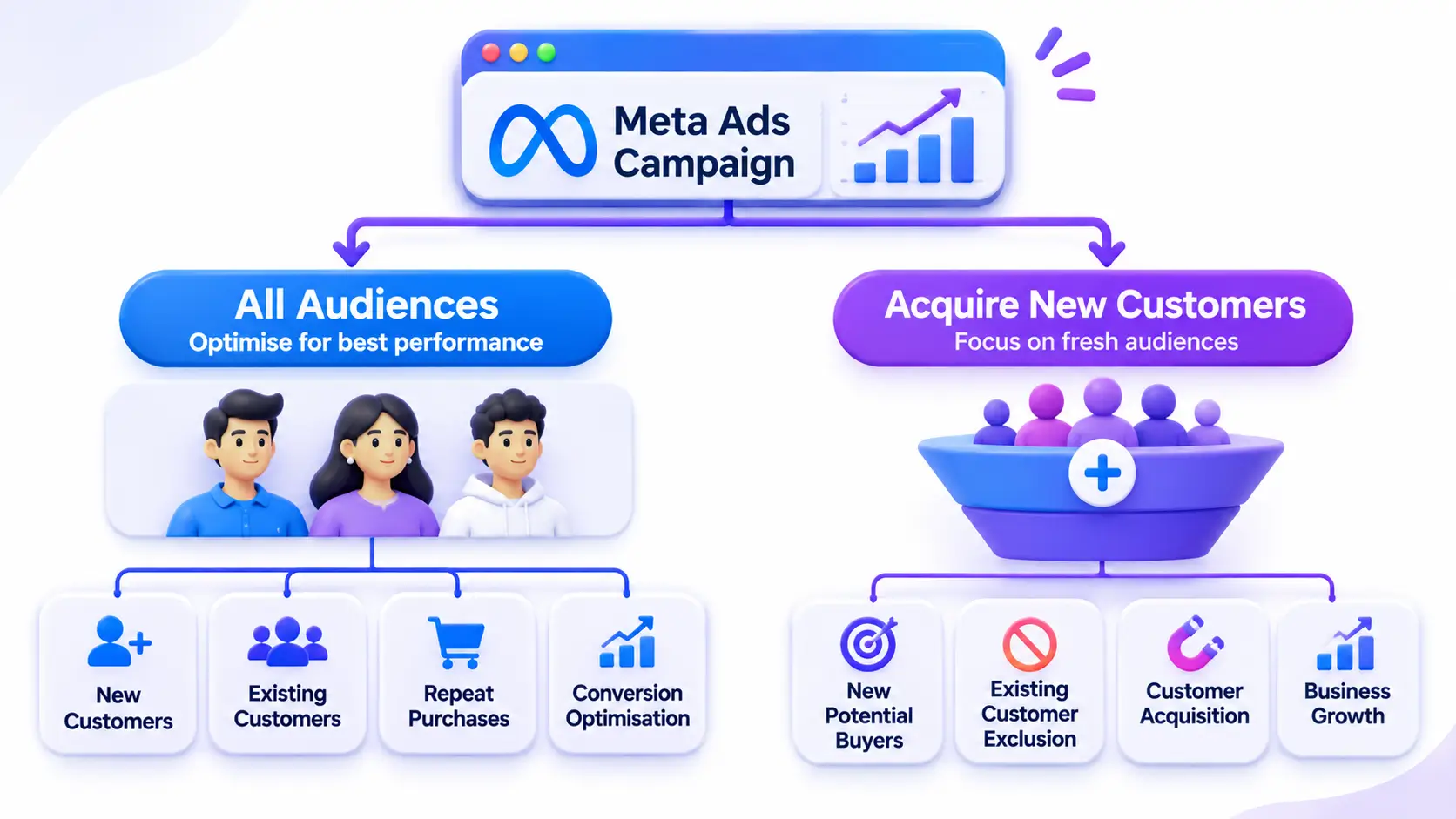
- Get conversions from all audiences: Meta optimises for the lowest cost per result across new and existing buyers. Choose it when blended efficiency matters and repeat purchases are welcome.
- Acquire new customers: Meta focuses delivery on people who haven’t bought before. Choose it when growth depends on expanding your customer base.
How to Set It Up
- Define your existing customers in your account settings through Pixel or Conversions API events and customer lists. Meta can only exclude buyers it can identify. As Jon Loomer explains, the Existing Customers audience segment is what makes the exclusion work.
- Create a Sales campaign using manual setup, since the option doesn’t appear in every Advantage+ scenario.
- Open the ad set and select Acquire new customers in the Customer Lifecycle Strategy dropdown.
- Add any custom audiences you want excluded on top of Meta’s defaults.
The 730-Day Exclusion Catch
When you choose to acquire new customers, Meta automatically excludes customers from your conversion data over 730 days, and you can’t turn this off. If you have a legitimate reason to reach past buyers, such as a high-value upsell, the workaround is to skip the setting and manage exclusions manually, as Loomer’s write-up on automatic exclusions describes. jonloomer
Does It Replace the Existing Customer Budget Cap?
Not exactly. Loomer calls it a 2026 twist on the Existing Customer Budget Cap from Advantage+ Shopping Campaigns. The old cap limited how much budget reached existing customers. The new setting excludes them. If you want a controlled split, use separate ad sets: one for acquisition and one for existing customers with a minimum spend. jonloomer
Combining Both: A Lifecycle-Based Creative Strategy
Most coverage treats these as separate features. They work better as one system.
For new customers, generate videos from lifestyle, benefit and problem-solving images. Your audience doesn’t know you, so lead with the hook and the use case.
For existing customers, generate videos around replenishment, cross-sell and loyalty cues, and run them in a separate ad set with its own budget.
Measure with nCAC, not just blended ROAS. Here’s a hypothetical example. You spend $10,000 and get 200 purchases, 120 from existing customers and 80 from new ones. Your blended cost per purchase looks healthy at $50, but your cost per new customer is $125. Retargeting-style conversions can flatter the blended number while acquisition quietly gets more expensive. Customer Lifecycle Strategy gives you a cleaner view of that second figure.
A 30-day test: In week one, set up two ad sets with the same budget, one on All audiences and one on New customers. In weeks two and three, run the same AI-generated creative in both. In week four, compare nCAC, not just ROAS, and keep a holdout or a comparison period to separate the effect from seasonality. If you manage accounts through AI tools, our guide to connecting Meta Ads MCP to Claude AI shows how to speed up reporting.
Limitations and Risks
Creative sameness. If every advertiser uses the same generator, differentiation has to come from your offer, brand assets and creative brief.
Unverified claims. Meta says advertisers who adopt its assistant’s recommendations typically see 5% more conversions at the same cost per conversion, but it published no method, period or vertical for the figure. Don’t build forecasts on it. Test in your own account. relevantaudience
Availability gaps. While the Meta Ads Updates 2026 introduce several new capabilities, many announcements, including agentic actions and AI checkout, are still tests with no firm dates.
Frequently Asked Questions
What is Meta’s image-to-video ad feature?
Meta’s image-to-video tool uses generative AI to turn still product photos into short, multi-scene video ads inside Ads Manager. Advertisers can upload up to 20 images, and the tool adds music and text overlays. Meta made video generation from static assets in Advantage+ creative generally available in October 2026.
What is Customer Lifecycle Strategy in Meta Ads?
Customer Lifecycle Strategy is an ad set–level setting in Meta Sales campaigns that tells Meta whom to prioritize. You choose between getting conversions from all audiences or acquiring new customers. The second option excludes existing buyers automatically, so your budget targets people who haven’t purchased from you before. Meta opened it to all advertisers in October 2026.
How do I turn on Customer Lifecycle Strategy?
Create or edit a Sales campaign in Ads Manager, open the ad set, and find the Customer Lifecycle Strategy dropdown. Select Acquire new customers instead of Get conversions from all audiences. Define your existing customers first through Pixel or Conversions API events and customer lists, because Meta can only exclude buyers it can identify.
Do AI-generated video ads perform as well as traditional video?
Independent benchmarks are still scarce. Meta says over 60% of time on Facebook and Instagram is spent with video, and AI video lowers production cost. But performance depends heavily on source photo quality and the creative brief. Test AI variants against your best static and filmed ads in your own account before shifting budget.
Which Meta 2026 ad features are live, and which are still in testing?
As of October 2026, Customer Lifecycle Strategy and Advantage+ video generation from static assets are available. Ads Creative Studio is rolling out gradually. Catalog product video is in beta, while agentic assistant actions, scheduled tasks and AI checkout are still in testing. AI audience discovery in Detailed Targeting is due by year-end.
Does Customer Lifecycle Strategy replace the Existing Customer Budget Cap?
Not exactly. Analysts describe it as a 2026 twist on the old Advantage+ Shopping existing-customer cap, but it works differently. It sits at the ad set level in manual Sales campaigns and excludes buyers rather than capping their spend. Advertisers wanting a set spend split can use separate ad sets with a minimum spend.
Conclusion
The latest Meta Ads Updates 2026 cut creative production costs and sharpen acquisition targeting, but only if you use them deliberately. Start by auditing your existing customer definitions, then run the 30-day test above and judge it on nCAC.
Want to turn these updates into a career skill? Build practical digital marketing expertise with Dotin Academy. Explore the Certified Digital Marketing Associate program in Kerala or our digital marketing course in Kochi, and take your next step.
Which of these two features will you test first?


