AI has made producing content nearly free. Deciding what to produce is the hard part. An SEO content roadmap solves that by turning keyword research, search intent, and business goals into a prioritized plan. But in the AI search era, the old version of that plan, ranked by volume and difficulty, quietly breaks. When an AI Overview answers a query before anyone clicks, a high-volume keyword can be worth far less than it looks.
Below is the eight-step process we use to build a roadmap tied to leads and revenue, not publishing volume.
What an SEO Content Roadmap & AI Search
It is a prioritized, time-sequenced plan showing which pages to create or update, in what order, and why. Every item traces back to a business outcome.
How do AI Overviews change content strategy?
AI Overviews often answer informational queries directly, so fewer people click through. Seer Interactive analyzed 3,119 informational queries across 42 organizations and found organic CTR on queries with an AI Overview fell 61% between mid-2024 and September 2025. Pew Research’s panel study found users clicked an organic result 8% of the time when an AI Overview appeared, versus 15% without one.
The picture is not purely bleak. Seer’s 2026 update found the decline slowing, with AI Overview click-through rates rebounding in early 2026, and advised against extrapolating from 2025. The practical lesson: assume informational content will earn fewer clicks, and plan around that rather than around a collapse.
What’s the difference between SEO, AEO, and GEO?
The difference between SEO, AEO, and GEO: SEO earns rankings and clicks. AEO (answer engine optimization) structures content to be the direct answer in snippets and summaries. GEO (generative engine optimization) aims to get your brand cited in AI-generated responses. All three rest on the same foundation: useful, trustworthy content.
Steps for SEO Content Roadmap  Step 1: Anchor the Roadmap to Revenue Goals
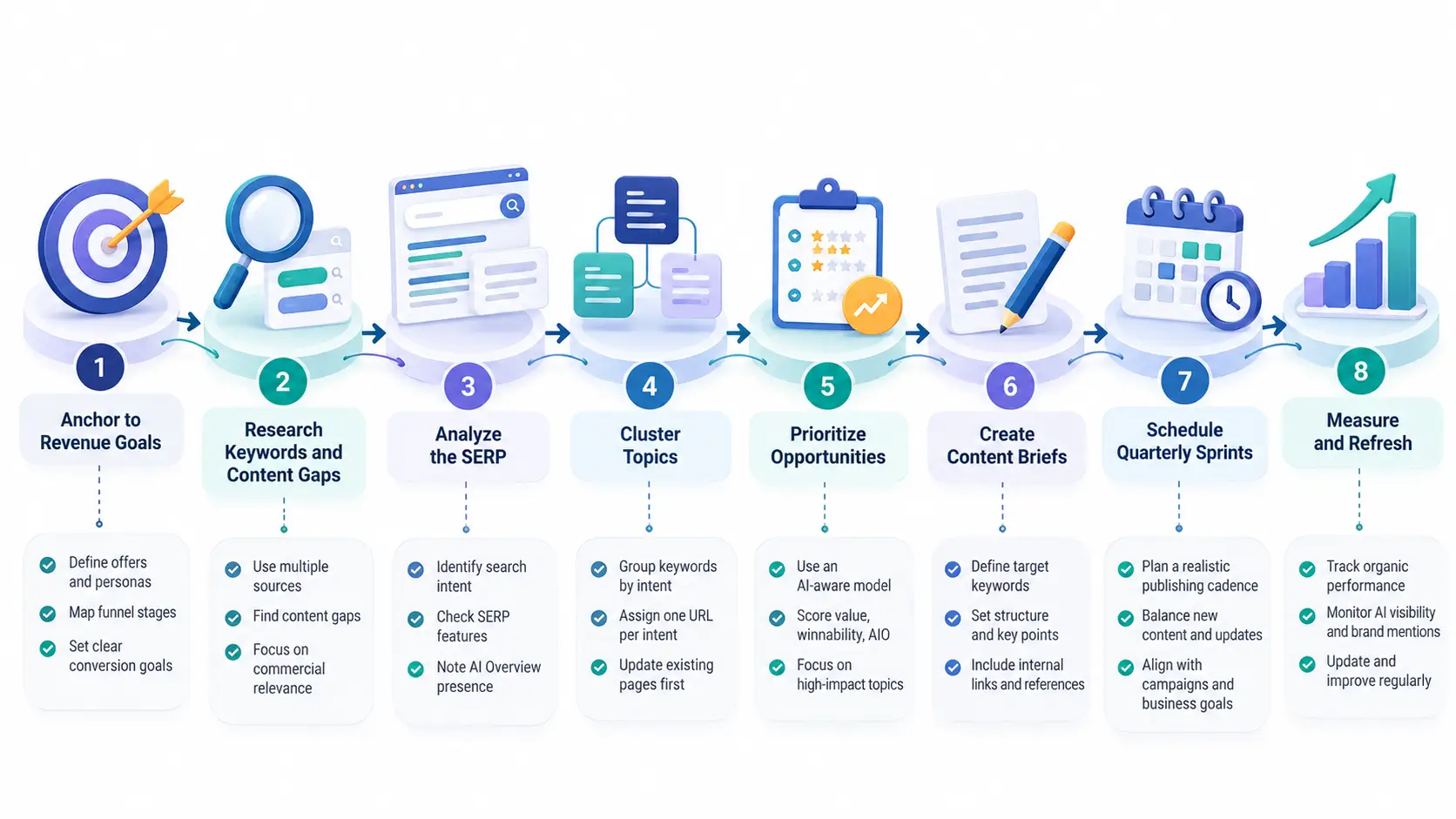 Step 1: Anchor the Roadmap to Revenue Goals
Start with the business, not the keyword tool. List your offers, margins, personas, and funnel stages. Then define what content must drive: demo requests, trial signups, or qualified pipeline, not sessions.
Map each funnel stage to a content type. Early-stage questions get educational guides, comparison queries get evaluation pages, and bottom-funnel queries get product-led content. One rule keeps the roadmap honest: if an item cannot be traced to a conversion goal, it does not make the list.
Step 2: Build the Keyword Universe and Run a Content Gap Analysis
Pull keywords from several sources: Google Search Console, a tool such as Ahrefs or Semrush, sales calls, support tickets, and communities where your audience asks questions, and help to track Generative AI visibility. A tool export alone misses the language customers actually use.
Then run a content gap analysis against your search competitors. These are the domains that rank for your target queries, and they are often publishers, marketplaces, or software vendors rather than the companies you compete with commercially. Focus on keywords where two or more competitors rank and you do not, and keep only the ones with clear commercial relevance.
Step 3: Read the SERP, Not Just the Keyword
This is the step that makes the roadmap AI-aware. Open the results page for every priority query and record:
- The dominant search intent (informational, commercial, transactional, navigational)
- The page formats that rank (guides, listicles, tools, forums, video)
- Which SERP features appear
- Whether an AI Overview appears, who is cited, and in what format
Score each query for AI Overview exposure. Queries with no AI Overview deserve special attention. Seer’s data showed organic CTR on informational queries without an AI Overview improved from 2.93% to 3.97% across 901 million impressions in 2025. These are often the queries where users still click, which makes them a competitive opportunity rather than a leftover.
Step 4: Cluster Topics and Build Topical Authority
Group keywords into pillar and supporting-page clusters. Cluster by intent, not just word similarity: two phrases that look alike can need different pages, and two that look different can share one.
Assign one URL per intent. Before creating anything new, check what you already have. If an existing page can be updated to cover a cluster, update it. This avoids cannibalization and builds topical authority faster than publishing near-duplicates.
Step 5: Prioritize with an AI-Aware Scoring Model
Most roadmaps rank by volume and difficulty alone. We add AI Overview exposure as a multiplier:
Priority score = (Business Value × Winnability × AIO Factor) ÷ Effort
Rate value, winnability, and effort from 1 to 5. Set the AIO Factor to 1.0 when no AI Overview appears, 0.7 when one appears but a brand can realistically be cited, and 0.4 when one appears and offers no opening. Calibrate these weights to your own data. Here is an illustrative example:
| Keyword | Value | Winnability | AIO Factor | Effort | Score |
| A: mid-volume, no AI Overview | 4 | 4 | 1.0 | 2 | 8.0 |
| B: commercial, AI Overview citable | 5 | 3 | 0.7 | 3 | 3.5 |
| C: high-volume, AI Overview, no opening | 3 | 3 | 0.4 | 3 | 1.2 |
The mid-volume keyword beats the high-volume one by a wide margin. Split the winners into two tracks. Click-first content drives traffic and conversions. Citation-first content builds brand visibility inside AI answers. They need different briefs and different KPIs.
Step 6: Write Briefs for Readers and AI Extraction
A good brief removes guesswork. Include the primary intent, the target keyword and related terms, the format the SERP rewards, an answer-first opening, subheadings that mirror the sub-questions, and the original evidence or experience the piece will add. Name the author and their credentials.
To be citable, lead each section with a direct, self-contained answer in roughly 40 to 60 words, then support it with evidence. Keep earning organic rankings too, since pages that already rank well are more likely to be cited.
Step 7: Sequence Priorities into a Roadmap
Turn the scored list into quarterly sprints that balance quick wins, foundational pillars, and refreshes.
Quarter | Focus | Typical work |
| Q1 | Quick wins | Refresh near-page-one pages, publish high-scoring no-AIO pages, fix cannibalization |
| Q2 | Pillars | Build core pillar pages and supporting clusters |
| Q3 | Citation-first | Original research, comparisons, expert-led guides |
| Q4 | Scale and refresh | Expand winning clusters, update aging content |
Assign an owner and note dependencies for each item, so a missing design asset or subject-matter interview does not stall a sprint.
Step 8: Measure, Refresh, and Adapt
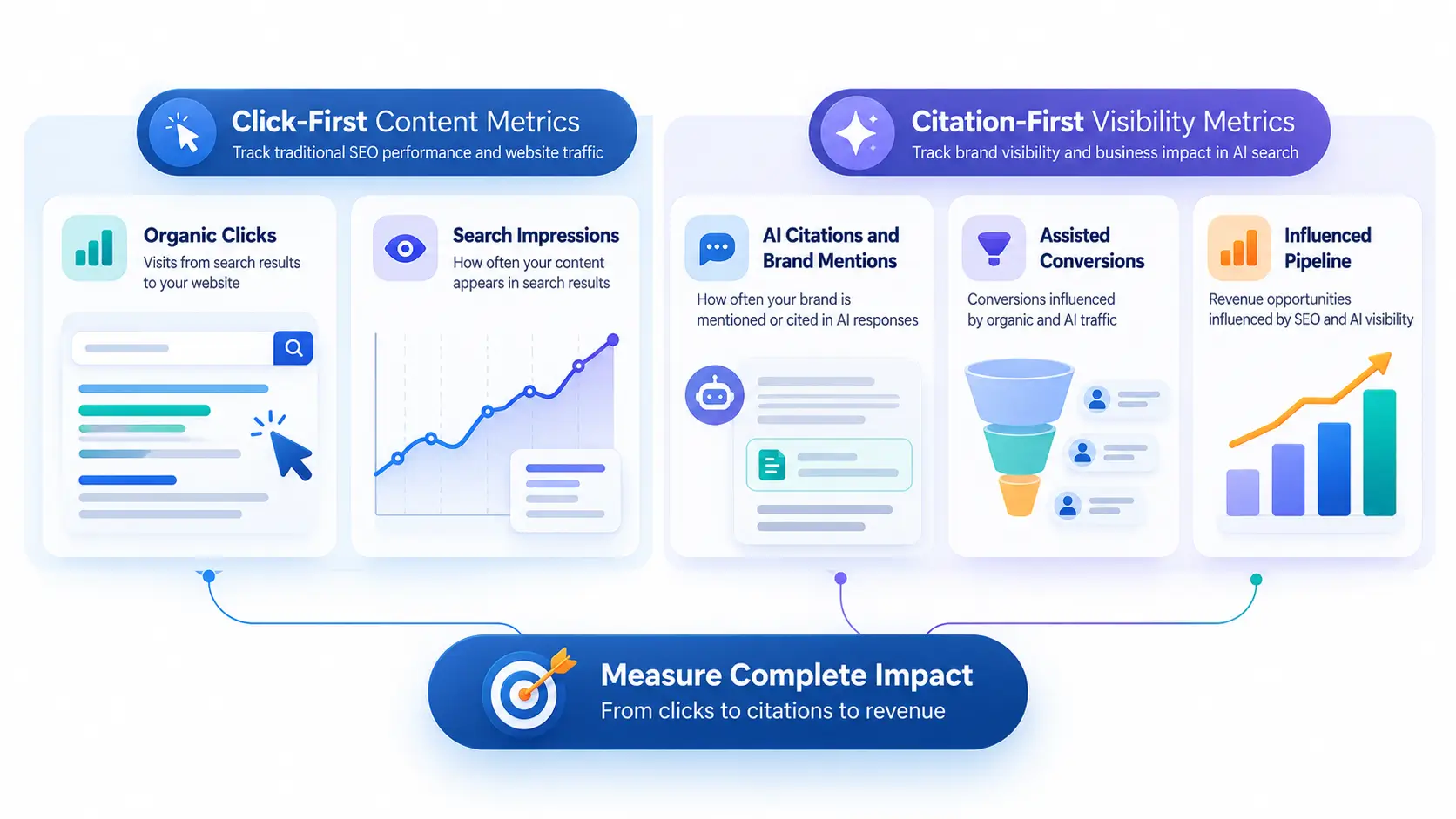
Track more than clicks. Useful KPIs include impressions, citations and mentions in AI answers, non-branded clicks on click-first pages, assisted conversions, and pipeline influenced. Judge citation-first content on visibility and click-first content on traffic and revenue.
Review performance monthly and re-plan quarterly. Re-check the SERPs of your priority queries each quarter, since AI Overview triggers shift. Refresh top pages every six to twelve months, and never forecast with pre-AI Overview click curves.
Common Roadmap Mistakes to Avoid
- Chasing volume. High search volume means little if an AI Overview absorbs the click.
- Ignoring AI Overview exposure. Check every priority SERP before committing resources.
- Forecasting with outdated CTRs. Old click curves overstate expected traffic.
- Publishing without briefs. Structure decides whether content ranks and gets cited.
- Never refreshing. A roadmap is a living plan, not a one-time document.
Frequently Asked Questions
What is an SEO content roadmap?
An SEO content roadmap is a prioritized, time-sequenced plan that shows which pages to create or update, in what order, and why. It connects keyword research, search intent, and business goals so every piece has a purpose. In the AI search era, it also factors in whether AI Overviews appear for each query.
How do you build an SEO content roadmap?
Start with revenue goals, then build a keyword universe and run a competitor content gap analysis. Classify each query by intent, check whether an AI Overview appears, cluster topics, and score them by business value, difficulty, and effort. Finally, sequence the winners into quarterly sprints and review performance monthly.
How do AI Overviews change content strategy?
AI Overviews often answer informational queries directly, which reduces clicks to organic results. Seer Interactive found organic CTR on informational queries with an AI Overview fell 61% from mid-2024 to September 2025. Strategy shifts toward earning citations, targeting queries that still drive clicks, and prioritizing commercial and experience-led content.
How do you optimize content for AI Overviews?
Lead each section with a direct, self-contained answer in the first 40–60 words, then expand with evidence. Use clear headings, original data, and named authors for credibility. Keep earning organic rankings, since pages already ranking well are more likely to be cited.
How often should you update your SEO content roadmap?
Review performance monthly and re-plan quarterly. AI Overview triggers and click-through rates shift quickly, so re-check the SERPs of your priority queries each quarter. Refresh top-performing pages every six to twelve months, and rerun your content gap analysis whenever a competitor, product line, or Google update changes the landscape.
What’s the difference between SEO, GEO, and AEO?
SEO earns rankings and clicks in traditional search results. AEO (answer engine optimization) structures content to be the direct answer in snippets, voice, and AI summaries. GEO (generative engine optimization) aims to get your brand cited inside AI-generated responses from tools like ChatGPT, Perplexity, and Google AI Overviews. All three share one foundation: useful, trustworthy content.
Build Your Roadmap Now
A strong SEO content roadmap in the AI search era comes down to one shift: stop ranking ideas by volume alone and start ranking them by how likely they are to earn clicks, citations, and revenue. Start with your business goals, read the SERPs, score what you find, and review it every quarter. Then pick your first ten queries and score them this week.


