Paying an influencer a flat fee for a post is a gamble, because you rarely know whether it produced a single sale. Running a pure affiliate program is safer, but it can leave you with lots of links and very little compelling content. Affiliate + influencer hybrid campaigns combine the two. The creator makes content people want to watch, and the brand pays partly on proven results. This guide covers what hybrid campaigns are, how the pay works, how to launch one, and which mistakes to avoid.
What Are Affiliate + Influencer Hybrid Campaigns?
A hybrid campaign combines a smaller guaranteed payment, such as a flat fee or free product, with a commission earned on each sale generated through the creator’s unique link or discount code. In this model, the creator acts as both an influencer and an affiliate.
In affiliate marketing, a partner promotes your product with a tracked link and earns a commission on sales. You pay only for results, but you have little control over how your brand is presented. In influencer marketing, you pay a creator to feature your product to their audience. You get strong content and trust, but the fee is usually paid upfront whether or not anyone buys.
The hybrid model combines affiliate and influencer marketing and keeps what each does best: storytelling and trust from the influencer side, tracking and performance-based pay from the affiliate side. Think of it as a base salary plus a bonus.
Why Brands Are Combining Both Models
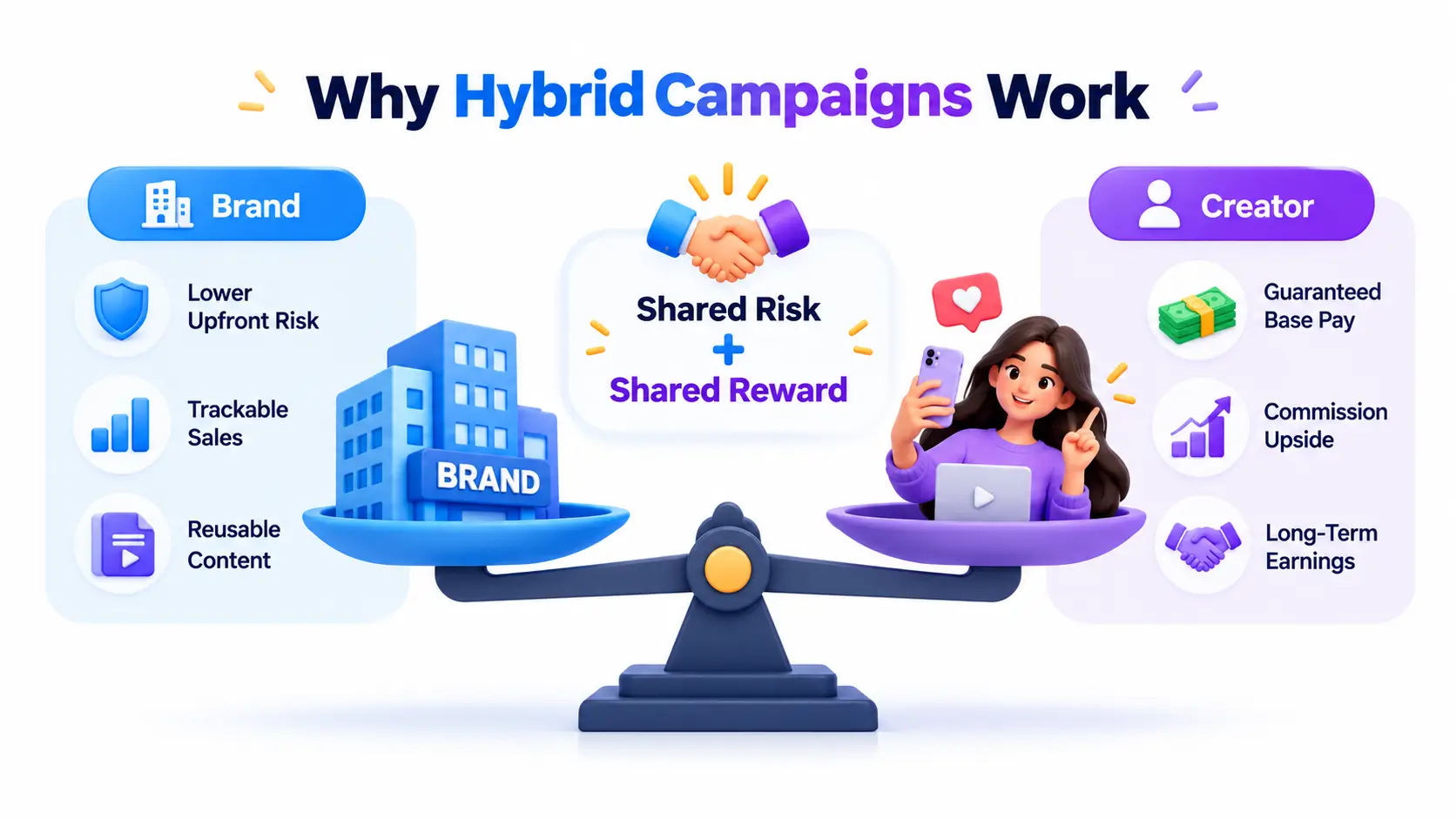
- Shared risk. With a flat fee, the brand carries all the risk. With commission only, the creator does. A hybrid deal splits it, so the brand spends less upfront and the creator earns something even in a slow month.
- Clearer attribution. Every creator has a trackable link or code, so you can connect posts to clicks and sales and decide who deserves a bigger budget next time.
- Motivated creators and reusable content. Creators who earn on sales tend to keep promoting after the first post. Brands can also reuse the content in ads, as long as usage rights are agreed in writing.
Hybrid vs. Affiliate-Only vs. Influencer-Only
| Factor | Influencer-only | Affiliate-only | Hybrid |
| Cost model | Flat fee, paid upfront | Commission on sales | Smaller fee or product plus commission |
| Brand risk | High | Low | Moderate |
| Tracking | Often weak | Strong | Strong |
| Content quality | Usually high | Varies widely | Usually high |
| Best for | Brand awareness | Lean budgets, scale | Testing creators with controlled risk |
Hybrid isn’t always the answer. If you only want a big awareness splash, a flat fee may be simpler. If you have almost no budget and don’t need custom content, pure affiliate may be enough.
Common Hybrid Payment Structures
- Flat fee plus commission: a modest fixed payment plus a percentage of tracked sales. It’s the most common and easiest to explain.
- Free product plus commission: the creator gets your product and earns on sales. This suits small brands and micro-influencers.
- Tiered commissions: the rate rises as sales hit set thresholds, rewarding top performers.
What commission should you offer?
Rates vary by industry, margin, and creator size. Many e-commerce programs start around 10–15%, but your margins decide what’s affordable. Work backward from profit per sale and make sure the total payout still leaves you profitable.
A worked example (illustrative only)
Suppose you sell a $50 product:
| Deal | Weak result (20 sales, $1,000) | Strong result (200 sales, $10,000) |
| Flat fee, $500 | $500 → $25.00 per sale | $500 → $2.50 per sale |
| Commission only, 15% | $150 → $7.50 per sale | $1,500 → $7.50 per sale |
| Hybrid, $150 + 10% | $250 → $12.50 per sale | $1,150 → $5.75 per sale |
These are hypothetical figures for teaching, not industry benchmarks.
The flat fee is expensive if the campaign flops and a bargain if it takes off. Commission-only keeps your cost per sale constant, but a low rate may not attract good creators. The hybrid deal limits your downside while paying the creator more when things go well.
How to Launch Your First Hybrid Campaign in 6 Steps
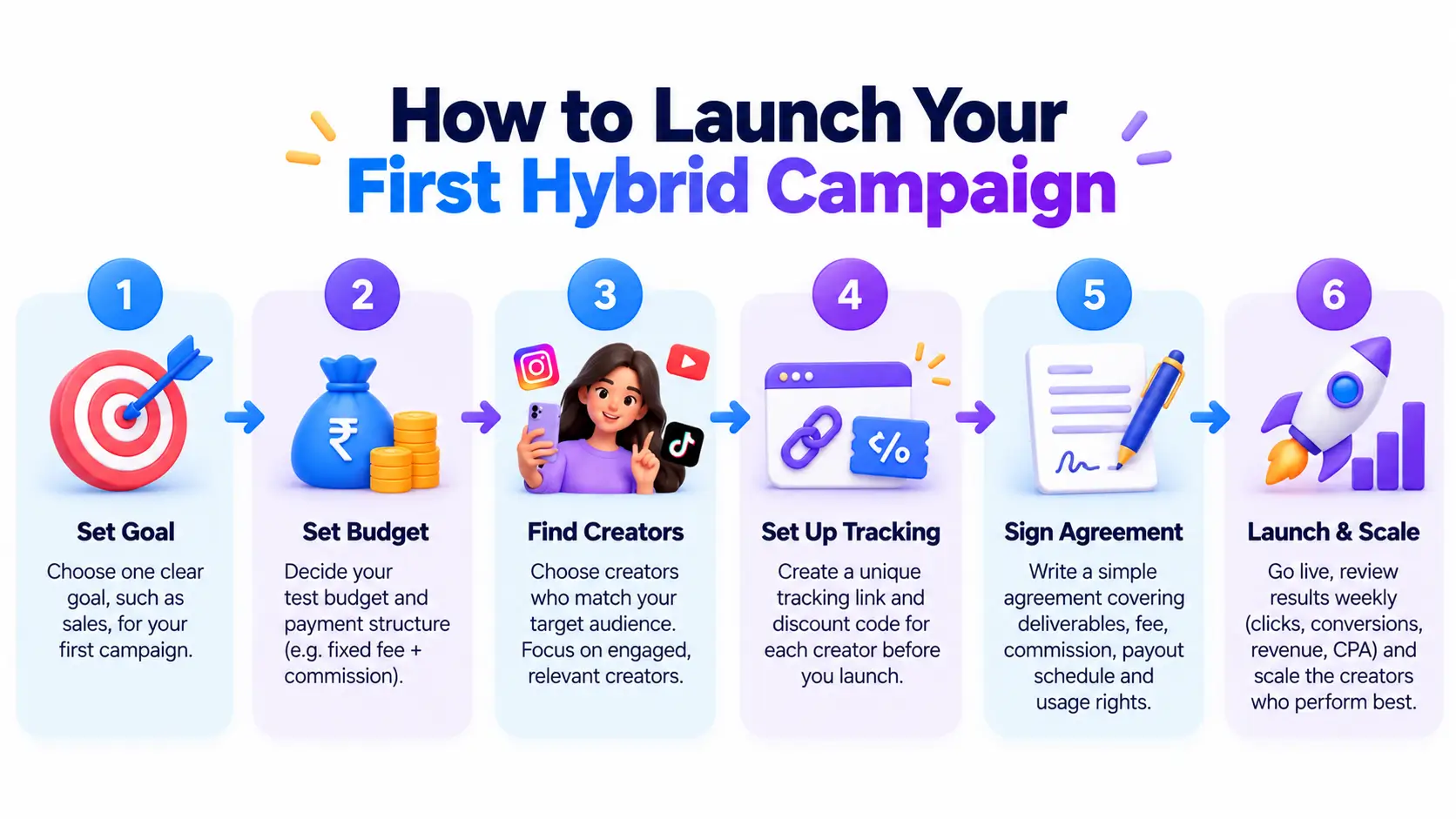
- Set one clear goal. Sales are usually the easiest to measure for a first test.
- Choose a budget and payment structure. Pick a test budget you can afford to lose, and offer the same deal to every creator at first so results are comparable.
- Find creators who fit your audience. Match followers to your customers, not just big numbers. Micro-influencers often have engaged niche audiences and are more open to hybrid terms.
- Set up tracking. Create a unique link and code for each creator before launch. Links track clicks, and codes catch buyers who purchase later.
- Write a simple agreement. Cover deliverables, deadlines, fee, commission, payout schedule, usage rights, and disclosure. One page prevents most disputes.
- Launch, review weekly, and scale. Check clicks, conversion rate, revenue, and cost per acquisition for each creator. Keep partners who deliver and drop those who don’t.
How to Track and Measure Results
Use both links and codes.
Links give you click data, but many people never click. They screenshot the post, search your brand, or buy later. A discount code captures some of the sales a link would miss.
Set an attribution rule.
An attribution window is how long after a click a sale still counts for that creator, often 7 to 30 days. Overlaps happen when one customer sees a creator’s video, clicks an affiliate link, and then sees a retargeting ad. A common beginner-friendly rule is to credit the most recent tracked click and never pay twice for the same sale. This is one common practice, not a universal standard.
Watch four numbers: clicks, conversion rate, revenue, and cost per acquisition (CPA). CPA is your total spend on a creator divided by the sales they generated, and it’s the fairest way to compare partners.
Disclosure and Legal Basics
Creators must tell their audience about any material connection to your brand, including commissions, free products, and payments. In the US, the FTC’s Endorsement Guides (16 CFR Part 255) require disclosures to be clear and conspicuous. That means plain wording like “ad” or “affiliate link” where viewers will notice it, not buried in hashtags or hidden behind a “more” button. Other countries have their own rules, so check local regulations. This is general information, not legal advice.
Common Beginner Mistakes to Avoid
- Vague terms. Unclear rates or payout dates damage trust quickly.
- Launching before tracking works. Test every link and code first.
- Choosing by follower count alone. An engaged, relevant audience beats a large, unrelated one.
- Ignoring overlapping credits. Decide how to handle them in advance.
- Overcomplicating the first test. Start with a few creators and one structure.
Frequently Asked Questions
What is a hybrid affiliate and influencer campaign?
A hybrid campaign pays a creator a smaller fixed fee or free product, plus a commission on sales tracked through their unique link or code. It blends an influencer’s content and audience trust with affiliate-style accountability, so brands and creators share risk.
How do you pay creators in a hybrid campaign?
Common structures include a small flat fee plus commission, free product plus commission, or tiered commissions that rise with sales. Many e-commerce programs start around 10–15%, but rates vary by industry and margin. Put terms in writing, including payout schedule and attribution window, before launch.
How do you track results in a hybrid campaign?
Give each creator a unique tracking link and discount code, then measure clicks, conversions, revenue, and cost per acquisition. Codes capture sales from people who don’t click links. Decide in advance how overlapping credits are handled so one sale isn’t counted or paid twice.
Do creators have to disclose affiliate links?
Yes. In the US, the FTC requires clear, conspicuous disclosure of any material connection, including commissions, free products, or payments. Use plain wording like “ad” or “affiliate link” near the start of the post. Other countries, such as the UK, have their own rules.
Is a hybrid campaign worth it for small businesses?
Often, yes. Hybrid deals let small brands test creators with modest upfront spend, since much of the cost depends on sales. Start with micro-influencers, gifted product, and a commission, then scale partners who convert. Results aren’t guaranteed, so set a test budget and success metrics first.
Conclusion: Start Small, Measure Everything
Affiliate + influencer hybrid campaigns give beginners a practical middle path: the creative strength of influencers, the accountability of affiliate tracking, and risk shared between both sides. Begin with one goal, two or three creators, a simple pay structure, and working tracking. Review the numbers weekly, keep what works, and scale from there. Your first campaign is a test, and its data is what makes the second one better.


