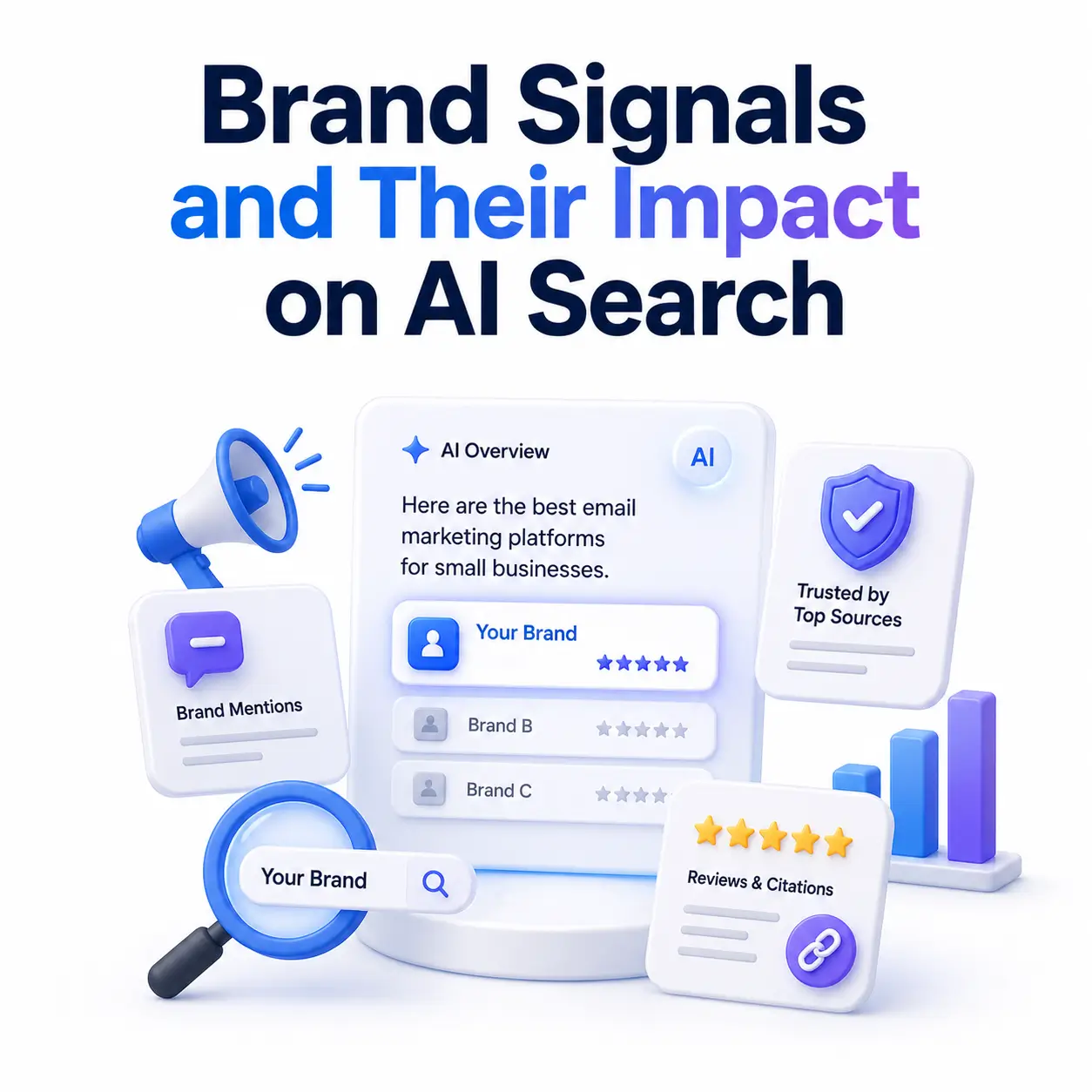
Enter a question into ChatGPT, Perplexity, or Google’s AI Overviews, and you’ll receive a direct answer, often featuring just a few brands. No ten blue links to scroll through, no chance to compare options side by side. Just a recommendation, already made on your behalf. That shift is quietly rewriting the rules of visibility, and the deciding factor increasingly isn’t which page ranks highest. It’s whether the AI system trusts your brand enough to mention it at all.
That trust is built on what’s known as brand signals, a set of trust and credibility indicators that both traditional search engines and generative AI systems use to decide who deserves to be named. Understanding how brand signals work, and how they differ from the ranking factors you’re used to optimizing for, is quickly becoming one of the most important skills in SEO. This guide breaks down exactly what brand signals are, how AI search engines evaluate them, and what you can do to strengthen yours.
What Are Brand Signals?
Brand signals are the trust and credibility indicators that search engines and AI systems use to evaluate a brand’s authority and reliability across the internet as a whole, rather than judging a single page in isolation. They include things like how often your brand is mentioned by other credible sites, how consistently your brand is described across the web, how much direct search demand exists for your brand name, and whether search engines and AI models recognize your brand as a distinct, real-world entity.
In short, brand signals answer a different question than traditional on-page SEO. It follows semantic SEO, where keyword optimization asks, “does this page match the query,” Brand signals ask, “is this brand a credible, trustworthy source on this topic at all?” That distinction matters more than ever now that AI systems are choosing which brands to name in their answers.
Brand Signals vs. Traditional Ranking Factors
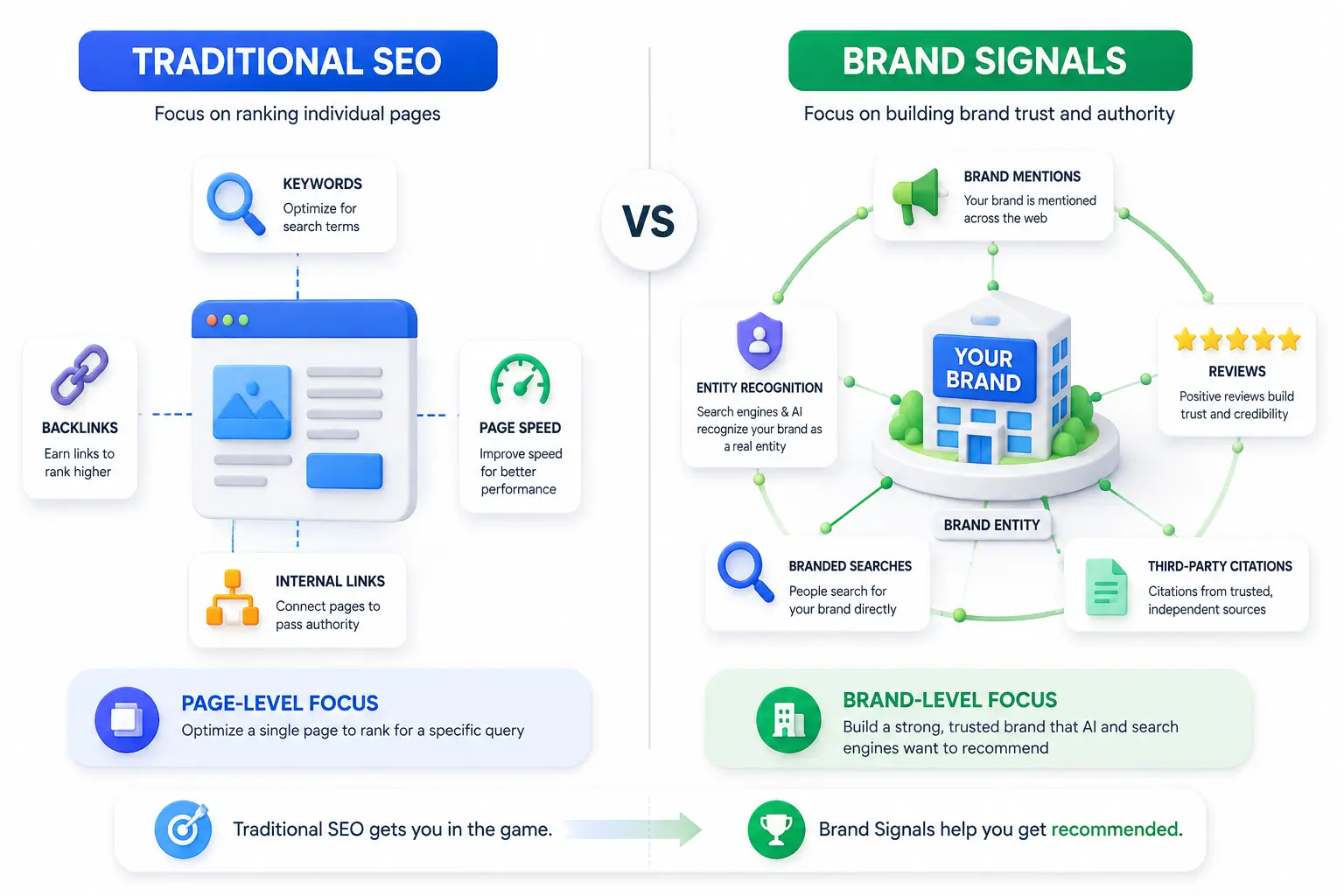
Traditional SEO ranking factors keyword targeting, backlinks, page speed, and internal linking are largely page-level. They help a specific URL rank for a specific query. Brand signals operate at a higher level entirely: they describe the reputation of the whole entity behind the content. A page can be perfectly optimized and still fail to earn an AI citation if the brand behind it has no recognizable presence elsewhere on the web. Conversely, a brand with strong signals can get cited even from a page that isn’t the top-ranking result for that exact query, because the AI system already trusts the brand as a source.
Why Brand Signals Matter More in the Age of AI Search
The mechanics of discovery have changed. Traditional search surfaces a list of options and lets the user decide. AI search evaluates a wide set of content, synthesizes an answer, and chooses which sources to name or link to inside that answer. That’s a fundamentally different filter, and it favors brands the system can already vouch for.
From Ranking Pages to Recommending Brands
AI-powered search doesn’t just ask which page is most relevant to a query. It asks which sources are trustworthy enough to build an answer around. Traffic, backlinks, and topical relevance still matter because they help AI systems discover and evaluate content in the first place, but once a brand clears that bar, what determines whether it actually gets cited is a separate layer of trust signals: consistent mentions, third-party corroboration, and recognizable entity status. A brand that only exists on its own website, with no outside verification, is far less likely to be surfaced, no matter how well-optimized its pages are.
The Rise of Generative Engine Optimization (GEO)
This shift has given rise to generative engine optimization, or GEO: the practice of optimizing a brand’s presence and content specifically so that AI systems are more likely to reference, cite, or recommend it inside generated answers. GEO doesn’t replace traditional SEO, but it adds a new layer of priorities on top of it, with brand signals sitting near the center.
How AI Search Engines Evaluate and Choose Brands
AI platforms don’t maintain a published, ranked list of preferred brands. Instead, they weigh a combination of signals every time they generate an answer, looking for evidence that a brand can be trusted as a credible reference for that specific topic.
Entity Recognition and Knowledge Graphs
Before an AI system can recommend your brand, it has to recognize your brand as a distinct entity a real, identifiable organization with a name, a category, and a set of associated facts, not just a collection of pages. This is called entity recognition, and it’s foundational to how both Google and large language models decide what to surface. A brand that shows up consistently across its own site, third-party listings, and structured data is far easier for these systems to recognize and place correctly in a knowledge graph than one whose identity is scattered or inconsistent.
Citation Frequency and Source Authority
Once a brand is recognized as an entity, the next question is how often credible, independent sources mention it, and how authoritative those sources are. A brand mentioned across a wide range of trusted industry publications carries more weight than one mentioned only once, or only on its own domain. AI systems treat repeated, independent corroboration as a strong trust signal, similar to how backlinks function in traditional SEO, but broader in scope since it includes mentions that don’t include a link at all.
Topical Consistency Across Content
AI platforms also look at whether a brand demonstrates expertise consistently, not just on one standout page. A single excellent blog post is no longer enough to establish authority. Systems evaluating what to cite favor brands that show depth across an entire topic area, multiple pieces of content that reinforce the same expertise from different angles, which signals that the brand’s authority is genuine rather than a single lucky ranking.
The Core Brand Signals You Should Be Tracking
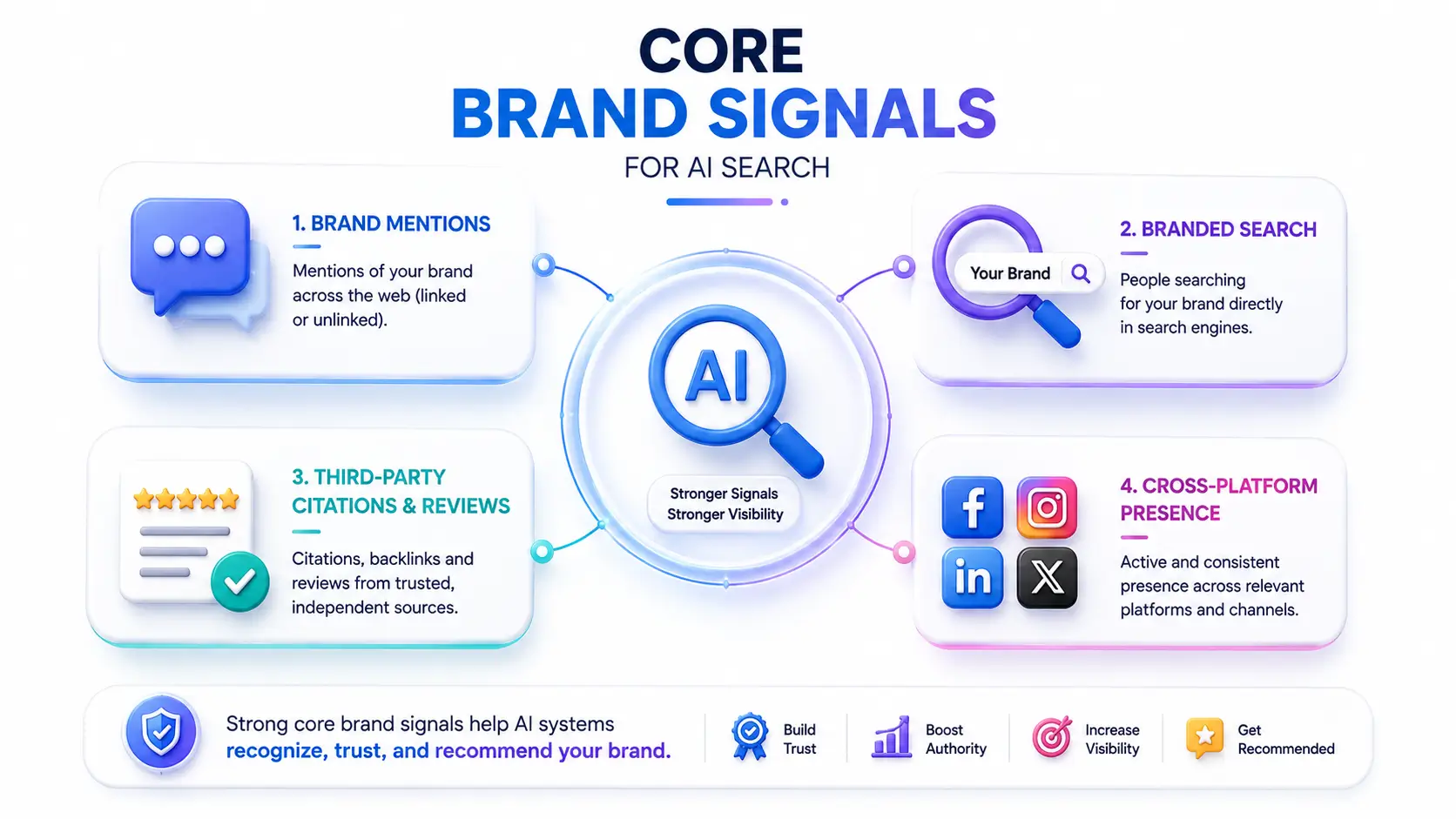
While AI ranking isn’t a fixed checklist, several measurable signals show up consistently in how these systems evaluate brands. These are the ones worth monitoring and actively building.
Brand Mentions (Linked and Unlinked)
Any mention of your brand name in relevant, credible content counts as a signal, whether or not it includes a hyperlink. AI systems parse text for corroborating evidence, not just link graphs, which means unlinked mentions in articles, roundups, and industry coverage now carry real weight that they wouldn’t have in a purely link-based ranking system.
Branded Search Volume
How often people search for your brand name directly is one of the most straightforward brand signals available. Rising branded search volume tells search engines that real-world demand and awareness exist for your brand, independent of any specific page’s optimization.
Third-Party Citations and Reviews
Coverage from independent publications, review sites, and industry sources acts as external validation that a brand can’t generate on its own. This kind of third-party corroboration is difficult to fake and is exactly the type of signal AI systems weigh most heavily when deciding whether a source can be trusted.
Social Proof and Cross-Platform Presence
A consistent presence across social platforms, forums, and community discussions contributes to a brand’s overall digital footprint. It isn’t a direct ranking factor in the way on-site content is, but it reinforces the broader pattern of recognition and consistency that AI systems use to build trust in a brand over time.
How to Strengthen Your Brand Signals for AI Search
Building brand signals is a long-term, compounding effort rather than a quick technical fix. The following practices give AI systems the clearest, most consistent evidence to work with.
Earn Mentions in Topically Relevant Content
Prioritize getting your brand mentioned in content that’s directly relevant to your niche, ideally alongside other established names in your space. Contextual relevance matters as much as volume: a mention buried in an unrelated article does far less for entity recognition than one that appears in content clearly about your industry.
Maintain a Consistent Brand Descriptor
Describe your brand the same way everywhere it appears: on your own site, in directory listings, press mentions, and social profiles. Inconsistent descriptions make it harder for AI systems to confidently connect mentions back to a single, coherent entity, which weakens the corroboration effect that repeated mentions are supposed to create.
Invest in Structured Data and Schema Markup
Structured data removes ambiguity by explicitly telling search engines and AI crawlers who you are, what you do, and how your content relates to your broader brand. Organization schema, author markup, and consistent metadata all make it easier for AI systems to parse your identity correctly rather than inferring it from unstructured text alone.
Measuring Your Brand’s AI Search Visibility
Because AI search doesn’t offer a traditional rank position, measuring visibility requires a different approach: tracking whether and how often your brand actually appears inside generated answers.
Tools for Monitoring AI Brand Mentions
A growing category of tools tracks brand citations specifically within AI platforms like ChatGPT, Perplexity, and Google AI Overviews, showing how often a brand is mentioned and in what context. Where dedicated tools aren’t available, manually running a set of relevant, non-branded prompts through these platforms on a regular basis can serve as a simple, low-cost way to spot-check visibility over time.
A large-scale analysis of roughly 75,000 brands by Ahrefs found that AI Overview mentions correlated far more strongly with text-based signals web mentions and anchor text than with user behavior signals like organic traffic, and that paid search spend showed little relationship to AI mentions at all. The takeaway: earning visibility in AI search is less about driving more visits to your site and more about earning more mentions in the right contextual company.
Common Mistakes That Undermine Brand Signals
- Describing your brand inconsistently across your website, directories, and social profiles, which makes entity recognition harder for AI systems.
- Relying on paid traffic or ad spend to drive visibility, which shows little correlation with how often AI systems actually cite a brand.
- Betting on a single standout page for topical authority instead of building consistent depth across an entire subject area.
- Ignoring unlinked mentions and third-party coverage because they don’t pass traditional link equity, even though AI systems weigh them heavily.
Frequently Asked Questions
What are brand signals in SEO?
Brand signals are trust and credibility indicators like mentions, citations, branded search volume, and entity recognition that search engines and AI systems use to evaluate a brand’s authority and reliability, separate from individual page-level ranking factors.
How does AI search decide which brands to cite?
AI search evaluates citation frequency across credible sources, topical consistency, and how clearly a brand’s identity is corroborated across the web. It favors brands with a verifiable, consistent digital footprint over single high-ranking pages.
Do backlinks still matter for AI search visibility?
Yes, but their role is shifting. Unlinked brand mentions and contextual references now carry significant weight alongside traditional backlinks, since AI systems assess overall brand presence rather than just link equity.
Does social media activity influence AI search rankings?
Indirectly. Social platforms generate brand mentions and reinforce a consistent digital footprint, which supports AI trust evaluation, though it isn’t a direct ranking factor the way on-site content is.
What is generative engine optimization (GEO)?
GEO is the practice of optimizing brand presence and content specifically so AI systems like ChatGPT, Perplexity, and AI Overviews are more likely to reference, cite, or recommend that brand in generated answers.
How can I check if AI tools are mentioning my brand?
Use brand-monitoring tools built for AI platforms, or manually query ChatGPT, Perplexity, and Google AI Overviews with relevant non-branded prompts to see if your brand appears in the responses.
Conclusion
AI search has changed what it means to be visible. It’s no longer enough to rank a page; your brand needs to be recognized, corroborated, and trusted enough for an AI system to name it out loud. That trust is built through consistent mentions, clear entity signals, and topical depth accumulated over time, not through a single optimization tactic. Brands that start treating brand signals as seriously as they treat keyword strategy today will be the ones AI systems are recommending tomorrow.


