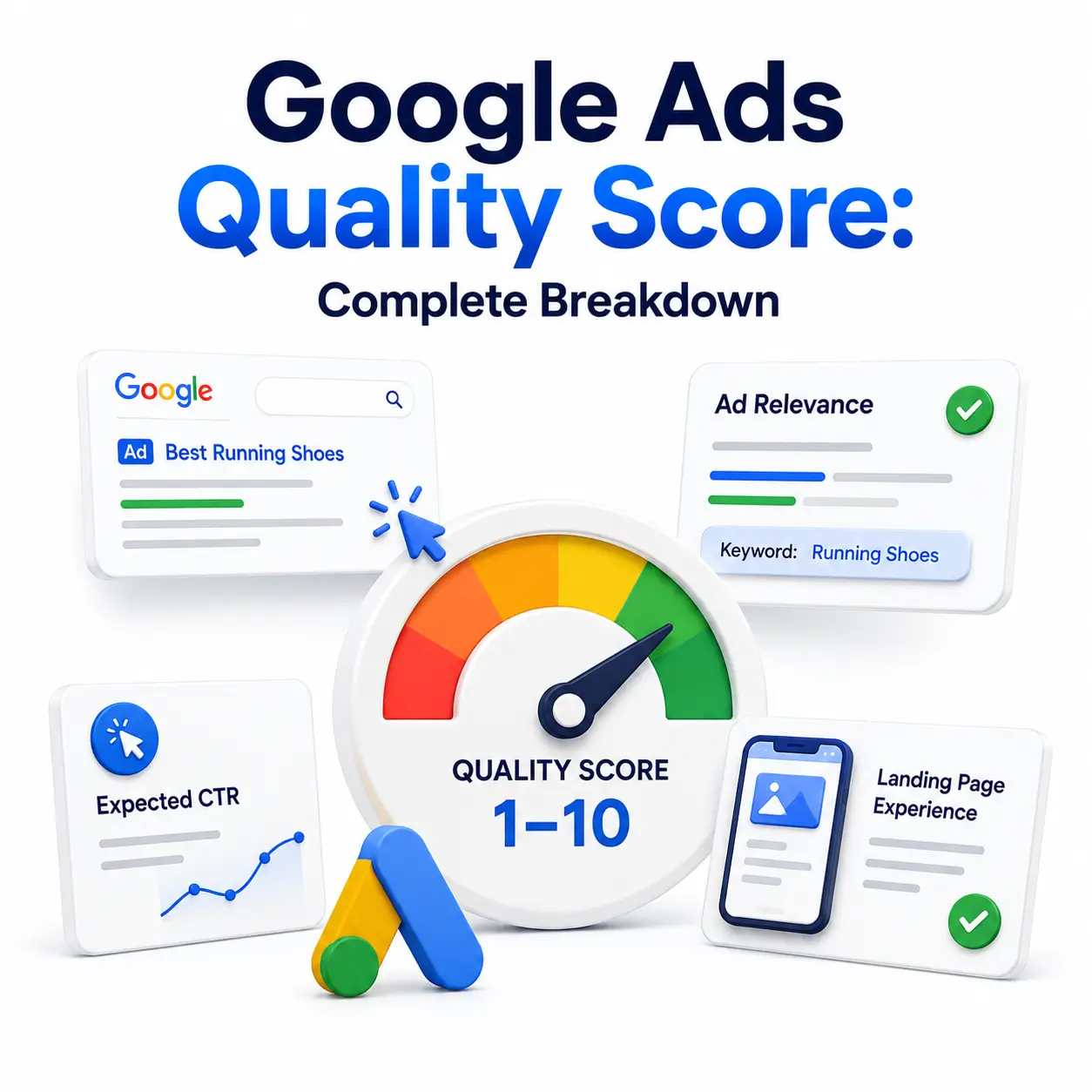
If you run Google Ads, you’ve seen the number sitting quietly next to your keywords: a score from 1 to 10 called Google Ads Quality Score. Some advertisers obsess over it. Others dismiss it as outdated now that Smart Bidding and broad match do most of the targeting work. The truth is in between, Quality Score is still one of the clearest windows into how Google actually judges your ads, and understanding it can meaningfully lower what you pay per click.
This guide breaks down exactly what Quality Score is, how it’s calculated, whether it still matters in an automation-heavy account, and most importantly how to diagnose and fix a low score.
What Is Google Ads Quality Score?
Google Ads Quality Score is Google’s 1–10 rating of how relevant and useful your keywords, ads, and landing pages are to the people searching for them. It’s a diagnostic metric, not a performance KPI Google built it to reward advertisers whose ads genuinely match what searchers are looking for, rather than whoever bids the most.
You’ll find it in the Google Ads interface at the keyword level, with a rating of below average, average, or above average for each of its three underlying components. A higher score generally signals a healthier account and, in most cases, a lower cost per click.
The 3 Components That Make Up Quality Score
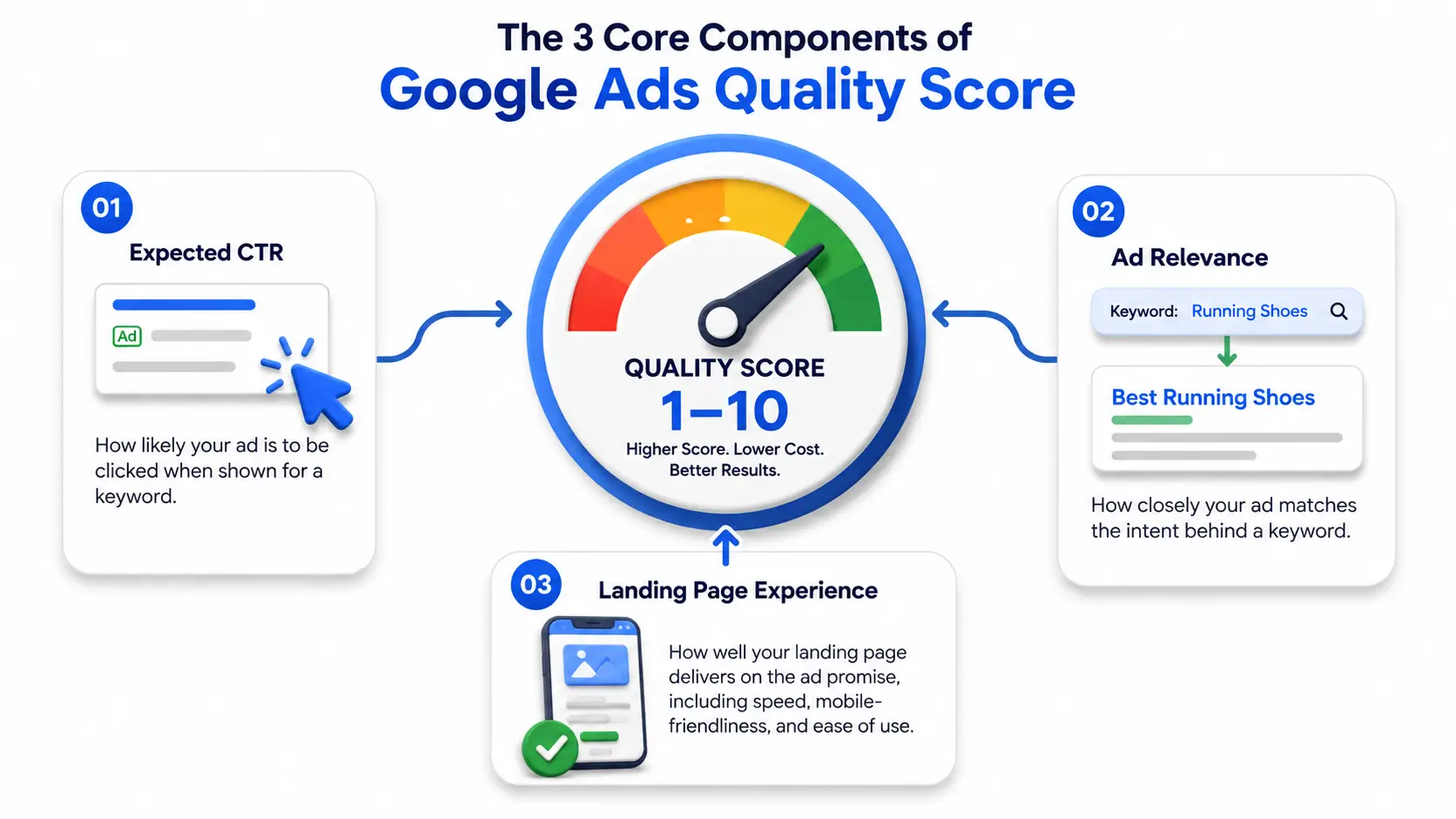
Quality Score isn’t one calculation it’s an aggregate of three separate signals, often called the “Big Three.” Understanding each one individually is the key to fixing a low score, because a generic fix rarely addresses the actual problem.
Expected Click-Through Rate (eCTR)
This estimates how likely your ad is to be clicked when it’s shown for a given keyword, based on historical performance and machine learning. It’s evaluated relative to other advertisers targeting the same keyword, not against your account’s overall average.
Ad Relevance
This measures how closely your ad copy matches the intent behind a keyword. If an ad group contains keywords with different themes competing for the same ad text, relevance suffers even if the ad itself is well written.
Landing Page Experience
This looks at whether your landing page delivers on what the ad promised, plus practical factors like load speed, mobile-friendliness, and ease of navigation. Google Ads Help identifies ad relevance and landing page experience together as accounting for roughly 61% of Quality Score’s overall weighting making landing page quality nearly as influential as ad copy, yet it’s often the most neglected of the three because campaign managers can edit ads far more easily than they can rebuild a page.
How Quality Score Is Calculated
The 1–10 number you see in your account is a trailing estimate, built from roughly 90 days of exact-match comparison data. It updates as new performance data comes in, so a change you make today won’t necessarily move the visible score immediately.
Visible Quality Score vs. Auction-Time Quality Score
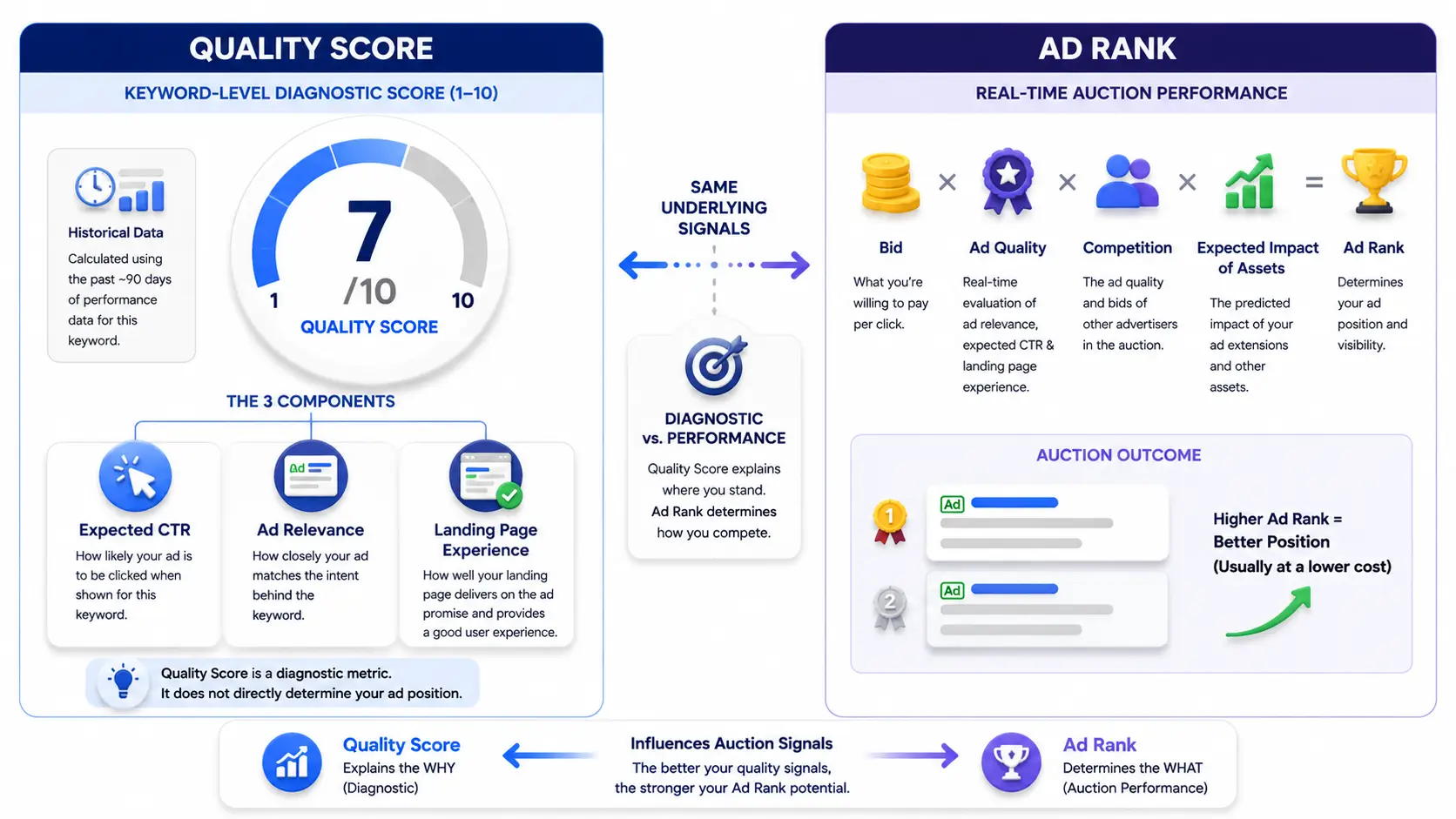
There’s an important distinction most guides skip. The visible score in your dashboard is a historical snapshot. But at the exact moment your keyword enters an auction, Google separately evaluates ad quality in real time using the same three underlying signals, and that real-time evaluation is what actually feeds Ad Rank. The stored 1–10 score doesn’t directly participate in the auction; it’s a diagnostic reflection of the same forces that do.
Why Quality Score Matters
Even though Google is explicit that Quality Score itself isn’t a KPI, the components behind it have real financial consequences.
Effect on CPC and Ad Position
Higher ad quality can let you win a better position at a lower cost per click than a competitor bidding more but scoring lower on relevance and expected CTR. In competitive auctions, this gap compounds accounts with consistently strong Quality Scores often pay noticeably less for the same or better placement.
Does Quality Score Still Matter in the Age of Automation?
This is the question most advertisers are actually asking in 2026, and most existing guides don’t answer it directly. Smart Bidding optimizes toward conversion signals rather than keyword-level tweaks, and broad match casts a much wider net than it used to so it’s fair to wonder whether Google ads Quality Score is a relic of manual PPC management.
It isn’t. Smart Bidding still operates inside auctions where Ad Rank is calculated from expected CTR, ad relevance, and landing page experience the exact same components. Automation changes how you influence those signals, not whether they matter. A weak landing page or a mismatched ad group will still cost you, even if you never look at a keyword-level bid again.
A Quick Word on Google Ads Conversion Tracking
Quality Score and conversion tracking aren’t the same thing conversion data doesn’t feed directly into your Quality Score calculation but the two are closely linked in practice. Accurate conversion tracking is what lets Smart Bidding find the searchers most likely to convert, and those are typically the same users who engage with your ad and land on a relevant, well-matched page. In other words, clean conversion data indirectly supports the exact behavior (higher engagement, better landing page outcomes) that raises Quality Score over time.
It also matters for diagnosis. Without reliable conversion tracking set up through Google Ads or Google Tag Manager, it’s hard to tell whether a Quality Score fix actually improved results or just moved a number. Before making structural changes to chase a higher score, confirm your conversion actions are firing correctly otherwise you’re optimizing blind.
How to Diagnose a Low Quality Score
Rather than applying generic tips, use a simple triage process: check which of the three components is rated below average, then trace that rating back to its structural cause.
Why Is My Google Ads Quality Score Low?
Open the keyword-level status column in your account and look at the individual ratings for expected CTR, ad relevance, and landing page experience. The below-average component tells you where the problem lives it just doesn’t tell you why yet. That requires a short audit of the related campaign settings.
Common Structural Causes
- Ad groups containing 50+ keywords or several unrelated themes, which dilutes relevance
- Ads that don’t closely mirror the language searchers actually use
- Landing pages that load slower than 3 seconds or aren’t mobile-optimized
- A content mismatch the ad promises one thing, the page delivers another
- Account-level CTR history dragging down expected CTR for new keywords
How to Improve Your Google Ads Quality Score
Once you know which component is weak, apply the fix that actually targets it rather than a blanket checklist.
Tighten Ad Group Themes and Keyword Grouping
Break large, mixed-theme ad groups into smaller, tightly related clusters. This makes it far easier to write ad copy that genuinely matches every keyword inside the group, which directly improves ad relevance.
Write and Test More Relevant Ad Copy
Speak directly to the searcher’s query in your headlines and descriptions. Running two or three ad variations per group and pausing the weaker performers steadily improves expected CTR over time.
Optimize Landing Page Speed and Mobile Experience
Confirm the page loads quickly, works cleanly on mobile, and clearly delivers on the ad’s promise. A simple, fast page with a clear call-to-action consistently outperforms a bloated one, regardless of how polished the design looks.
Pause Underperforming Ads and Keywords
Ads with deep impressions but very low clicks quietly drag down expected CTR. Reviewing performance regularly and pausing consistent underperformers keeps the account’s historical data working in your favor rather than against it.
Quality Score Myths and Misconceptions
- It’s not a KPI Quality Score is a diagnostic tool, not a goal to chase for its own sake.
- It doesn’t vary by match type; broad, phrase, and exact match versions of the same keyword share one Quality Score.
- It isn’t the same as Ad Strength Ad Strength rates your ad copy alone; Quality Score is keyword-level and includes landing page and CTR data too.
Frequently Asked Questions
What is a good Google Ads Quality Score?
A Quality Score of 7–10 is considered good, indicating above-average relevance across expected CTR, ad relevance, and landing page experience. Scores of 5–6 are average, while anything below 5 signals a component needs attention and may raise your cost per click.
Why is my Google Ads Quality Score low?
Low Quality Score usually traces to one of three causes: weak expected click-through rate, ads that don’t closely match the keyword’s theme, or a landing page with poor speed, mobile experience, or content mismatch. Check the component breakdown in your account to isolate which one is failing.
Does Quality Score still matter with Smart Bidding and broad match?
Yes, indirectly. While the visible 1–10 score isn’t used directly in the auction, the same three components (eCTR, ad relevance, landing page experience) feed real-time Ad Rank calculations, so they still influence cost and ad position even in automated accounts.
What’s the difference between Quality Score and Ad Rank?
Quality Score is a trailing, 90-day diagnostic estimate visible in your account. Ad Rank is calculated in real time at each auction and factors in bid amount, ad quality, competitiveness, and expected impact of extensions Quality Score doesn’t directly set your rank.
How long does it take to improve Quality Score?
Google needs roughly 3 days of data to begin rating a new ad, but meaningful Quality Score movement typically takes 2–4 weeks as click and landing page performance accumulate enough history to shift the trailing average.
Does Quality Score vary by keyword match type?
No. Google calculates Quality Score at the keyword level regardless of match type, so a broad, phrase, and exact match version of the same keyword will share the same Quality Score in your account.


